
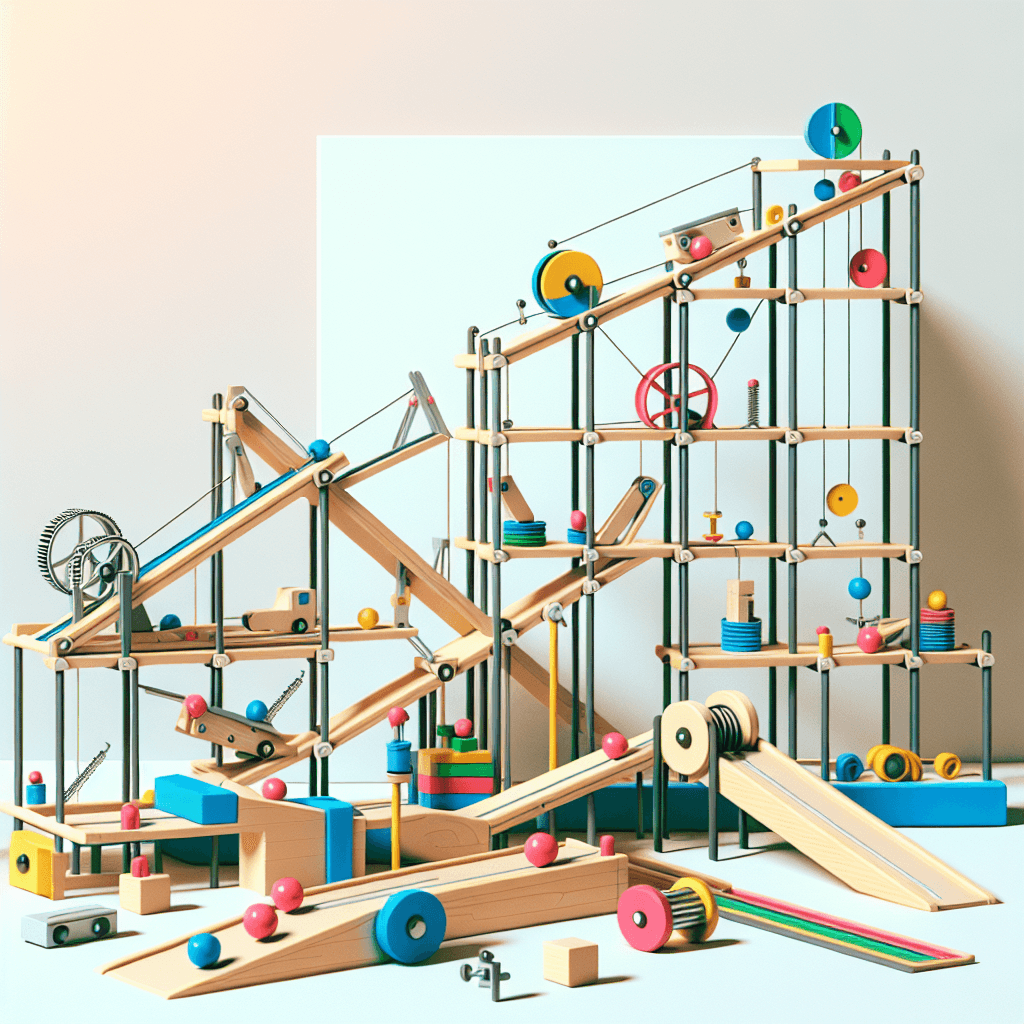
Rube Goldberg Physics Exploration
Inquiry Framework
Question Framework
Driving Question
The overarching question that guides the entire project.How can you apply the principles of physics and creativity to design and build a functional and innovative Rube Goldberg machine that uses energy transformations efficiently?Essential Questions
Supporting questions that break down major concepts.- What are the basic principles of energy and motion that can be applied to construct a Rube Goldberg machine?
- How can different forms of energy be transformed and conserved while creating a complex machine?
- How do forces and interactions influence the movement and functionality of a Rube Goldberg machine?
- In what ways can simple machines be combined to perform complex tasks in a Rube Goldberg machine?
- What role does creativity play in designing and building an effective Rube Goldberg machine?
Standards & Learning Goals
Learning Goals
By the end of this project, students will be able to:- Understand and apply the principles of energy transformations and conservation in building intricate systems.
- Develop creative thinking and problem-solving skills through the design and construction of a Rube Goldberg machine.
- Analyze and apply Newton's laws of motion and the principles of force and interactions in a practical project.
- Explore the use of simple machines and their mechanisms to accomplish complex tasks in a cohesive system.
- Collaborate effectively in teams to design and refine an innovative and functional Rube Goldberg machine.
Next Generation Science Standards
Entry Events
Events that will be used to introduce the project to studentsThe Invisible Energy Hunt
Launch the project with a mysterious treasure hunt themed event where students use clues to find hidden sources of energy around the school. This interactive exploration promotes curiosity about how everyday objects and systems convert energy, setting the stage for students to apply these observations into building their own Rube Goldberg machines.Mystery Machine Challenge
Present students with a partially constructed Rube Goldberg machine and challenge them to hypothesize on how it functions and complete the chain reaction. This activity drives intrigue as they reverse-engineer the machine, during which they naturally explore the processes of energy transfer and machine interactions.Portfolio Activities
Portfolio Activities
These activities progressively build towards your learning goals, with each submission contributing to the student's final portfolio.Collaborative Design Sprint
Students will work in teams to brainstorm and sketch ideas for their Rube Goldberg machines, incorporating knowledge of energy transformations, simple machines, and forces.Steps
Here is some basic scaffolding to help students complete the activity.Final Product
What students will submit as the final product of the activityA team-designed blueprint of a Rube Goldberg machine that integrates energy transformation and mechanics creatively.Alignment
How this activity aligns with the learning objectives & standardsAligns with HS-PS3-3 by requiring students to plan devices converting energy, and fosters collaboration and creative problem-solving skills, supporting broader learning goals.Creative Chain Reaction Simulation
Using software or a virtual simulation tool, students will build digital models of chain reactions, applying energy and motion principles to refine their understanding before building physical prototypes.Steps
Here is some basic scaffolding to help students complete the activity.Final Product
What students will submit as the final product of the activityA digital simulation of a functional chain reaction system.Alignment
How this activity aligns with the learning objectives & standardsSupports HS-PS3-3 and HS-PS2-1 by allowing students to apply energy transfer and Newton’s laws in a virtual environment.Rubric & Reflection
Portfolio Rubric
Grading criteria for assessing the overall project portfolioRube Goldberg Machine Design & Simulation Evaluation
Application of Physics Concepts
Assessment of understanding and application of physics concepts such as energy transformation, Newton's laws, and the use of simple machines.Energy Transformations
Evaluation of the ability to apply principles of energy transformation and conservation in the design of a Rube Goldberg machine.
Exemplary
4 PointsDemonstrates a sophisticated application of energy transformation principles, effectively integrating multiple forms of energy in innovative ways.
Proficient
3 PointsClearly applies energy transformation principles with appropriate use of multiple energy forms.
Developing
2 PointsShows basic understanding with limited application of energy transformation principles; some inconsistencies in integration.
Beginning
1 PointsShows minimal understanding of energy transformation principles with significant misconceptions or lacking application.
Forces and Motion Analysis
Ability to analyze and apply forces and motion principles effectively in the machine design.
Exemplary
4 PointsAnalyzes forces and motions with great accuracy, employing Newton's laws creatively across the project.
Proficient
3 PointsAccurately applies Newton's laws with generally correct analysis of forces and motions.
Developing
2 PointsShows emerging understanding with basic application; some inaccuracies in analysis.
Beginning
1 PointsStruggles with applying Newton's laws, showing little understanding or inaccurate analysis.
Use of Simple Machines
Assessment of how effectively simple machines are integrated into the Rube Goldberg machine to perform tasks.
Exemplary
4 PointsIntegrates a wide variety of simple machines in highly effective and creative ways to enhance functionality.
Proficient
3 PointsUses simple machines effectively to improve the machine's functionality.
Developing
2 PointsUtilizes simple machines with varying effectiveness; some may not enhance functionality as intended.
Beginning
1 PointsLimited use of simple machines, with minimal influence on functionality.
Creative Design and Innovation
Assessment of creativity, originality, and innovation in both the physical and digital design of the Rube Goldberg machine.Originality and Innovation
Evaluation of the creative elements and innovation demonstrated in the machine designs.
Exemplary
4 PointsDisplays exceptional creativity and originality, pushing boundaries of traditional designs.
Proficient
3 PointsDemonstrates creativity and originality in design with some innovative aspects.
Developing
2 PointsShows some creative attempts; could benefit from greater originality.
Beginning
1 PointsLimited creativity with mostly conventional designs.
Collaboration and Teamwork
Evaluation of team dynamics, participation, and contribution towards the project outcome.Team Contribution
Assessment of individual contributions and active participation in team efforts to design and build the machine.
Exemplary
4 PointsShows exceptional leadership and contribution, effectively facilitating team dynamics and collaboration.
Proficient
3 PointsContributes effectively, actively participating and supporting team working.
Developing
2 PointsParticipates in team activities but contribution may be limited or inconsistent.
Beginning
1 PointsMinimal participation and contribution in team activities, often requires support.