
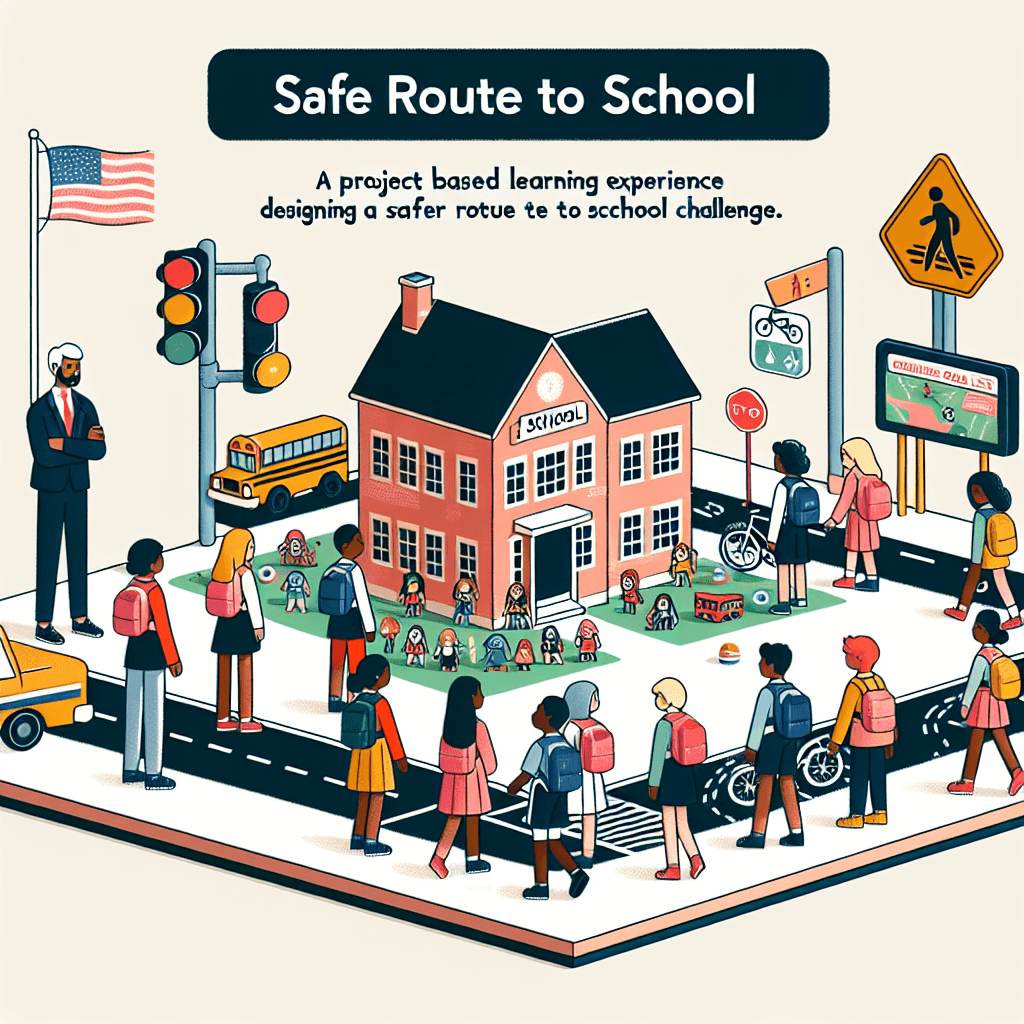
Safe Route to School Design Challenge
Inquiry Framework
Question Framework
Driving Question
The overarching question that guides the entire project.How can we, as safety advocates, design and advocate for a safer route to school for pedestrians and cyclists in our community, using persuasive communication to address key dangers and promote the well-being of students?Essential Questions
Supporting questions that break down major concepts.- How can we improve safety for students walking and biking to school?
- What are the main dangers students face on their way to school?
- How can we use persuasive writing to convince the city to make changes?
- What makes a route safe for pedestrians and cyclists?
- How can we design a map to show the safest route?
Standards & Learning Goals
Learning Goals
By the end of this project, students will be able to:- Identify dangers to pedestrians and cyclists on the way to school.
- Design a safer route to school, incorporating safety measures.
- Use persuasive writing to advocate for the proposed route.
- Create a map of the safest route to school.
- Understand the principles of pedestrian and cyclist safety.
Common Core Standards
Entry Events
Events that will be used to introduce the project to students"Sidewalk Obstacle Course"
Transform the classroom into a mini-city sidewalk, filled with unexpected 'obstacles' like construction cones, parked scooters, and confusing signage. Students navigate the course as pedestrians and cyclists, documenting challenges and brainstorming improvements to sidewalk design and traffic flow. This experiential activity highlights the frustrations and dangers of the current routes.Portfolio Activities
Portfolio Activities
These activities progressively build towards your learning goals, with each submission contributing to the student's final portfolio.Danger Detectives
Students will work like detectives to identify and document the existing dangers to pedestrians and cyclists on their current routes to school. They will use observation skills and note-taking to gather data.Steps
Here is some basic scaffolding to help students complete the activity.Final Product
What students will submit as the final product of the activityA detailed list of dangers with descriptions and visual aids (photos or drawings).Alignment
How this activity aligns with the learning objectives & standardsAligns with identifying dangers to pedestrians and cyclists, a key learning goal. Also supports CCSS.ELA-LITERACY.W.4.2 by examining a topic and conveying information clearly.Safety Solution Sketchers
Based on the identified dangers, students will brainstorm and sketch potential solutions to improve safety for pedestrians and cyclists. They will focus on practical and creative ideas.Steps
Here is some basic scaffolding to help students complete the activity.Final Product
What students will submit as the final product of the activityA series of sketches illustrating safety solutions with accompanying explanations.Alignment
How this activity aligns with the learning objectives & standardsAddresses the learning goal of designing a safer route to school. It also supports CCSS.ELA-LITERACY.W.4.2 by providing explanatory details about their design solutions.Persuasive Proposal Planners
Students will develop a persuasive proposal to advocate for their safer route design. This involves outlining their argument, providing supporting evidence, and crafting a compelling message.Steps
Here is some basic scaffolding to help students complete the activity.Final Product
What students will submit as the final product of the activityA structured persuasive proposal outlining the need for a safer route and advocating for specific design solutions.Alignment
How this activity aligns with the learning objectives & standardsDirectly aligns with the learning goal of using persuasive writing to advocate for the proposed route and supports CCSS.ELA-LITERACY.W.4.1, focusing on opinion pieces with reasons and information.Mapping the Marvel
Students create a detailed map showcasing their proposed safer route to school, highlighting key safety features and alternative paths. This map serves as a visual aid for their persuasive proposal.Steps
Here is some basic scaffolding to help students complete the activity.Final Product
What students will submit as the final product of the activityA visually clear and informative map of the proposed safer route to school.Alignment
How this activity aligns with the learning objectives & standardsCorresponds to the learning goal of creating a map of the safest route to school. It also provides a visual aid that enhances the persuasive argument, supporting CCSS.ELA-LITERACY.W.4.2.Safety Speech Showdown
Students will prepare and deliver a persuasive speech, advocating for their safer route design to an audience (e.g., classmates, teachers, community members).Steps
Here is some basic scaffolding to help students complete the activity.Final Product
What students will submit as the final product of the activityA persuasive speech presented to an audience, advocating for a safer route to school.Alignment
How this activity aligns with the learning objectives & standardsSupports the learning goal of using persuasive writing to advocate for the proposed route and presenting their designs, aligning with CCSS.ELA-LITERACY.SL.4.4, which focuses on organized and descriptive presentations.Rubric & Reflection
Portfolio Rubric
Grading criteria for assessing the overall project portfolioSafe Route to School Design Challenge Portfolio Rubric
Hazard Identification (Danger Detectives)
This category assesses the student's ability to identify and document dangers to pedestrians and cyclists on their route to school. It focuses on observation skills, attention to detail, and clear communication of identified hazards.Accuracy of Hazard Identification
Demonstrates the accuracy and completeness of identified hazards.
Exemplary
4 PointsAccurately identifies and describes at least five significant hazards with clear, specific details and supporting visual evidence.
Proficient
3 PointsIdentifies and describes four significant hazards with adequate details and visual evidence.
Developing
2 PointsIdentifies and describes three hazards with some details and visual evidence, but may lack specificity.
Beginning
1 PointsIdentifies and describes fewer than three hazards with limited details and minimal visual evidence.
Clarity of Description
Assesses how clearly the student describes each identified hazard and explains its potential danger.
Exemplary
4 PointsProvides exceptionally clear and concise descriptions of each hazard, thoroughly explaining the potential dangers to pedestrians and cyclists.
Proficient
3 PointsProvides clear descriptions of each hazard, explaining the potential dangers to pedestrians and cyclists.
Developing
2 PointsProvides descriptions of each hazard, but the explanation of potential dangers may be unclear or incomplete.
Beginning
1 PointsProvides vague or unclear descriptions of the hazards, with little or no explanation of the potential dangers.
Solution Design (Safety Solution Sketchers)
This category evaluates the student's ability to brainstorm and sketch potential solutions to improve safety for pedestrians and cyclists. It focuses on creativity, practicality, and clear communication of design ideas.Creativity and Innovation
Assesses the creativity and originality of the proposed solutions.
Exemplary
4 PointsProposes highly creative and innovative solutions that address the identified hazards in unique and effective ways.
Proficient
3 PointsProposes creative solutions that address the identified hazards effectively.
Developing
2 PointsProposes solutions that address the identified hazards, but may lack creativity or originality.
Beginning
1 PointsProposes solutions that are impractical or do not effectively address the identified hazards.
Clarity of Sketches and Explanations
Evaluates the clarity of the sketches and the accompanying explanations of how each solution improves safety.
Exemplary
4 PointsProvides exceptionally clear and detailed sketches with thorough explanations of how each solution significantly improves safety.
Proficient
3 PointsProvides clear sketches with adequate explanations of how each solution improves safety.
Developing
2 PointsProvides sketches with some explanations, but clarity and detail may be lacking.
Beginning
1 PointsProvides unclear or incomplete sketches with minimal or no explanation of how the solutions improve safety.
Persuasive Argument (Persuasive Proposal Planners)
This category assesses the student's ability to develop a persuasive proposal advocating for their safer route design. It focuses on the strength of their argument, the use of supporting evidence, and the clarity of their writing.Strength of Argument
Evaluates the logical strength and persuasiveness of the argument presented in the proposal.
Exemplary
4 PointsPresents an exceptionally strong and compelling argument that effectively advocates for the proposed safer route.
Proficient
3 PointsPresents a strong and persuasive argument advocating for the proposed safer route.
Developing
2 PointsPresents an argument advocating for the proposed safer route, but it may lack logical strength or persuasiveness.
Beginning
1 PointsPresents a weak or unclear argument that fails to effectively advocate for the proposed safer route.
Use of Supporting Evidence
Assesses the student's ability to use relevant evidence to support their claims.
Exemplary
4 PointsProvides compelling and relevant evidence (statistics, expert quotes, etc.) to strongly support each reason presented in the proposal.
Proficient
3 PointsProvides relevant evidence to support each reason presented in the proposal.
Developing
2 PointsProvides some evidence to support the reasons presented in the proposal, but the evidence may be weak or irrelevant.
Beginning
1 PointsProvides little or no evidence to support the reasons presented in the proposal.
Clarity and Organization
Assesses the clarity, organization, and overall quality of the written proposal.
Exemplary
4 PointsWrites an exceptionally clear, concise, and well-organized proposal with a compelling introduction and conclusion.
Proficient
3 PointsWrites a clear and well-organized proposal with a coherent introduction and conclusion.
Developing
2 PointsWrites a proposal that is somewhat organized, but may lack clarity or a strong introduction/conclusion.
Beginning
1 PointsWrites a disorganized and unclear proposal with a weak or missing introduction/conclusion.
Map Design (Mapping the Marvel)
This category evaluates the student's ability to create a clear and informative map showcasing their proposed safer route to school. It focuses on accuracy, clarity, and the effective use of visual aids.Accuracy and Completeness
Assesses the accuracy of the map in representing the existing and proposed routes, as well as the completeness of labeled safety features.
Exemplary
4 PointsCreates a highly accurate and complete map with all key safety features clearly labeled and the proposed route precisely depicted.
Proficient
3 PointsCreates an accurate and complete map with most key safety features labeled and the proposed route clearly depicted.
Developing
2 PointsCreates a map with some inaccuracies or omissions, and some safety features may be missing or unclearly labeled.
Beginning
1 PointsCreates an inaccurate or incomplete map with many missing safety features and an unclear depiction of the proposed route.
Clarity and Visual Appeal
Evaluates the clarity, organization, and visual appeal of the map.
Exemplary
4 PointsCreates a visually appealing and easy-to-understand map with clear symbols, labels, and a well-organized key.
Proficient
3 PointsCreates a clear and organized map with appropriate symbols, labels, and a key.
Developing
2 PointsCreates a map that is somewhat cluttered or difficult to understand, with unclear symbols, labels, or a poorly organized key.
Beginning
1 PointsCreates a map that is visually unappealing and difficult to understand, with missing or confusing symbols, labels, and a missing or incomprehensible key.
Presentation Skills (Safety Speech Showdown)
This category assesses the student's ability to deliver a persuasive speech advocating for their safer route design. It focuses on clarity, confidence, and the effective use of visual aids.Clarity and Confidence
Evaluates the clarity of the speech and the student's confidence in delivering it.
Exemplary
4 PointsDelivers a highly clear and engaging speech with exceptional confidence and poise.
Proficient
3 PointsDelivers a clear and engaging speech with confidence.
Developing
2 PointsDelivers a speech that is somewhat unclear or lacks confidence.
Beginning
1 PointsDelivers an unclear and hesitant speech with minimal confidence.
Effective Use of Visual Aids
Assesses the student's ability to effectively use visual aids (map, photos, etc.) to enhance their presentation.
Exemplary
4 PointsUses visual aids seamlessly and effectively to enhance the speech and engage the audience.
Proficient
3 PointsUses visual aids effectively to support the speech and engage the audience.
Developing
2 PointsUses visual aids, but they may be distracting or not effectively integrated into the speech.
Beginning
1 PointsUses visual aids ineffectively or not at all.
Persuasive Techniques
Evaluates the student's use of persuasive techniques to convince the audience of the need for a safer route.
Exemplary
4 PointsEmploys a variety of persuasive techniques effectively to create a compelling and impactful presentation.
Proficient
3 PointsUses persuasive techniques effectively to convince the audience of the need for a safer route.
Developing
2 PointsUses some persuasive techniques, but they may be ineffective or poorly executed.
Beginning
1 PointsUses few or no persuasive techniques.