
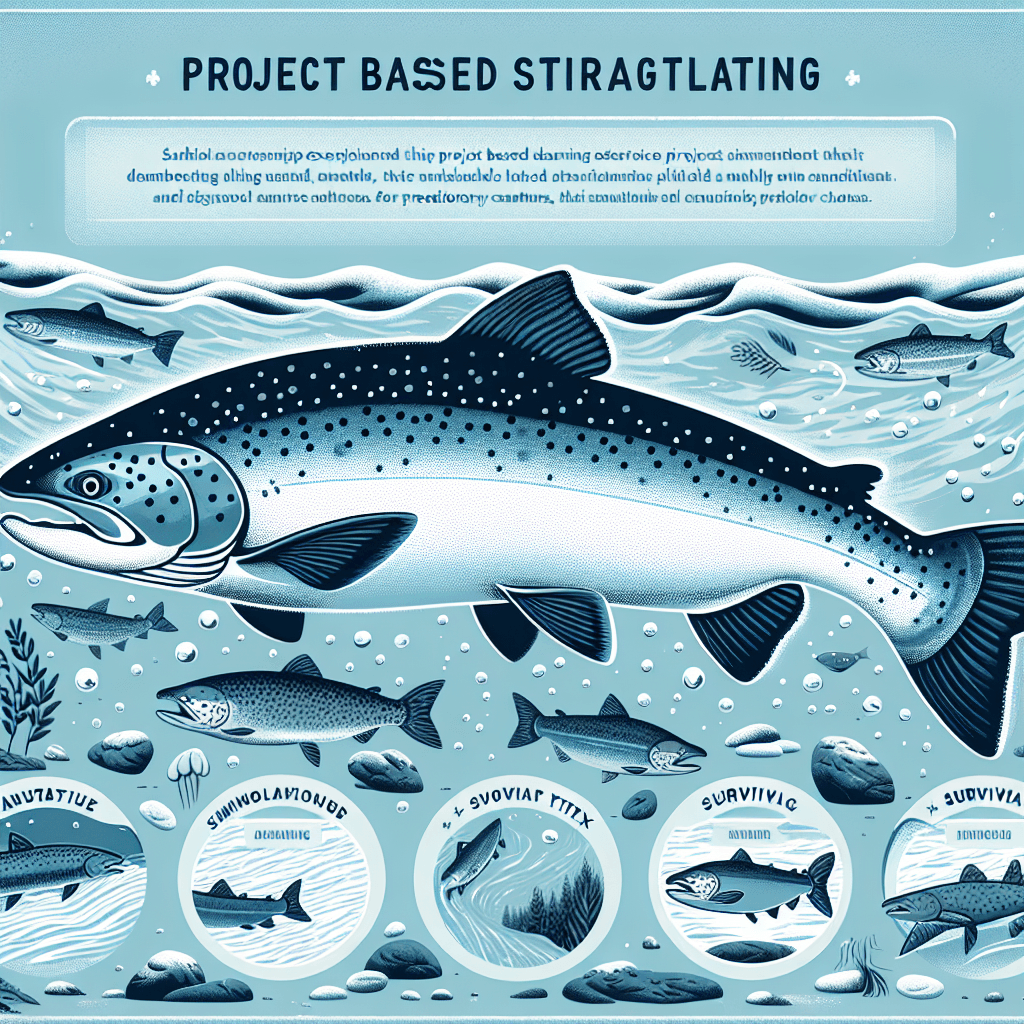
Salmon Survival Simulation: Exploring Adaptations of Coho Salmon
Inquiry Framework
Question Framework
Driving Question
The overarching question that guides the entire project.How can we design a simulation game that effectively models the internal and external structures of Coho Salmon, and demonstrates how these structures contribute to their survival, growth, behavior, and reproduction in diverse habitats?Essential Questions
Supporting questions that break down major concepts.- What internal and external structures do Coho Salmon have that help them survive in their environment?
- How do the different structures of the Coho Salmon function individually and together to support their survival, growth, behavior, and reproduction?
- In what ways do physical adaptations of the Coho Salmon contribute to its ability to thrive in diverse habitats?
- How can we develop a simulation game to model the Coho Salmon’s survival strategies effectively?
Standards & Learning Goals
Learning Goals
By the end of this project, students will be able to:- Students will identify and describe the internal and external structures of Coho Salmon that contribute to their survival and reproduction.
- Students will analyze how Coho Salmon’s structures function individually and collaboratively to support various aspects of their life cycle.
- Learners will develop a digital simulation game that accurately represents the survival strategies of Coho Salmon, focusing on structural adaptations.
- Students will apply scientific reasoning to explain how Coho Salmon's physical characteristics enable them to thrive in diverse habitats.
Next Generation Science Standards
Entry Events
Events that will be used to introduce the project to studentsMystery of the Missing Salmon
Students walk into the classroom to find a 'news report' video about a mysterious decline in the salmon population in a local river. They're tasked with figuring out the reasons behind it, exploring salmon's life cycle, habitat, and survival strategies to solve the mystery.Portfolio Activities
Portfolio Activities
These activities progressively build towards your learning goals, with each submission contributing to the student's final portfolio.Simulation Sketch Studio
In this activity, students will sketch the preliminary designs of their simulation game, conceptualizing how to model Coho Salmon's survival mechanisms through gameplay.Steps
Here is some basic scaffolding to help students complete the activity.Final Product
What students will submit as the final product of the activityA storyboard and game design document depicting the essential features and mechanics of the simulation game.Alignment
How this activity aligns with the learning objectives & standardsAligns with 4-LS1-1 by using scientific reasoning to portray Coho Salmon's structures in a learning context.Salmon Structure Sleuths
In this activity, students will become detectives to explore and identify the internal and external structures of the Coho Salmon. They will investigate how each structure aids in the survival and reproduction of these fascinating fish.Steps
Here is some basic scaffolding to help students complete the activity.Final Product
What students will submit as the final product of the activityA 'Coho Salmon Structure Guide' that details the internal and external structures of Coho Salmon and explains their survival functions.Alignment
How this activity aligns with the learning objectives & standardsAligns with 4-LS1-1 by focusing on understanding organism structures and functions to support survival and reproduction.Rubric & Reflection
Portfolio Rubric
Grading criteria for assessing the overall project portfolioSalmon Simulation Game Design Rubric
Content Understanding
Evaluates the student's understanding of Coho Salmon's internal and external structures and functions for survival.Identification of Structures
Ability to accurately identify and describe the internal and external structures of Coho Salmon.
Exemplary
4 PointsCorrectly identifies and provides detailed descriptions of all relevant Coho Salmon's internal and external structures, showing a sophisticated understanding of their relationships and functions.
Proficient
3 PointsAccurately identifies and describes most of the key internal and external structures of Coho Salmon, with an established understanding of their functions.
Developing
2 PointsIdentifies and describes some internal and external structures of Coho Salmon, but with gaps or inaccuracies in understanding their functions.
Beginning
1 PointsStruggles to identify or inaccurately describes Coho Salmon's structures, with minimal understanding of their functions.
Explanation of Functions
Ability to explain how Coho Salmon’s structures support their survival and reproduction in various environments.
Exemplary
4 PointsProvides a comprehensive and insightful explanation of how all structures aid in survival and reproduction, integrating examples of adaptation.
Proficient
3 PointsClearly explains how the majority of structures support survival and reproduction, with examples of adaptation.
Developing
2 PointsOffers a basic explanation of some structures' functions with limited examples of adaptation.
Beginning
1 PointsProvides an incomplete or unclear explanation of the structures' functions, lacking examples.
Implementation of Scientific Concepts
Evaluates use of scientific concepts in the simulation design.
Exemplary
4 PointsSkillfully applies scientific concepts to create a simulation that reflects a deep understanding of Coho Salmon's survival strategies.
Proficient
3 PointsEffectively applies scientific concepts in the simulation, showing a clear understanding of Coho Salmon’s survival strategies.
Developing
2 PointsAttempts to apply scientific concepts in the simulation, though with some inaccuracies or omissions.
Beginning
1 PointsShows little to no application of scientific concepts in the simulation design.
Creativity and Presentation
Assesses the creativity and clarity of the simulation storyboard and design.Storyboard and Game Design
Quality and creativity of the storyboard and overall game design.
Exemplary
4 PointsPresents a highly creative and visually engaging storyboard with clear, detailed game design that enhances learning outcomes.
Proficient
3 PointsProvides a creative and clear storyboard with an effective game design that supports learning goals.
Developing
2 PointsIncludes a basic storyboard and game design with some elements needing clarity or creativity.
Beginning
1 PointsOffers an unclear or incomplete storyboard and game design with minimal creativity.