
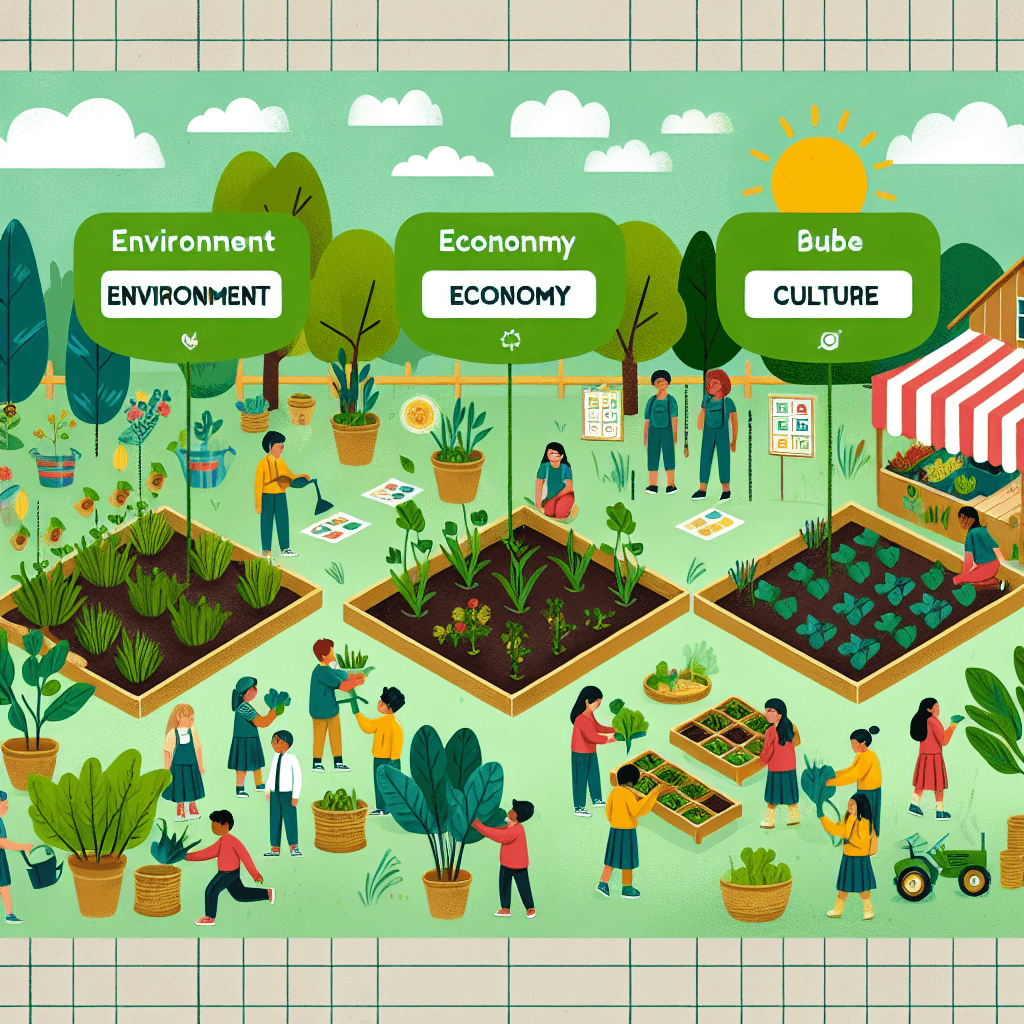
School Gardens: Cultivating Environment, Economy, and Culture
Inquiry Framework
Question Framework
Driving Question
The overarching question that guides the entire project.Πώς μπορούμε, ως μαθητές-αγρότες, να δημιουργήσουμε και να διαχειριστούμε έναν σχολικό λαχανόκηπο, ώστε να μεγιστοποιήσουμε τα περιβαλλοντικά, οικονομικά και κοινωνικά οφέλη, ενώ παράλληλα αναπτύσσουμε μια βαθύτερη κατανόηση των μαθηματικών, των επιστημών και της τεχνολογίας;Essential Questions
Supporting questions that break down major concepts.- Πώς οι σχολικοί λαχανόκηποι μπορούν να συμβάλουν στη βελτίωση του περιβάλλοντος;
- Πώς η δημιουργία ενός σχολικού λαχανόκηπου προάγει την κυκλική οικονομία;
- Με ποιους τρόπους οι σχολικοί λαχανόκηποι διαμορφώνουν μια οικολογική και περιβαλλοντική κουλτούρα στους μαθητές;
- Πώς η ενασχόληση με έναν σχολικό λαχανόκηπο συνδέεται με τις έννοιες των μαθηματικών, της επιστήμης, της περιβαλλοντικής επιστήμης, της βιολογίας, της χημείας, της φυσικής, της φιλοσοφίας, της κοινωνιολογίας, της οικονομίας και της τεχνολογίας;
Standards & Learning Goals
Learning Goals
By the end of this project, students will be able to:- Students will be able to design and cultivate a school vegetable garden.
- Students will understand the benefits of school vegetable gardens for the environment.
- Students will be able to apply circular economy principles in the context of a school garden.
- Students will develop an ecological and environmental culture through hands-on experience.
- Students will connect school garden activities with concepts from math, science, environmental science, biology, chemistry, physics, philosophy, sociology, economics, and technology.
Entry Events
Events that will be used to introduce the project to studentsThe Mysterious Seed
A package arrives at school containing only a single, unknown seed and a cryptic note about its potential to solve a local environmental problem. Students must use their scientific knowledge and problem-solving skills to identify the seed, determine its needs, and cultivate it, connecting to the role of a farmer/gardener and the benefits of school gardens.Portfolio Activities
Portfolio Activities
These activities progressively build towards your learning goals, with each submission contributing to the student's final portfolio.Seed to Sprout: Observation Journal
Students document the growth of various plants in the school garden, recording measurements and observations.Steps
Here is some basic scaffolding to help students complete the activity.Final Product
What students will submit as the final product of the activityA detailed journal with drawings, measurements, and written observations of plant growth.Alignment
How this activity aligns with the learning objectives & standardsConnects garden activities with biology and environmental science concepts, fostering observation and data collection skills.Garden Geometry: Measuring and Mapping
Students use math to measure the garden area, plan the layout, and calculate the amount of soil and fertilizer needed.Steps
Here is some basic scaffolding to help students complete the activity.Final Product
What students will submit as the final product of the activityA scaled map of the garden layout with calculations of area, volume, and fertilizer needs.Alignment
How this activity aligns with the learning objectives & standardsApplies mathematical concepts (measurement, area, volume) to practical garden planning, linking math with environmental science and economics (resource management).Composting Chemistry: Decomposition Analysis
Students investigate the decomposition process in a compost bin, analyzing the chemical reactions involved and the impact on nutrient cycling.Steps
Here is some basic scaffolding to help students complete the activity.Final Product
What students will submit as the final product of the activityA report on the decomposition process, including observations, data, and an explanation of the chemical reactions and biological processes involved.Alignment
How this activity aligns with the learning objectives & standardsConnects chemistry and biology concepts to the practical application of composting, promoting understanding of nutrient cycling and environmental sustainability.Eco-Ethics: Garden Philosophy Discussion
Students discuss the ethical considerations of gardening, including the impact on the environment, food production, and community well-being.Steps
Here is some basic scaffolding to help students complete the activity.Final Product
What students will submit as the final product of the activityA written reflection on the ethical considerations of gardening, including personal opinions and supporting arguments.Alignment
How this activity aligns with the learning objectives & standardsIntegrates philosophical and sociological perspectives into the project, encouraging students to think critically about the ethical dimensions of environmental stewardship and community engagement.Circular Economy in Action: Waste Reduction Strategies
Students implement strategies to reduce waste in the school garden and promote a circular economy, focusing on reusing and recycling materials.Steps
Here is some basic scaffolding to help students complete the activity.Final Product
What students will submit as the final product of the activityA presentation on the waste reduction strategies implemented in the garden, including data on waste reduction and cost savings.Alignment
How this activity aligns with the learning objectives & standardsApplies economic and environmental science principles to promote a circular economy, teaching students about resource management and sustainability.Rubric & Reflection
Portfolio Rubric
Grading criteria for assessing the overall project portfolioSchool Garden Portfolio Rubric
Scientific Observation and Data Collection
This category assesses students' ability to observe, record, and analyze data related to plant growth and environmental factors.Accuracy of Observations
The extent to which student observations are detailed, accurate, and relevant to the growth of plants.
Exemplary
4 PointsObservations are exceptionally detailed, accurate, and insightful, capturing subtle nuances in plant growth and environmental interactions. Demonstrates a sophisticated understanding of plant biology and environmental science.
Proficient
3 PointsObservations are thorough, accurate, and relevant to the growth of plants, providing a clear picture of the growth process and environmental influences. Demonstrates a solid understanding of plant biology and environmental science.
Developing
2 PointsObservations are somewhat detailed and accurate, but may miss some key aspects of plant growth or environmental factors. Shows a basic understanding of plant biology and environmental science.
Beginning
1 PointsObservations are incomplete, inaccurate, or irrelevant to plant growth, showing a limited understanding of plant biology and environmental science.
Data Recording and Analysis
The quality of data recording (measurements, notes) and the analysis of trends and patterns.
Exemplary
4 PointsData is meticulously recorded, clearly presented, and analyzed to reveal significant trends and patterns in plant growth. Demonstrates advanced data interpretation skills and a strong understanding of experimental design.
Proficient
3 PointsData is accurately recorded, well-organized, and analyzed to identify key trends and patterns in plant growth. Demonstrates effective data interpretation skills and a good understanding of experimental design.
Developing
2 PointsData recording is inconsistent or incomplete, and analysis is limited or superficial. Shows a basic understanding of data interpretation and experimental design.
Beginning
1 PointsData is poorly recorded, disorganized, and lacks any meaningful analysis. Demonstrates minimal understanding of data interpretation and experimental design.
Mathematical Application and Planning
This category assesses the ability to apply mathematical concepts to garden planning and resource management.Accuracy of Calculations
The precision and correctness of mathematical calculations related to area, volume, and resource needs.
Exemplary
4 PointsCalculations are consistently accurate, precise, and demonstrate a deep understanding of mathematical concepts in the context of garden planning. Exhibits sophisticated problem-solving skills and attention to detail.
Proficient
3 PointsCalculations are generally accurate and demonstrate a good understanding of mathematical concepts in garden planning. Shows effective problem-solving skills and attention to detail.
Developing
2 PointsCalculations contain some errors or inconsistencies, indicating a partial understanding of mathematical concepts. Problem-solving skills are emerging.
Beginning
1 PointsCalculations are largely inaccurate or missing, demonstrating a limited understanding of mathematical concepts in the context of garden planning. Requires significant support in problem-solving.
Effective Planning and Layout
The effectiveness of the garden layout plan, considering plant spacing and resource optimization.
Exemplary
4 PointsGarden layout is exceptionally well-planned, demonstrating a thorough understanding of plant needs and resource optimization. Shows innovative thinking and a strong ability to apply mathematical principles to practical design.
Proficient
3 PointsGarden layout is well-planned, considering plant needs and efficient use of space and resources. Demonstrates a good ability to apply mathematical principles to practical design.
Developing
2 PointsGarden layout shows some consideration of plant needs, but may lack optimization of space or resources. Mathematical application is partially successful.
Beginning
1 PointsGarden layout is poorly planned and does not adequately consider plant needs or resource management. Demonstrates limited ability to apply mathematical principles to design.
Environmental Stewardship and Circular Economy
This category assesses students' understanding of environmental sustainability, waste reduction, and the principles of a circular economy.Waste Reduction Strategies
The creativity and effectiveness of strategies implemented to reduce waste in the school garden.
Exemplary
4 PointsImplements highly creative and effective waste reduction strategies, demonstrating a deep commitment to environmental sustainability and circular economy principles. Serves as a role model for responsible resource management.
Proficient
3 PointsImplements effective waste reduction strategies, demonstrating a good understanding of environmental sustainability and circular economy principles.
Developing
2 PointsImplements some waste reduction strategies, but with limited effectiveness or understanding of underlying principles.
Beginning
1 PointsDemonstrates minimal effort or understanding of waste reduction strategies and environmental sustainability.
Understanding of Circular Economy
The depth of understanding of circular economy principles and their application in the garden context.
Exemplary
4 PointsDemonstrates a sophisticated understanding of circular economy principles and applies them innovatively in the garden context, promoting closed-loop systems and resource efficiency. Explains complex interrelationships with clarity.
Proficient
3 PointsDemonstrates a good understanding of circular economy principles and their application in the garden context, promoting resource efficiency.
Developing
2 PointsShows a basic understanding of circular economy principles, but with limited application in the garden context.
Beginning
1 PointsDemonstrates minimal understanding of circular economy principles.
Ethical Considerations and Philosophical Reflection
This category assesses students' ability to critically reflect on the ethical dimensions of gardening, including environmental impact, food production, and community well-being.Depth of Reflection
The extent to which students demonstrate critical thinking and engage with complex ethical issues related to gardening.
Exemplary
4 PointsDemonstrates exceptional critical thinking and engages deeply with complex ethical issues related to gardening, offering nuanced perspectives and well-supported arguments. Reflection shows original thought and a strong ethical compass.
Proficient
3 PointsDemonstrates effective critical thinking and engages with ethical issues related to gardening, offering thoughtful perspectives and supported arguments.
Developing
2 PointsShows emerging critical thinking skills and identifies some ethical issues related to gardening, but with limited depth of analysis.
Beginning
1 PointsDemonstrates minimal critical thinking and struggles to identify or engage with ethical issues related to gardening.
Articulation of Personal Opinions
The clarity and persuasiveness with which students articulate their personal opinions and supporting arguments.
Exemplary
4 PointsArticulates personal opinions with exceptional clarity and persuasiveness, providing compelling arguments and insightful justifications. Demonstrates a strong ability to communicate complex ideas effectively.
Proficient
3 PointsArticulates personal opinions clearly and persuasively, providing well-reasoned arguments and justifications.
Developing
2 PointsExpresses personal opinions, but arguments may be unclear or lack sufficient support.
Beginning
1 PointsStruggles to articulate personal opinions or provide supporting arguments.