
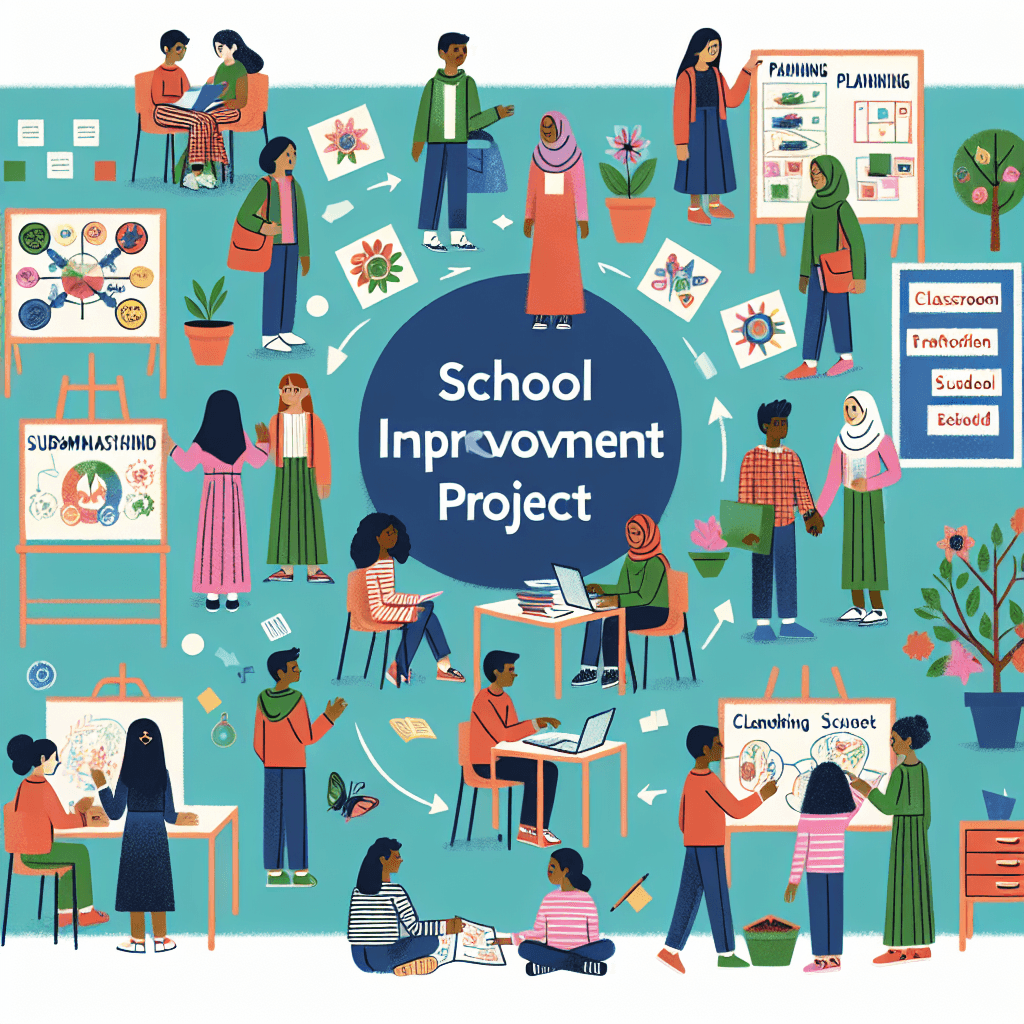
School Improvement Project: Making Our School Better
Inquiry Framework
Question Framework
Driving Question
The overarching question that guides the entire project.How can we make our school environment a better place for everyone?Essential Questions
Supporting questions that break down major concepts.- How can we make our classroom a better place to learn and play?
- What are some challenges in our school environment?
- What solutions can we create to improve our school environment?
- How can we communicate our ideas effectively to make a positive change?
Standards & Learning Goals
Learning Goals
By the end of this project, students will be able to:- Students will be able to identify challenges within their school environment.
- Students will propose and develop solutions to address the identified challenges.
- Students will effectively communicate their ideas for improving the school environment.
Entry Events
Events that will be used to introduce the project to students'Environmental Explorers: Discovering Our School'
The lesson starts with a brief discussion about what 'environment' means. Students then take a quick pre-survey to share their initial thoughts on current school problems. After the survey, students embark on a 'School Safari,' walking around with clipboards to document issues and problems they observe. Back in class, they discuss these problems and brainstorm potential solutions. Finally, students form groups based on the problems they're most interested in solving and begin planning a product to address their chosen issue.Portfolio Activities
Portfolio Activities
These activities progressively build towards your learning goals, with each submission contributing to the student's final portfolio.Problem Spotters: Identifying School Challenges
Students will begin by exploring their school environment to identify specific problems or areas that need improvement. This activity encourages observation and critical thinking about their surroundings.Steps
Here is some basic scaffolding to help students complete the activity.Final Product
What students will submit as the final product of the activityA class-generated list of problems within the school environment, categorized for further investigation.Alignment
How this activity aligns with the learning objectives & standardsAddresses the learning goal: Students will be able to identify challenges within their school environment.Solution Thinkers: Brainstorming Improvements
Building on the identified problems, students will work in small groups to brainstorm potential solutions for one specific issue. This activity fosters creative problem-solving and teamwork.Steps
Here is some basic scaffolding to help students complete the activity.Final Product
What students will submit as the final product of the activityEach group will have a drawing or diagram of their proposed solution, along with a brief explanation of how it would improve the school environment.Alignment
How this activity aligns with the learning objectives & standardsAddresses the learning goal: Students will propose and develop solutions to address the identified challenges.Pitch It!: Communicating Our Ideas
Students will prepare a short presentation to communicate their proposed solution to the class. This activity develops communication skills and builds confidence in presenting ideas.Steps
Here is some basic scaffolding to help students complete the activity.Final Product
What students will submit as the final product of the activityA short presentation by each group, clearly communicating their problem and proposed solution to the class.Alignment
How this activity aligns with the learning objectives & standardsAddresses the learning goal: Students will effectively communicate their ideas for improving the school environment.Rubric & Reflection
Portfolio Rubric
Grading criteria for assessing the overall project portfolioSchool Environment Improvement Project
Observation & Identification
Evaluates the student's ability to observe and identify problems within the school environment.Problem Identification
Ability to identify and document specific issues within the school environment.
Exemplary
4 PointsIdentifies multiple specific and relevant problems with detailed notes or drawings.
Proficient
3 PointsIdentifies a few specific problems with clear notes or drawings.
Developing
2 PointsIdentifies general problems with some notes or drawings.
Beginning
1 PointsStruggles to identify specific problems or provides minimal notes or drawings.
Solution Development
Assesses the creativity and feasibility of the proposed solutions to identified problems.Solution Creativity
The degree of creativity and innovation in proposing solutions.
Exemplary
4 PointsProposes highly creative and innovative solutions that consider feasibility and impact.
Proficient
3 PointsProposes creative solutions that are feasible and have a positive impact.
Developing
2 PointsProposes solutions with some creativity and feasible elements.
Beginning
1 PointsStruggles to propose creative or feasible solutions.
Communication & Presentation
Evaluates how effectively students communicate their ideas and solutions.Presentation Clarity
Clarity and organization of the presentation, including the use of visual aids.
Exemplary
4 PointsDelivers a clear, well-organized presentation with effective use of visual aids, and strong engagement with the audience.
Proficient
3 PointsDelivers a clear and organized presentation with appropriate use of visual aids.
Developing
2 PointsPresents ideas with some clarity and organization; uses visual aids with guidance.
Beginning
1 PointsStruggles to present ideas clearly or uses visual aids ineffectively.