
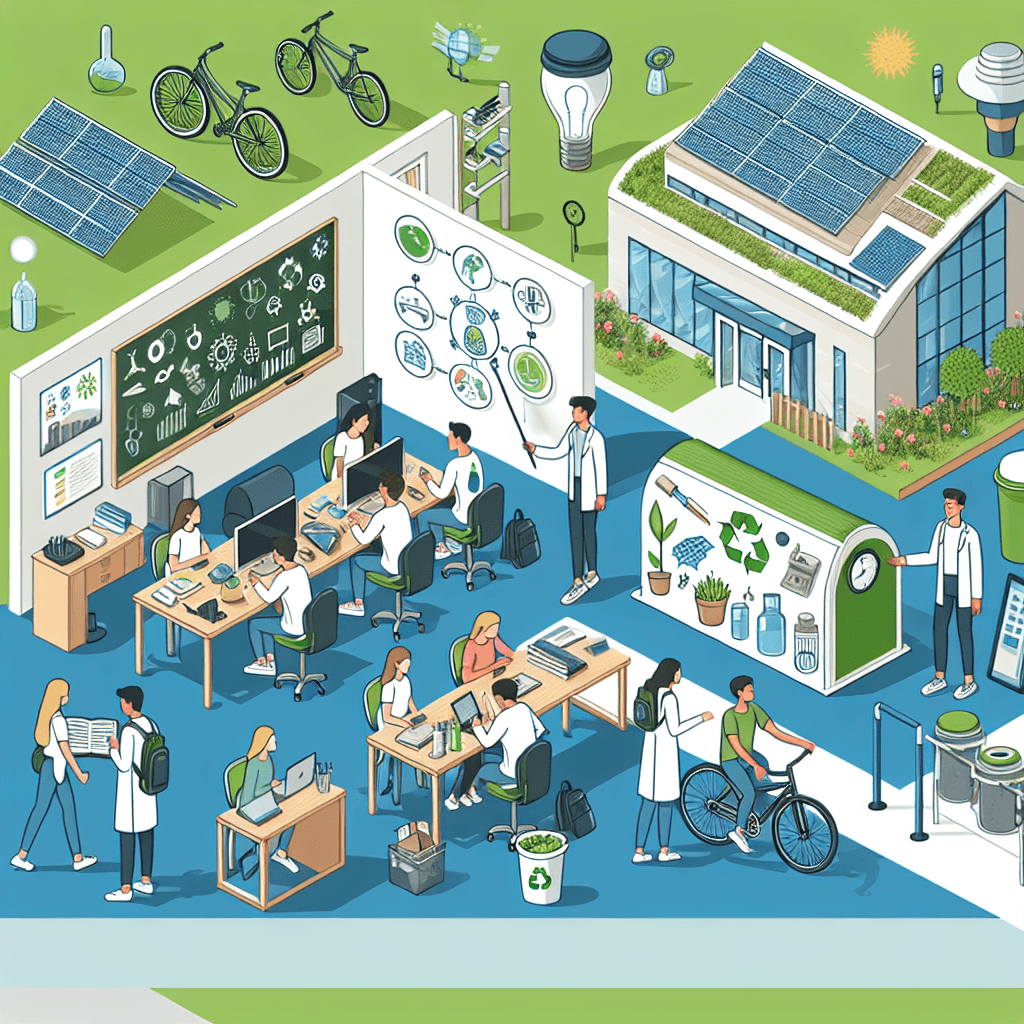
Science and Tech Solutions for Campus Environmental Sustainability
Inquiry Framework
Question Framework
Driving Question
The overarching question that guides the entire project.How can we design and validate a scalable technological intervention that optimizes the environmental metabolism of our campus by integrating real-time data analytics with sustainable engineering principles?Essential Questions
Supporting questions that break down major concepts.- What are the primary metabolic inputs (energy, water, materials) and outputs (waste, emissions) of our specific campus infrastructure, and how do we quantify them?
- How can we utilize sensor technology, IoT, and real-time data analytics to identify and monitor specific inefficiencies in campus resource management?
- To what extent can green engineering principles and emerging technologies (such as renewable energy microgrids or advanced filtration systems) mitigate the campus's carbon and chemical footprint?
- How do we perform a Life Cycle Assessment (LCA) on a specific campus system to determine the long-term environmental viability of proposed technological interventions?
- What are the socio-technical barriers—such as cost-benefit ratios, institutional policy, and user behavior—to implementing sustainable technological solutions on campus?
- How can we design a scalable prototype or model that integrates scientific research with functional technology to solve a localized environmental problem?
Standards & Learning Goals
Learning Goals
By the end of this project, students will be able to:- Quantify and analyze campus resource inputs and waste outputs using environmental metabolism frameworks to identify baseline environmental impacts.
- Design and deploy IoT-based sensor networks or data-collection tools to monitor real-time resource inefficiencies within campus infrastructure.
- Apply Life Cycle Assessment (LCA) methodologies to evaluate the long-term environmental viability and carbon footprint of technological interventions.
- Develop and prototype a scalable engineering solution that integrates renewable energy, waste reduction, or filtration technologies to solve a localized environmental problem.
- Evaluate socio-technical barriers, including economic costs, institutional policies, and user behavior, that impact the implementation of sustainable technology on campus.
Entry Events
Events that will be used to introduce the project to studentsOfficial Project Launch and Site Briefing
A formal project briefing where students are presented with the university's current environmental impact data and infrastructure maps to immediately begin identifying technical challenges.Portfolio Activities
Portfolio Activities
These activities progressively build towards your learning goals, with each submission contributing to the student's final portfolio.Mapping the Campus Pulse: Environmental Metabolism Audit
Students will conduct a comprehensive 'Environmental Metabolism' audit of a specific campus sector (e.g., a specific laboratory building, the dining hall, or a residence hall). Using the university data provided in the entry event, students will map the flow of energy, water, and materials (inputs) and the resulting waste and emissions (outputs). This activity focuses on identifying 'hot spots' of inefficiency where technological intervention could have the highest impact.Steps
Here is some basic scaffolding to help students complete the activity.Final Product
What students will submit as the final product of the activityA Campus Metabolism Systems Map and Baseline Report, featuring Sankey diagrams for resource flows and a prioritized list of three identified inefficiencies.Alignment
How this activity aligns with the learning objectives & standardsDirectly aligns with Learning Goal 1: 'Quantify and analyze campus resource inputs and waste outputs using environmental metabolism frameworks to identify baseline environmental impacts.' This activity establishes the scientific baseline required for all subsequent engineering interventions.Digital Eyes: Designing IoT Sensor Networks
In this activity, students shift from historical data to real-time monitoring. They will design a technical blueprint for an IoT (Internet of Things) sensor network or a data-collection strategy tailored to the inefficiency identified in Activity 1. Students must select appropriate sensors (e.g., flow meters, smart plugs, air quality sensors), determine deployment locations, and plan the data architecture for real-time analysis.Steps
Here is some basic scaffolding to help students complete the activity.Final Product
What students will submit as the final product of the activityA Technical IoT Deployment Blueprint, including a sensor specification list, a network topology diagram, and a data-dashboard wireframe.Alignment
How this activity aligns with the learning objectives & standardsAligns with Learning Goal 2: 'Design and deploy IoT-based sensor networks or data-collection tools to monitor real-time resource inefficiencies within campus infrastructure.' It bridges the gap between raw historical data and real-time technological monitoring.Cradle to Grave: Life Cycle Assessment (LCA) Deep Dive
Before building a prototype, students must evaluate the potential environmental impact of their proposed technological solution itself. Using LCA software or standardized databases, students will perform a 'Cradle-to-Grave' analysis of their proposed intervention, looking at the environmental costs of manufacturing, operation, and eventual disposal/recycling.Steps
Here is some basic scaffolding to help students complete the activity.Final Product
What students will submit as the final product of the activityAn LCA Technical Memo that quantifies the 'Environmental Payback Period'—the time it takes for the intervention to save more carbon/energy than it cost to produce.Alignment
How this activity aligns with the learning objectives & standardsAligns with Learning Goal 3: 'Apply Life Cycle Assessment (LCA) methodologies to evaluate the long-term environmental viability and carbon footprint of technological interventions.' This ensures the proposed technology doesn't solve one problem while creating another elsewhere.Green Engineering: Prototyping Scalable Interventions
Students will move into the 'Maker' phase, where they design and build a functional prototype or a high-fidelity digital simulation of their technological intervention. This could be a physical model of a greywater filtration system, a code-based energy optimization algorithm, or a scaled-down renewable energy microgrid. The focus is on scalability and functional proof-of-concept.Steps
Here is some basic scaffolding to help students complete the activity.Final Product
What students will submit as the final product of the activityA Functional Engineering Prototype or Simulation, accompanied by a technical performance report showing data from initial test runs.Alignment
How this activity aligns with the learning objectives & standardsAligns with Learning Goal 4: 'Develop and prototype a scalable engineering solution that integrates renewable energy, waste reduction, or filtration technologies to solve a localized environmental problem.' This is the core engineering and design phase.Beyond the Lab: Socio-Technical Feasibility Strategy
The final activity requires students to look beyond the technology to the human and institutional systems it must inhabit. Students will analyze the barriers to implementing their prototype at scale on campus. This includes performing a cost-benefit analysis (ROI), reviewing university facilities policies, and designing a strategy to address user behavior (e.g., how to get students to actually use a new recycling technology).Steps
Here is some basic scaffolding to help students complete the activity.Final Product
What students will submit as the final product of the activityA Strategic Implementation Pitch Deck, including a cost-benefit analysis, a policy-alignment brief, and a stakeholder engagement plan.Alignment
How this activity aligns with the learning objectives & standardsAligns with Learning Goal 5: 'Evaluate socio-technical barriers, including economic costs, institutional policies, and user behavior, that impact the implementation of sustainable technology on campus.' This addresses the real-world feasibility of the project.Rubric & Reflection
Portfolio Rubric
Grading criteria for assessing the overall project portfolioCampus Metabolism & Sustainable Engineering Portfolio Rubric
Environmental Systems Analysis
Evaluates the student's ability to quantify and visualize the environmental 'pulse' of the campus infrastructure.Systems Mapping & Metabolism Audit
The ability to define system boundaries and accurately map resource flows (energy, water, materials) and outputs (waste, emissions) using scientific frameworks.
Exemplary
4 PointsExemplary mapping with precise thermodynamic boundaries; Sankey diagrams are comprehensive, showing nuanced resource flows; identifies high-impact 'hot spots' with sophisticated data-driven justification.
Proficient
3 PointsThorough mapping with clear boundaries; Sankey diagrams accurately represent major flows; identifies key inefficiencies with sound evidence from university datasets.
Developing
2 PointsMapping shows basic resource flows but may lack detail or precision in boundaries; diagrams are present but may omit secondary flows or specific 'hot spots'.
Beginning
1 PointsInitial attempt at mapping; boundaries are vague; diagrams are incomplete or fail to accurately represent the metabolism of the selected site.
Technological Monitoring & IoT
Assesses the technical blueprinting of real-time monitoring systems for resource management.IoT & Data Architecture Design
Effectiveness of the IoT network design, including sensor selection, physical placement for data coverage, and data architecture planning.
Exemplary
4 PointsDesign demonstrates advanced integration of hardware and software; sensor placement is optimized for spatial coverage; data management plan is robust and includes real-time visualization strategies.
Proficient
3 PointsDesign identifies appropriate sensors and logical placement; network topology is clear; data plan addresses collection and transmission effectively.
Developing
2 PointsDesign includes basic sensor selection but may lack technical specificity or optimal placement; data management plan is emerging but incomplete.
Beginning
1 PointsMinimal technical detail provided; sensor selection is inappropriate for the variable monitored; network topology is unclear or non-functional.
Sustainability & Lifecycle Impact
Focuses on the long-term sustainability and cradle-to-grave impact of the technological intervention.Life Cycle Assessment (LCA) Rigor
Application of LCA methodologies to assess the long-term environmental viability, carbon footprint, and potential 'burden shifting' of the proposed technology.
Exemplary
4 PointsComprehensive LCA including detailed LCI and impact assessment; accurately quantifies the 'environmental payback period' and identifies subtle trade-offs or burden shifts.
Proficient
3 PointsClear LCA application; identifies major life cycle stages and translates inventory into relevant impact categories like GWP; provides a logical payback period calculation.
Developing
2 PointsBasic LCA performed; some inventory items or life cycle stages are overlooked; impact assessment is general rather than specific.
Beginning
1 PointsMinimal or incorrect application of LCA; fails to consider production or disposal impacts; payback period is not calculated or is fundamentally flawed.
Design & Engineering Innovation
Evaluates the core engineering phase where conceptual designs are transformed into functional proofs-of-concept.Engineering Prototyping & Iteration
The quality, functionality, and scalability of the engineering prototype or simulation, including the use of testing data for refinement.
Exemplary
4 PointsHigh-fidelity prototype or simulation with exceptional functionality; testing data is used to drive sophisticated design iterations; scalability is clearly demonstrated in the model.
Proficient
3 PointsFunctional prototype or simulation that addresses the identified inefficiency; design is supported by CAD or schematics; testing data informs logical refinements.
Developing
2 PointsPrototype is partially functional or lacks fidelity; some testing performed but results are not fully integrated into design improvements; scalability is mentioned but not demonstrated.
Beginning
1 PointsPrototype is non-functional or purely conceptual; lacks technical performance data; no evidence of design iteration based on testing.
Feasibility & Stakeholder Integration
Assesses the student's ability to bridge the gap between technical success and institutional implementation.Socio-Technical Implementation Strategy
Analysis of economic, policy, and behavioral factors that influence the real-world deployment of the technology on campus.
Exemplary
4 PointsSophisticated feasibility strategy including precise TCO (CAPEX/OPEX); identifies complex policy hurdles and provides a nuanced behavioral intervention plan for users.
Proficient
3 PointsComprehensive strategy including cost-benefit analysis and policy review; addresses user behavior and institutional alignment with clear, actionable steps.
Developing
2 PointsBasic feasibility analysis; economic costs or policy reviews are superficial; behavioral strategy lacks specific engagement tactics.
Beginning
1 PointsIncomplete analysis; overlooks critical financial or regulatory barriers; fails to account for human interaction with the technology.