
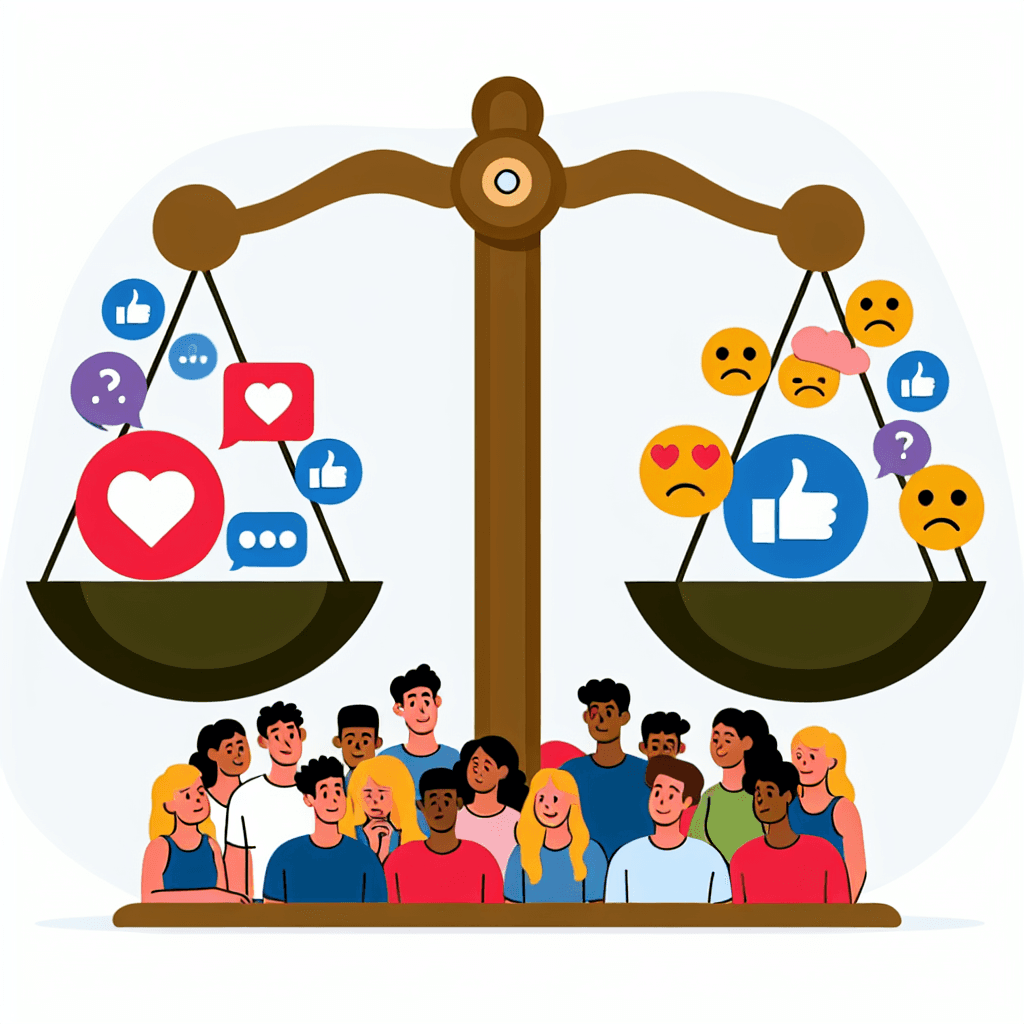
Scroll Smart: Navigating the Risks and Rewards of Social Media
Inquiry Framework
Question Framework
Driving Question
The overarching question that guides the entire project.How can we, as digital consultants, research and present a compelling infographic that helps our peers navigate the benefits and risks of social media to promote positive well-being in our community?Essential Questions
Supporting questions that break down major concepts.- What are the diverse purposes, benefits, and risks associated with the social media platforms most popular among teenagers today?
- How can we synthesize complex research into a clear, logical, and visually engaging infographic for a specific audience?
- What strategies ensure that information is presented clearly and logically to an audience, maintaining their awareness and understanding?
- In what ways does our digital footprint and social media usage impact our personal well-being and community?
Standards & Learning Goals
Learning Goals
By the end of this project, students will be able to:- Students will conduct targeted research on popular social media platforms to identify and categorize specific benefits, risks, and purposeful uses for teenagers.
- Students will design a visually engaging infographic that organizes complex information logically and uses evidence to advocate for positive digital well-being.
- Students will deliver a formal presentation of their infographic, demonstrating audience awareness and using clear, logical reasoning to explain their findings.
Common Core State Standards (ELA)
ISTE Standards for Students
Entry Events
Events that will be used to introduce the project to studentsThe Newsroom Blitz: Correcting the Narrative
Students enter a classroom transformed into a 'Breaking News' studio where a video plays featuring older adults making wildly inaccurate and stereotypical claims about how teens 'waste time' on social media. Students are immediately tasked as 'Digital Consultants' to research the truth and prepare a visual rebuttal (infographic) that educates these adults on the actual benefits and risks of their digital lives.Portfolio Activities
Portfolio Activities
These activities progressively build towards your learning goals, with each submission contributing to the student's final portfolio.The Digital Detective Case File
Acting as 'Digital Consultants,' students will investigate three popular social media platforms. They will go beyond the surface level to identify the 'The Good, The Bad, and The Purposeful.' This involves finding specific examples of how these platforms can be used for positive community building, the inherent risks to mental health or privacy, and the specific reasons teens find them indispensable.Steps
Here is some basic scaffolding to help students complete the activity.Final Product
What students will submit as the final product of the activityA 'Digital Consultant Case File' (a structured research organizer) featuring categorized data, statistics, and citations for three different platforms.Alignment
How this activity aligns with the learning objectives & standardsThis activity directly aligns with CCSS.ELA-LITERACY.W.8.7 by requiring students to conduct a short research project to answer a specific question about social media platforms using multiple sources. It also addresses ISTE 1.2.b as students begin identifying the rights and responsibilities of digital citizens.The Visual Blueprint Workshop
Now that the research is gathered, students must translate complex data into a visual story. This activity focuses on 'Information Architecture'—deciding what information is most important and how to layout that information so it is logical and persuasive. Students will design a 'wireframe' (a rough sketch) of their infographic, focusing on the hierarchy of information and how to counter the misconceptions presented in the Newsroom Blitz.Steps
Here is some basic scaffolding to help students complete the activity.Final Product
What students will submit as the final product of the activityA 'Visual Blueprint' (wireframe sketch) that outlines the layout, color scheme, and hierarchy of information for their final infographic.Alignment
How this activity aligns with the learning objectives & standardsThis activity aligns with CCSS.ELA-LITERACY.SL.8.4 by focusing on organization and audience awareness. It requires students to plan a 'line of reasoning' that is appropriate to the specific task (correcting the newsroom narrative) and the audience (the older adults from the entry event).The Consultant’s Keynote Presentation
In this final phase, students create their digital infographic using a tool like Canva or Adobe Express and then deliver a formal presentation. They must explain their design choices, their research findings, and their recommendations for positive digital well-being. The focus is on the 'Line of Reasoning'—how their evidence leads to their conclusion that social media, when used purposefully, is a tool for good rather than just a 'waste of time.'Steps
Here is some basic scaffolding to help students complete the activity.Final Product
What students will submit as the final product of the activityA high-quality digital infographic and a 3-minute formal presentation delivered to the 'Newsroom Board' (the class and teacher).Alignment
How this activity aligns with the learning objectives & standardsThis activity is the culmination of CCSS.ELA-LITERACY.SL.8.4. Students must present their findings and evidence clearly, concisely, and logically. By explaining their infographic, they demonstrate a command of substance and style appropriate to their purpose and audience.Rubric & Reflection
Portfolio Rubric
Grading criteria for assessing the overall project portfolioDigital Consultant: Social Media Advocacy Rubric
Research and Critical Thinking
Evaluates the quality of the research phase and the depth of understanding regarding digital well-being.Research Integrity and Evidence
The depth, accuracy, and credibility of information gathered for three social media platforms, including the use of statistics and expert quotes.
Exemplary
4 PointsInformation for all three platforms is comprehensive and exceptionally detailed. All statistics and quotes are from highly credible sources and used innovatively to build a powerful argument. Follow-up questions show deep, sophisticated inquiry into digital well-being.
Proficient
3 PointsInformation for three platforms is thorough and accurate. Includes credible statistics or quotes for each platform. Follow-up questions are relevant and show a clear understanding of impact on well-being.
Developing
2 PointsInformation is provided for three platforms but may lack depth or specific detail in some areas. Statistics or quotes are present but may not be fully credible or clearly connected to findings. Follow-up questions are basic.
Beginning
1 PointsResearch is incomplete or covers fewer than three platforms. Information lacks accuracy, and statistics or quotes are missing or not credible. Follow-up questions are missing or irrelevant.
Digital Citizenship & Wellness Analysis
The degree to which the student demonstrates an understanding of the rights, responsibilities, and impacts of social media usage on personal and community well-being.
Exemplary
4 PointsProvides a nuanced and insightful analysis of benefits and risks, demonstrating a sophisticated understanding of digital citizenship and ethical social media usage that could serve as a model for others.
Proficient
3 PointsClearly identifies and categorizes specific benefits, risks, and purposeful uses. Demonstrates a solid understanding of how digital footprints impact well-being.
Developing
2 PointsIdentifies benefits and risks, but the analysis is surface-level or inconsistent. Shows a basic understanding of digital citizenship with some gaps in reasoning.
Beginning
1 PointsStruggles to identify purposeful uses or risks. Shows minimal understanding of the impact of social media on well-being or the responsibilities of a digital citizen.
Structure and Design
Assesses how information is structured and visually represented to persuade and educate the audience.Information Architecture and Logic
The logical flow of information from 'The Problem' to 'The Reality,' ensuring the line of reasoning is clear and persuasive for the intended audience.
Exemplary
4 PointsThe blueprint exhibits a masterfully logical flow with a compelling narrative arc. Information is prioritized perfectly to influence the audience's perspective effectively.
Proficient
3 PointsInformation is organized logically with a clear progression of ideas. The 'Headline' and 'Hook' are effective and directly address the target audience's misconceptions.
Developing
2 PointsThe organization is present but contains some logical gaps. The transition from problem to reality is somewhat unclear, or the headline only partially addresses the audience.
Beginning
1 PointsThe blueprint lacks a clear structure or logical flow. It is difficult to follow the reasoning, and the organization does not appear to consider the target audience.
Visual Communication Design
The use of visual elements (icons, charts, layout, color) to translate complex data into a clear and visually engaging story.
Exemplary
4 PointsVisual design is professional and highly innovative. Icons and charts are used seamlessly to enhance understanding of complex data. The layout is exceptionally clean and balanced.
Proficient
3 PointsThe infographic is visually engaging and uses icons and charts effectively to support the data. The layout follows the blueprint and uses color and hierarchy to guide the reader.
Developing
2 PointsThe visual design is basic and may be cluttered. Icons or charts are used but may not clearly represent the data or help the reader's understanding.
Beginning
1 PointsVisual elements are missing, distracting, or poorly chosen. The layout is disorganized, making it difficult to find or understand the information.
Communication and Advocacy
Focuses on the verbal and interpersonal skills required to communicate findings to the community.Presentation Delivery and Engagement
The clarity, logic, and professionalism of the oral presentation, including the ability to adapt to the audience and respond to questions.
Exemplary
4 PointsThe presentation is exceptionally articulate and persuasive. The speaker maintains strong audience engagement and provides a masterful, data-backed response to challenging questions.
Proficient
3 PointsThe presentation is clear, concise, and logical. The speaker uses the infographic effectively as a guide and provides a solid, data-backed response to an audience question.
Developing
2 PointsThe presentation is generally clear but may lack a consistent logical flow. The speaker relies too heavily on the visual or struggles to answer audience questions with specific data.
Beginning
1 PointsThe presentation is disorganized or difficult to understand. The speaker shows little audience awareness and is unable to respond effectively to questions or explain design choices.