
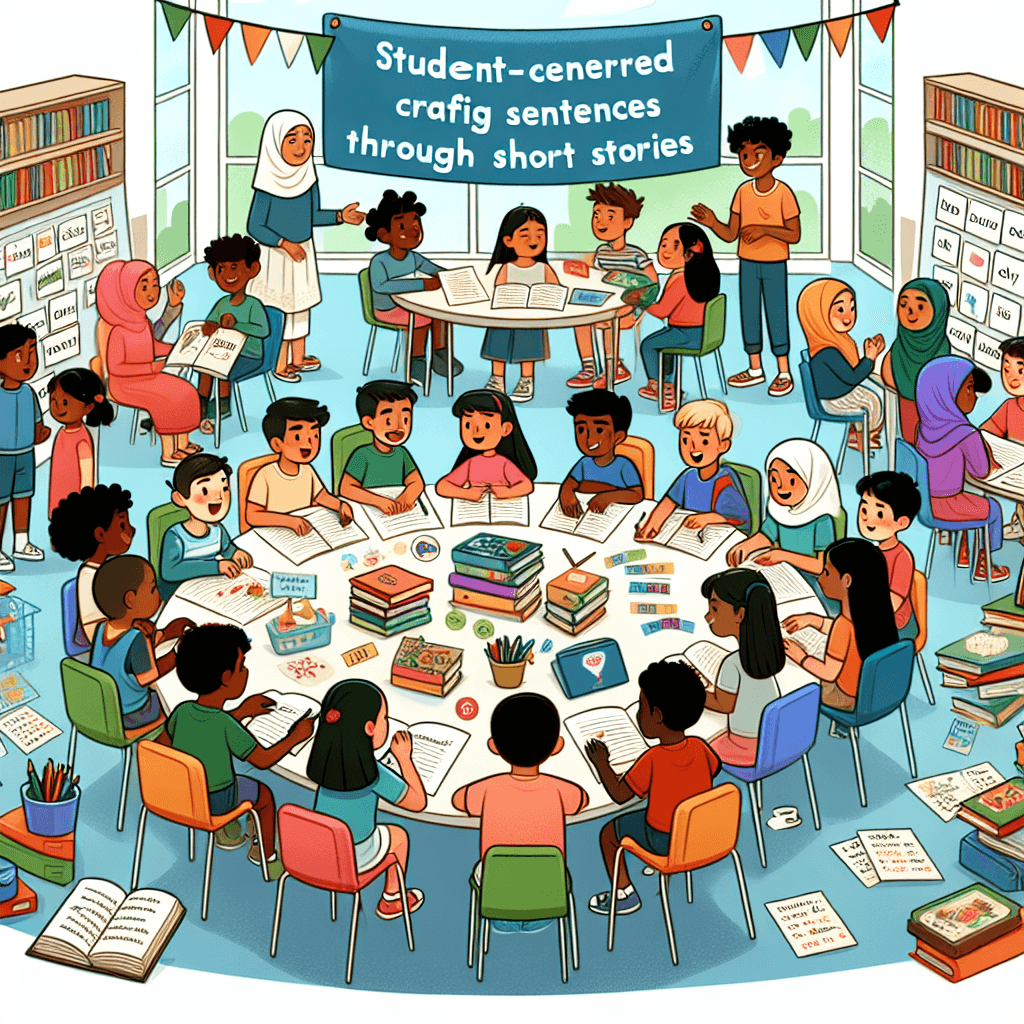
Sentence Creation through Short Stories
Inquiry Framework
Question Framework
Driving Question
The overarching question that guides the entire project.How can understanding and using nouns, adjectives, and verbs transform a simple sentence into a compelling and communicative piece of writing?Essential Questions
Supporting questions that break down major concepts.- What are the key components of a sentence, and how do they contribute to effective communication?
- How do nouns, adjectives, and verbs function within a sentence to convey clear meaning?
- In what ways do different language features, such as verbs and adjectives, enhance storytelling in written narratives?
- How can understanding patterns of speech improve our writing and our interpretation of texts?
Standards & Learning Goals
Learning Goals
By the end of this project, students will be able to:- Students will identify and define nouns, adjectives, and verbs in short stories and various texts.
- Students will demonstrate the ability to use nouns, adjectives, and verbs correctly in their own sentence and paragraph creations.
- Students will analyze how the use of adjectives and verbs can modify narratives and enhance communication.
- Students will apply knowledge of language features to write narratives, incorporating effective use of nouns, adjectives, and verbs.
- Students will gain an understanding of how sentence structure and word choice impact storytelling and reader interpretation.
Common Core Standards
Entry Events
Events that will be used to introduce the project to studentsGrammar Game Show
Transform the classroom into a lively game show set. Students participate in challenges to create the funniest story, replacing blanks with proper nouns, adjectives, and verbs. Win points as you go deeper into sentence patterns and uncover how language builds meaning.Story Detanglers
Students walk into a classroom turned into a labyrinth of string and images connected on a bulletin board. Each string thread ties different parts of speech to segments of a story. The task is to 'detangle' and recreate the narrative, piecing together the puzzle of nouns, verbs, and adjectives to form a cohesive piece.Portfolio Activities
Portfolio Activities
These activities progressively build towards your learning goals, with each submission contributing to the student's final portfolio.Noun Safari Hunt
Students embark on a virtual or classroom safari to identify nouns in selected short stories. They will focus on distinguishing between different types of nouns (e.g., proper, common, abstract) as they explore the narrative.Steps
Here is some basic scaffolding to help students complete the activity.Final Product
What students will submit as the final product of the activityA 'Noun Safari' board displaying categorized nouns from selected stories.Alignment
How this activity aligns with the learning objectives & standardsAligns with CCSS.ELA-LITERACY.L.7.1 by fostering understanding of standard English grammar through noun identification.Adjective Artistry
Students will explore adjectives and their impact on storytelling by creating artistic adjective collages that depict scenes from short stories, highlighting how adjectives enhance imagery.Steps
Here is some basic scaffolding to help students complete the activity.Final Product
What students will submit as the final product of the activityAn adjective collage that vividly depicts story scenes and highlights the role of adjectives in enhancing storytelling.Alignment
How this activity aligns with the learning objectives & standardsSupports CCSS.ELA-LITERACY.L.7.5, enhancing understanding of word relationships and nuances in meanings.Sentence Surgeons
Working in pairs, students perform 'surgery' on bland sentences by adding nouns, adjectives, and verbs for more compelling communication. They'll dissect sentence construction and add layers with descriptive language.Steps
Here is some basic scaffolding to help students complete the activity.Final Product
What students will submit as the final product of the activityAn expanded list of vivid sentences shared with classmates.Alignment
How this activity aligns with the learning objectives & standardsMeets CCSS.ELA-LITERACY.W.7.3 by developing narratives through descriptive details and well-structured sentences.Narrative Innovators
Students use their knowledge of nouns, adjectives, and verbs to craft short narratives. They focus on effective technique, descriptive detail, and structuring to convey compelling experiences or events.Steps
Here is some basic scaffolding to help students complete the activity.Final Product
What students will submit as the final product of the activityA polished narrative that effectively utilizes nouns, adjectives, and verbs to craft a compelling story.Alignment
How this activity aligns with the learning objectives & standardsDirectly aligns with CCSS.ELA-LITERACY.W.7.3 by applying language knowledge in narrative writing.Rubric & Reflection
Portfolio Rubric
Grading criteria for assessing the overall project portfolioEnglish Language Arts Mastery: Nouns, Adjectives, and Verbs
Grammar and Usage
Assessment of understanding and correct use of nouns, adjectives, and verbs according to standard English grammar rules.Noun Identification
Ability to accurately identify and categorize nouns in texts into proper, common, and abstract types.
Exemplary
4 PointsAccurately identifies and categorizes all types of nouns, demonstrating a comprehensive understanding of noun types in various texts.
Proficient
3 PointsIdentifies and categorizes most types of nouns with minor errors, showing a solid understanding of noun types.
Developing
2 PointsIdentifies nouns but struggles with accurate categorization, displaying a basic understanding of noun types.
Beginning
1 PointsStruggles to identify and categorize nouns, indicating minimal understanding of noun types.
Adjective Analysis
Evaluate the ability to recognize and analyze the role of adjectives in enhancing narrative imagery.
Exemplary
4 PointsInsightfully analyzes and articulates the impact of adjectives on narrative imagery, demonstrating a deep understanding of their role.
Proficient
3 PointsCapably analyzes adjectives' impact on narrative imagery with some insight, showing a good understanding of their role.
Developing
2 PointsProvides basic analysis of adjectives' impact on imagery but lacks depth, showing limited understanding.
Beginning
1 PointsStruggles to analyze adjectives' role in narratives, indicating minimal understanding of their impact.
Verb Usage
Assessment of using verbs to enhance sentence clarity and narrative progress.
Exemplary
4 PointsConsistently uses dynamic verbs to enhance clarity and drive narrative progress, showing exceptional command.
Proficient
3 PointsEffectively uses verbs to improve clarity and narrative flow, demonstrating strong ability.
Developing
2 PointsOccasionally uses verbs to enhance clarity but lacks consistency, indicating partial command.
Beginning
1 PointsStruggles to use verbs effectively in narrative context, indicating limited understanding.
Sentence and Narrative Construction
Evaluation of students' ability to construct sentences and narratives using learned grammar principles.Sentence Enhancement
Ability to transform simple sentences into more descriptive and complex structures using nouns, adjectives, and verbs.
Exemplary
4 PointsTransforms sentences with sophisticated use of nouns, adjectives, and verbs, creating vivid and detailed constructions.
Proficient
3 PointsEffectively enhances sentences with thoughtful use of descriptive language.
Developing
2 PointsApplies descriptive language inconsistently, resulting in variable sentence enhancement.
Beginning
1 PointsStruggles to enhance sentences using descriptive language, indicating minimal skill development.
Narrative Writing
Ability to craft engaging, well-structured narratives by applying grammatical techniques.
Exemplary
4 PointsCrafts a compelling and well-structured narrative with exceptional use of grammar and descriptive detail.
Proficient
3 PointsCreates engaging narratives with clear structure and effective grammatical application.
Developing
2 PointsWrites narratives with basic structure and limited descriptive detail.
Beginning
1 PointsProduces narratives lacking in structure and detail, showing minimal application of grammar.
Collaborative Engagement
Evaluation of students' ability to work collaboratively and utilize peer feedback to improve narrative writing.Peer Review and Feedback
Participation in peer review with constructive feedback and acceptance of suggestions for narrative improvement.
Exemplary
4 PointsActively engages in peer review, providing insightful feedback and effectively incorporating peer suggestions into revisions.
Proficient
3 PointsParticipates in peer review with useful feedback and incorporates most peer suggestions.
Developing
2 PointsEngages in peer review with limited feedback and incorporates some peer suggestions with guidance.
Beginning
1 PointsProvides minimal feedback during peer review and struggles to incorporate peer suggestions.