
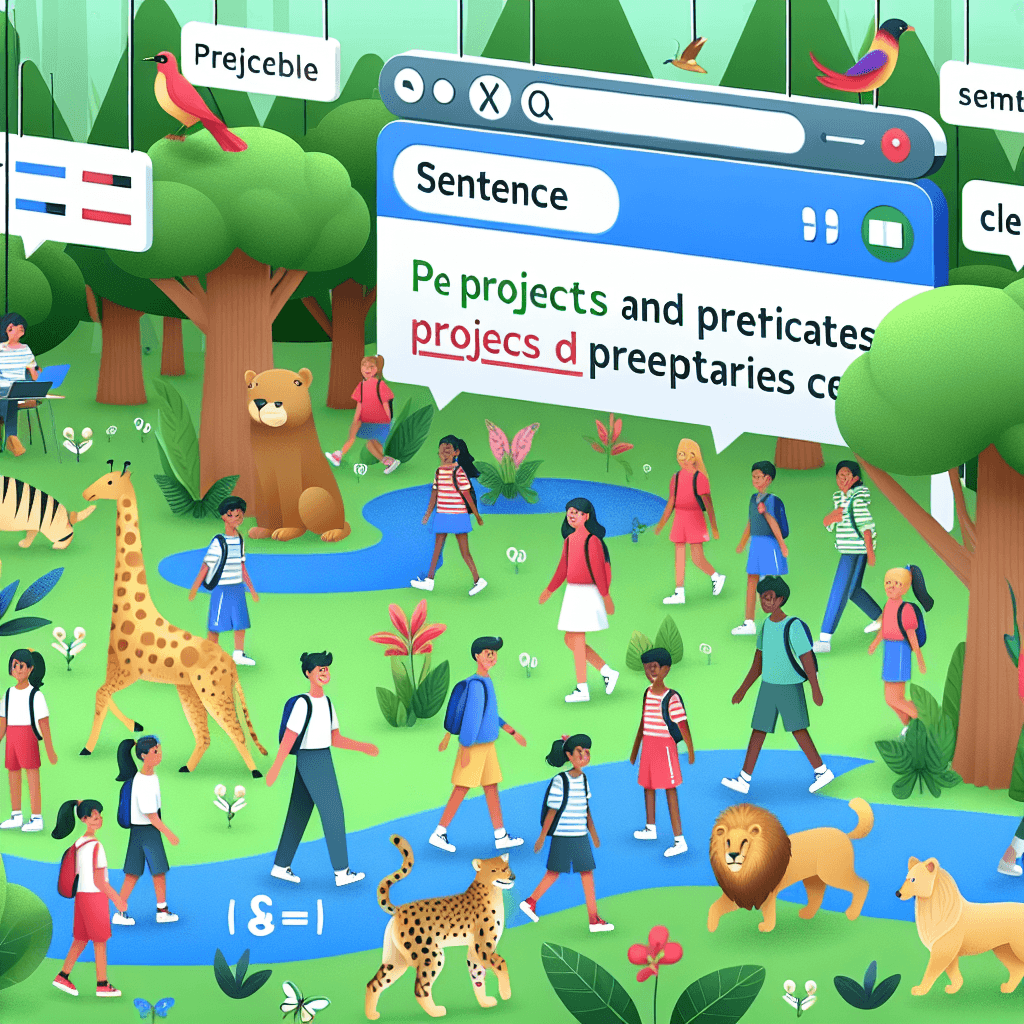
Sentence Safari: Projects and Predicates in Nature
Inquiry Framework
Question Framework
Driving Question
The overarching question that guides the entire project.How can we use our understanding of subjects, predicates, and conjunctions to explore and describe the world around us by forming simple and compound sentences?Essential Questions
Supporting questions that break down major concepts.- What is a subject in a sentence, and why is it important?
- How do you identify the predicate in a sentence?
- What is the role of coordinating conjunctions in compound sentences?
- How can we combine two simple sentences to form a compound sentence?
- Why is it important to understand the subject-predicate structure when forming sentences?
Standards & Learning Goals
Learning Goals
By the end of this project, students will be able to:- Students will be able to identify the subject and predicate in simple sentences with accuracy.
- Students will practice and master the identification of subjects and predicates in compound sentences.
- Students will effectively use coordinating conjunctions to form compound sentences.
- Students will demonstrate the ability to combine simple sentences into compound sentences.
- Students will understand the importance of sentence structure in conveying information clearly.
Common Core Standards
Entry Events
Events that will be used to introduce the project to studentsWildlife Mystery: Sentence Creation
Students receive a mysterious letter from a wildlife explorer detailing unusual animal behaviors. To uncover more about these animals, they must form sentences using subject-predicate pairs that describe these behaviors. This sparks curiosity in sentence structure while connecting to their love for animals.Portfolio Activities
Portfolio Activities
These activities progressively build towards your learning goals, with each submission contributing to the student's final portfolio.Subject Safari - What's the Subject?
Students will embark on a journey to hunt for subjects within simple sentences related to the animal world. This activity helps students identify the main actor or subject and its importance within a sentence, connecting it to a familiar and engaging theme: animals.Steps
Here is some basic scaffolding to help students complete the activity.Final Product
What students will submit as the final product of the activityA collection of student-generated sentences about animals with identified subjects.Alignment
How this activity aligns with the learning objectives & standardsAligns with L.3.1 and L.3.1.A by explaining the function of nouns in particular sentences.Predator Predicate Hunt
Students will explore the predicates that complete their animal-themed sentences. This activity focuses on understanding what action the subject is performing or the state of being, thus forming a complete thought.Steps
Here is some basic scaffolding to help students complete the activity.Final Product
What students will submit as the final product of the activityStudent sentences with predicates correctly identified and underlined, completing their understanding of simple sentence structure.Alignment
How this activity aligns with the learning objectives & standardsAligns with L.3.1 by commanding the conventions of English grammar, focusing on verbs in predicates.Conjunction Jungle - Connecting Animal Actions
This activity introduces students to coordinating conjunctions, enabling them to connect sentences using words like 'and', 'but', and 'or.' Students learn to expand their descriptions and form compound sentences using animal behavior etc.Steps
Here is some basic scaffolding to help students complete the activity.Final Product
What students will submit as the final product of the activityStudents will produce combined sentences using coordinating conjunctions to describe various animal actions.Alignment
How this activity aligns with the learning objectives & standardsAligns with L.3.1.I, focusing on producing compound sentences using conjunctions.Compound Adventure - Building Complex Animal Narratives
Students will now combine their knowledge from previous activities to construct compound sentences that tell short animal stories. This will solidify their understanding of sentence structure and engage them in creative sentence-building.Steps
Here is some basic scaffolding to help students complete the activity.Final Product
What students will submit as the final product of the activityA short narrative made up of compound sentences detailing animal adventures.Alignment
How this activity aligns with the learning objectives & standardsSupports L.3.1.I, encouraging the production of compound sentences and enhancing narrative skills.Rubric & Reflection
Portfolio Rubric
Grading criteria for assessing the overall project portfolioExploring Sentence Structure
Subject Identification
Assesses the student's ability to accurately identify and understand the role of subjects in a sentence.Subject Recognition
Evaluates the student's proficiency in identifying the subject within given sentences about animals.
Exemplary
4 PointsAccurately identifies subjects in all sentences and demonstrates a deep understanding of what constitutes a subject in the context of sentences.
Proficient
3 PointsIdentifies subjects correctly in most sentences, showing a clear understanding of their role in sentences.
Developing
2 PointsIdentifies subjects correctly in some sentences but shows inconsistent understanding of the concept.
Beginning
1 PointsStruggles to identify subjects and demonstrates limited understanding of their role in sentences.
Predicate Identification
Evaluates students' ability to recognize and explain predicates in sentences and their importance for forming complete thoughts.Predicate Recognition
Measures the ability to correctly identify predicates within animal-related sentences.
Exemplary
4 PointsConsistently identifies predicates accurately in all sentences and explains their function expertly in sentences.
Proficient
3 PointsCorrectly identifies predicates in most sentences and provides a clear explanation of their purpose.
Developing
2 PointsIdentifies predicates in some sentences but offers limited explanation of their role.
Beginning
1 PointsDemonstrates difficulty in identifying predicates and lacks understanding of their importance.
Usage of Coordinating Conjunctions
Assesses students' ability to apply coordinating conjunctions effectively to form compound sentences.Conjunction Usage
Evaluates the proper use of coordinating conjunctions to connect simple sentences into compound sentences.
Exemplary
4 PointsEffectively uses coordinating conjunctions to create compound sentences with clarity and creativity.
Proficient
3 PointsUses coordinating conjunctions correctly in most cases, creating clear compound sentences.
Developing
2 PointsAttempts to use conjunctions but does so inconsistently or with errors in sentence formation.
Beginning
1 PointsStruggles to use conjunctions in sentence formation and creates incomplete or incorrect sentences.
Sentence and Narrative Construction
Evaluates the ability to construct clear and meaningful sentences and short narratives using acquired sentence structures.Sentence Construction
Assesses the ability to combine learned structures to produce complete and clear sentences.
Exemplary
4 PointsProduces well-constructed and clear sentences, showing creativity and a solid grasp of sentence structure in narratives.
Proficient
3 PointsConstructs clear sentences consistently, demonstrating an adequate understanding of sentence and narrative structure.
Developing
2 PointsProduces sentences that lack clarity and coherence, indicating partial understanding of sentence construction.
Beginning
1 PointsStruggles to construct meaningful and coherent sentences, indicating a lack of understanding of basic sentence structure.