
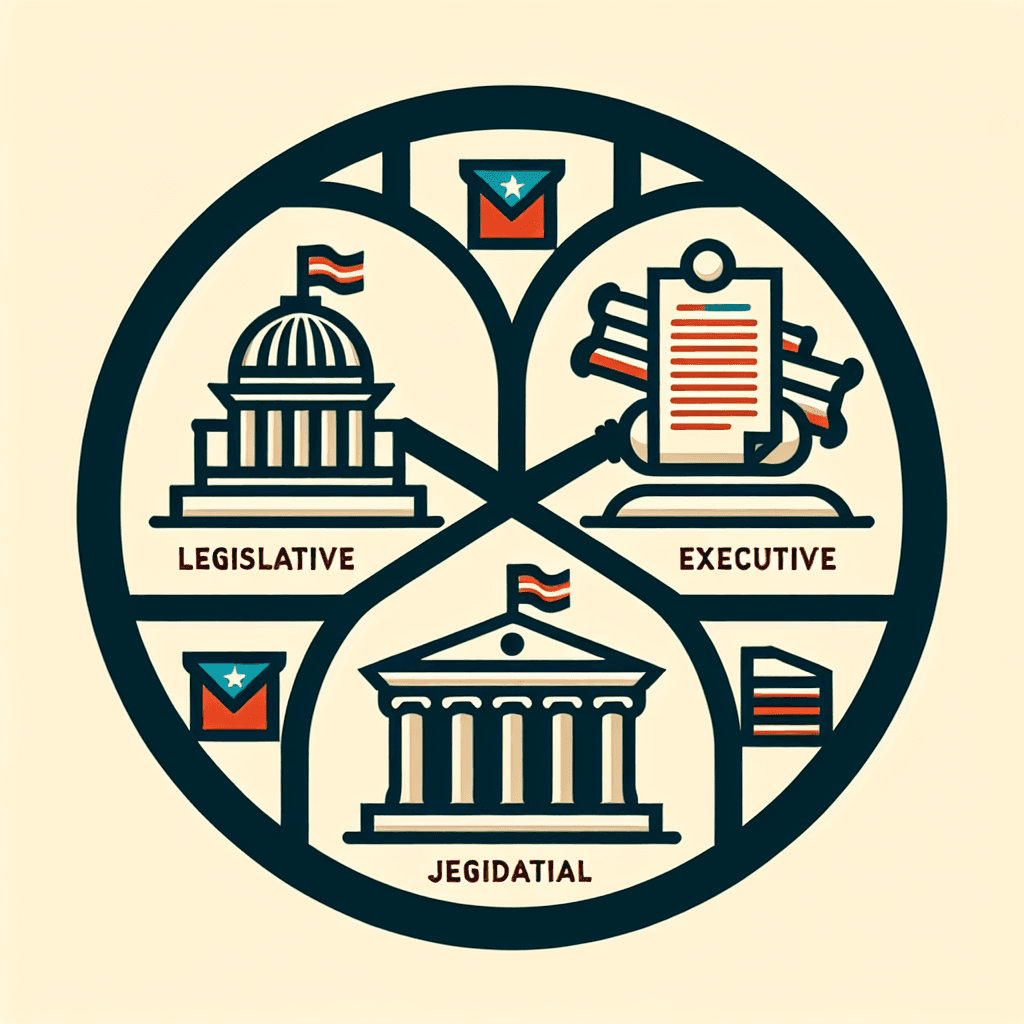
Separation of Powers: A Deep Dive into the U.S. Government
Inquiry Framework
Question Framework
Driving Question
The overarching question that guides the entire project.How do we define the distinct roles and responsibilities of the three branches of the U.S. government, as well as their interdependence and constitutional obligations that shape public policy and protect citizen rights?Essential Questions
Supporting questions that break down major concepts.- How does each branch of the government operate independently and interdependently?
- What are the roles and responsibilities of each branch of the government?
- How do the three branches of government uphold the constitution?
- How does the balance of power among the three branches of government affect public policy and citizen rights?
Standards & Learning Goals
Learning Goals
By the end of this project, students will be able to:- Students will be able to analyze the structure, functions, and constitutional basis of the three branches of the U.S. government.
- Students will be able to explain the system of checks and balances and its impact on government power and policy-making.
- Students will be able to evaluate how each branch contributes to public policy and the protection of citizen rights.
- Students will be able to compare and contrast the legislative, executive, and judicial branches.
Entry Events
Events that will be used to introduce the project to studentsBranches in Balance: A Multimedia Exploration
Students create a multimedia presentation or interactive website that compares and contrasts the structure, function, and powers of the three branches. This project allows for creative expression while reinforcing key concepts and encouraging deeper understanding of the balance of power.The Constitutional Convention Challenge
Students participate in a mock constitutional convention where they must debate and decide on the powers and responsibilities of each branch of a new government, mirroring the challenges faced by the Founding Fathers. This simulates the initial creation of the three branches and forces students to grapple with competing interests and philosophies.Portfolio Activities
Portfolio Activities
These activities progressively build towards your learning goals, with each submission contributing to the student's final portfolio.Branch Breakdown: Structure, Function, and Basis
Students will research and create detailed profiles for each of the three branches of the U.S. government: Legislative, Executive, and Judicial.Steps
Here is some basic scaffolding to help students complete the activity.Final Product
What students will submit as the final product of the activityThree comprehensive branch profiles, including structure, functions, and constitutional basis.Alignment
How this activity aligns with the learning objectives & standardsLearning Goal 1: Students will be able to analyze the structure, functions, and constitutional basis of the three branches of the U.S. government.Checks and Balances Visualizer
Students will create a visual representation (e.g., flowchart, infographic) illustrating the checks and balances between the three branches.Steps
Here is some basic scaffolding to help students complete the activity.Final Product
What students will submit as the final product of the activityA visual aid that explains the checks and balances system, highlighting how each branch can limit the power of the others.Alignment
How this activity aligns with the learning objectives & standardsLearning Goal 2: Students will be able to explain the system of checks and balances and its impact on government power and policy-making.Policy Impact Assessment
Students will select a current public policy issue and analyze how each branch of government is involved in shaping or addressing it.Steps
Here is some basic scaffolding to help students complete the activity.Final Product
What students will submit as the final product of the activityA written analysis of each branch's role in the selected public policy issue.Alignment
How this activity aligns with the learning objectives & standardsLearning Goal 3: Students will be able to evaluate how each branch contributes to public policy and the protection of citizen rights.Branches Compared: Essay Analysis
Students will write a comparative essay outlining the similarities and differences between the three branches of government, focusing on their powers, functions, and roles.Steps
Here is some basic scaffolding to help students complete the activity.Final Product
What students will submit as the final product of the activityA comparative essay that clearly outlines the similarities and differences between the legislative, executive, and judicial branches.Alignment
How this activity aligns with the learning objectives & standardsLearning Goal 4: Students will be able to compare and contrast the legislative, executive, and judicial branches.Rubric & Reflection
Portfolio Rubric
Grading criteria for assessing the overall project portfolioThree Branches of Government Portfolio Rubric
Branch Profile
Assesses the accuracy, clarity, and depth of understanding demonstrated in the branch profile.Structural Accuracy
Accuracy of details about the structure of the selected branch
Beginning
1 PointsProvides inaccurate or incomplete details about the branch's structure; shows significant misunderstandings.
Developing
2 PointsProvides some accurate details about the branch's structure but misses key components or shows some confusion.
Proficient
3 PointsProvides a thorough and mostly accurate description of the branch's structure with only minor omissions.
Exemplary
4 PointsProvides a comprehensive, accurate, and insightful description of the branch's structure, demonstrating a deep understanding.
Functional Clarity
Clarity and completeness in describing the functions of the selected branch
Beginning
1 PointsStruggles to identify or explain the functions of the branch; functions are vague or missing.
Developing
2 PointsIdentifies some functions of the branch but explanations are unclear or incomplete.
Proficient
3 PointsClearly describes the main functions of the branch with sufficient detail and accuracy.
Exemplary
4 PointsClearly and comprehensively describes the functions of the branch, providing insightful details and showing a thorough understanding.
Constitutional Basis
Thoroughness in identifying the constitutional basis for the branch’s existence and powers
Beginning
1 PointsFails to identify or inaccurately identifies the constitutional basis for the branch.
Developing
2 PointsIdentifies a constitutional basis, but it is incomplete or partially inaccurate.
Proficient
3 PointsAccurately identifies the primary constitutional basis for the branch's existence and powers.
Exemplary
4 PointsAccurately and comprehensively identifies the constitutional basis, referencing specific articles/sections and explaining their relevance.
Checks and Balances
Evaluates the student’s understanding of the checks and balances system through their visual representation and explanations.Checks Identification
Accuracy in identifying and describing the checks each branch has on the others
Beginning
1 PointsDemonstrates little to no understanding of checks and balances; inaccuracies in depicting the checks of each branch.
Developing
2 PointsIdentifies some checks and balances but with inaccuracies or omissions.
Proficient
3 PointsAccurately identifies and describes the primary checks each branch has on the others.
Exemplary
4 PointsProvides a comprehensive and insightful explanation of the checks and balances system, including subtle and nuanced checks.
Visual Clarity
Effectiveness of the visual representation in illustrating the checks and balances
Beginning
1 PointsVisual representation is confusing, poorly designed, or does not effectively illustrate the checks and balances.
Developing
2 PointsVisual representation is somewhat effective but lacks clarity or is difficult to interpret.
Proficient
3 PointsVisual representation clearly illustrates the checks and balances and is easy to understand.
Exemplary
4 PointsVisual representation is exceptionally clear, creative, and insightful, enhancing understanding of the checks and balances system.
Impact Explanation
Clarity in explaining how checks and balances impact government power and policy-making
Beginning
1 PointsFails to explain or inaccurately explains the impact of checks and balances on government power and policy-making.
Developing
2 PointsProvides a limited or superficial explanation of the impact of checks and balances.
Proficient
3 PointsClearly explains how checks and balances limit government power and influence policy-making.
Exemplary
4 PointsProvides an in-depth and nuanced explanation of the impact of checks and balances, demonstrating a strong understanding of its significance.
Policy Analysis
Assesses the depth of research, clarity of analysis, and relevance of the chosen public policy issue.Research Depth
Depth of research into each branch's involvement in the selected public policy issue
Beginning
1 PointsDemonstrates minimal research; provides little to no information on each branch's involvement.
Developing
2 PointsShows some research effort but lacks depth; provides superficial information on each branch's involvement.
Proficient
3 PointsDemonstrates thorough research and provides detailed information on each branch's involvement.
Exemplary
4 PointsDemonstrates exceptional research; provides comprehensive, insightful, and nuanced information on each branch's involvement.
Analysis Clarity
Clarity and insightfulness of the analysis of each branch's role and contribution
Beginning
1 PointsAnalysis is unclear, inaccurate, or missing; fails to demonstrate an understanding of each branch's role.
Developing
2 PointsAnalysis is basic and lacks depth; provides a superficial understanding of each branch's role.
Proficient
3 PointsAnalysis is clear, accurate, and demonstrates a good understanding of each branch's role.
Exemplary
4 PointsAnalysis is exceptionally clear, insightful, and demonstrates a deep and nuanced understanding of each branch's role.
Issue Relevance
Relevance and accuracy of the selected public policy issue
Beginning
1 PointsIssue is irrelevant, inaccurately presented, or not related to the three branches of government.
Developing
2 PointsIssue is somewhat relevant but lacks focus or accuracy.
Proficient
3 PointsIssue is relevant and accurately presented, providing a suitable context for analysis.
Exemplary
4 PointsIssue is highly relevant and accurately presented, allowing for a comprehensive and insightful analysis of the branches' roles.
Essay Comparison
Assesses the completeness, organization, clarity, and depth of the comparative essay.Comparative Completeness
Completeness in identifying key similarities and differences between the branches
Beginning
1 PointsFails to identify or inaccurately identifies similarities and differences between the branches.
Developing
2 PointsIdentifies some similarities and differences, but the analysis is incomplete or superficial.
Proficient
3 PointsIdentifies most of the key similarities and differences between the branches.
Exemplary
4 PointsIdentifies all key similarities and differences and demonstrates a comprehensive understanding of the relationships between the branches.
Essay Organization
Organization and clarity of the comparative essay
Beginning
1 PointsEssay lacks organization and clarity; difficult to understand the comparisons and contrasts.
Developing
2 PointsEssay is poorly organized with some clarity issues; comparisons and contrasts are not well-defined.
Proficient
3 PointsEssay is well-organized and clearly presents the comparisons and contrasts between the branches.
Exemplary
4 PointsEssay is exceptionally well-organized, logically structured, and clearly articulates the nuanced comparisons and contrasts.
Analytical Depth
Depth of analysis regarding the powers, functions, and roles of each branch
Beginning
1 PointsDemonstrates a minimal understanding of the powers, functions, and roles of each branch; lacks depth.
Developing
2 PointsShows some understanding but the analysis is superficial and lacks specific details.
Proficient
3 PointsDemonstrates a good understanding and provides a thorough analysis of the powers, functions, and roles.
Exemplary
4 PointsDemonstrates a deep and nuanced understanding and provides an insightful analysis of the powers, functions, and roles of each branch.