
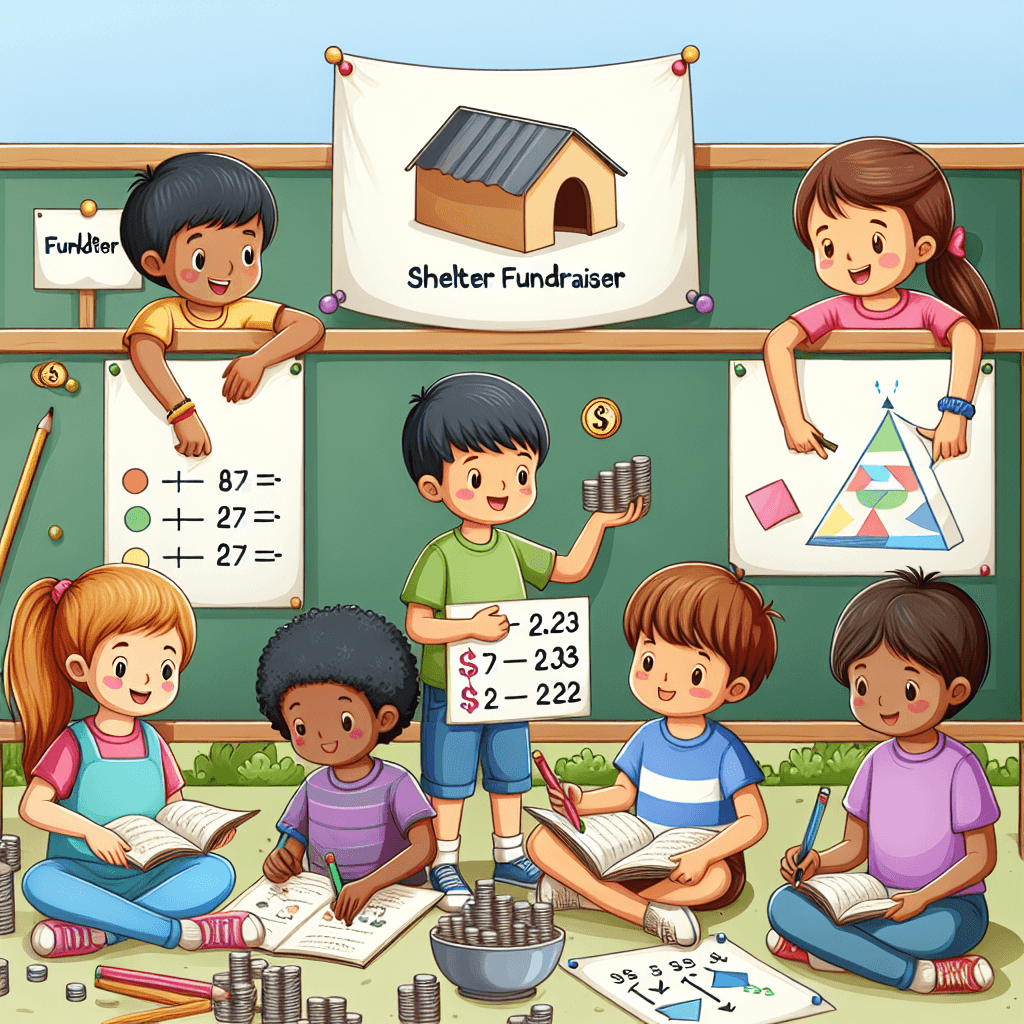
Shelter Fundraiser: Math in Action!
Inquiry Framework
Question Framework
Driving Question
The overarching question that guides the entire project.How can we, as mathematicians and compassionate citizens, design and implement a fundraising campaign for our local animal shelter, using our understanding of place value, rounding, addition, and subtraction to manage donations and effectively communicate our impact to the community?Essential Questions
Supporting questions that break down major concepts.- How can we use place value to represent and compare donations?
- How can we use rounding to estimate the total money raised?
- What strategies can we use to manage and track donations?
- How can we clearly present the data we collected to the community?
Standards & Learning Goals
Learning Goals
By the end of this project, students will be able to:- Students will be able to apply place value understanding to represent and compare monetary donations.
- Students will be able to use rounding to estimate the total funds raised.
- Students will be able to fluently add and subtract multi-digit whole numbers to manage and track donations.
- Students will be able to present data effectively to communicate the impact of their fundraising campaign to the community.
Common Core Standards
Entry Events
Events that will be used to introduce the project to studentsExpert Panel: The Price of Compassion
A panel of 'animal experts' (local vets, shelter volunteers) presents different perspectives on animal welfare and the shelter's operations, highlighting the various costs involved. Students engage in a Q&A session, using their math skills to estimate expenses and propose initial fundraising ideas based on the experts' insights.Animal Shelter SOS: A News Report
A local news clip showcases the animal shelter's urgent need for funding due to overcrowding. Students analyze the data presented in the news report (number of animals, costs of care) to understand the scope of the problem and the financial goals of the shelter, sparking immediate empathy and a desire to help.Virtual Pet Budget Challenge
Students participate in a simulation where they 'adopt' virtual pets, each with unique needs and associated costs (food, medical care, toys). They must manage their virtual pet's budget using their math skills, facing unexpected expenses and making resource allocation decisions. This experience fosters empathy and provides a tangible connection to the financial challenges faced by real animal shelters.Portfolio Activities
Portfolio Activities
These activities progressively build towards your learning goals, with each submission contributing to the student's final portfolio.Donation Amount Decoder
Students will explore place value by representing different donation amounts in various forms. They'll practice reading, writing, and expanding numbers related to potential donations.Steps
Here is some basic scaffolding to help students complete the activity.Final Product
What students will submit as the final product of the activityA 'Donation Representation Chart' showcasing different donation amounts (e.g., $1234) in base-ten numerals, number names (e.g., one thousand two hundred thirty-four), and expanded form (e.g., 1000 + 200 + 30 + 4).Alignment
How this activity aligns with the learning objectives & standardsCovers 4.NBT.2 (Read and write multi-digit whole numbers using base-ten numerals, number names, and expanded form.)Comparing Contributions: The Great Donation Race
Students will compare potential donation amounts to understand the relative value of different contributions. They'll use comparison symbols to show which donations are greater, lesser, or equal.Steps
Here is some basic scaffolding to help students complete the activity.Final Product
What students will submit as the final product of the activityA 'Donation Comparison Game' where students compare pairs of donation amounts using >, =, and < symbols. The game includes a set of comparison cards and a recording sheet to track their answers.Alignment
How this activity aligns with the learning objectives & standardsCovers 4.NBT.2 (Compare two multi-digit numbers based on meanings of the digits in each place, using >, =, and <)Rounding for Rescue: Estimate Our Earnings!
Students will learn to round potential donation amounts to the nearest ten, hundred, and thousand to estimate the total funds raised. This helps them predict whether they are on track to meet their fundraising goal.Steps
Here is some basic scaffolding to help students complete the activity.Final Product
What students will submit as the final product of the activityA 'Rounding Thermometer' visual aid. Students will create a thermometer-style chart that shows how to round donation amounts to different place values, along with examples relevant to the animal shelter fundraiser.Alignment
How this activity aligns with the learning objectives & standardsCovers 4.NBT.3 (Use place value understanding to round multi-digit whole numbers to any place.)Tracking Treasure: The Donation Ledger
Students will track and manage the donations received using addition and subtraction. They will calculate the total funds raised, subtract expenses, and determine the remaining balance to be donated to the animal shelter.Steps
Here is some basic scaffolding to help students complete the activity.Final Product
What students will submit as the final product of the activityA 'Donation Ledger' where students record all incoming donations and outgoing expenses related to the fundraiser. The ledger includes columns for date, description, income/expense, and balance. The final balance represents the total amount available for donation.Alignment
How this activity aligns with the learning objectives & standardsCovers 4.NBT.4 (Fluently add and subtract multi-digit whole numbers using the standard algorithm.)Rubric & Reflection
Portfolio Rubric
Grading criteria for assessing the overall project portfolioAnimal Shelter Fundraiser Portfolio Rubric
Donation Representation
Focuses on the student's ability to represent donation amounts in various forms and the clarity of their presentation.Representation Accuracy
Accuracy of representing donation amounts in base-ten numerals, number names, and expanded form.
Exemplary
4 PointsDemonstrates sophisticated accuracy in representing all donation amounts in base-ten numerals, number names, and expanded form, with no errors.
Proficient
3 PointsAccurately represents donation amounts in base-ten numerals, number names, and expanded form with only minor errors.
Developing
2 PointsShows emerging understanding of representing donation amounts but struggles with accuracy in one or two forms.
Beginning
1 PointsShows initial understanding but struggles with representing donation amounts in all three forms, with multiple errors.
Clarity and Organization
Clarity and organization of the 'Donation Representation Chart'.
Exemplary
4 PointsPresents the 'Donation Representation Chart' with exceptional clarity and organization, making it easy to understand and visually appealing.
Proficient
3 PointsPresents the 'Donation Representation Chart' with good clarity and organization, making it easy to understand.
Developing
2 PointsPresents the 'Donation Representation Chart' with some clarity and organization, but may require some effort to understand.
Beginning
1 PointsPresents the 'Donation Representation Chart' with poor clarity and organization, making it difficult to understand.
Donation Comparison
Focuses on the student's ability to compare donation amounts accurately and create an engaging game.Comparison Accuracy
Accuracy in comparing pairs of donation amounts using comparison symbols (>, =, <).
Exemplary
4 PointsDemonstrates sophisticated accuracy in comparing all pairs of donation amounts using the correct symbols, with no errors.
Proficient
3 PointsAccurately compares pairs of donation amounts using the correct symbols with only minor errors.
Developing
2 PointsShows emerging understanding of comparison symbols but struggles with accuracy in some comparisons.
Beginning
1 PointsShows initial understanding but struggles with comparing donation amounts and using the correct symbols, with multiple errors.
Game Engagement
Creativity and engagement in the 'Donation Comparison Game'.
Exemplary
4 PointsCreates a highly creative and engaging 'Donation Comparison Game' that enhances understanding and promotes active participation.
Proficient
3 PointsCreates a 'Donation Comparison Game' that is engaging and promotes understanding.
Developing
2 PointsCreates a 'Donation Comparison Game' that is somewhat engaging but may lack clarity or depth.
Beginning
1 PointsCreates a 'Donation Comparison Game' that is not engaging and lacks clarity.
Donation Rounding
Focuses on the student's ability to round donation amounts accurately and create an effective visual aid.Rounding Accuracy
Accuracy in rounding donation amounts to the nearest ten, hundred, and thousand.
Exemplary
4 PointsDemonstrates sophisticated accuracy in rounding all donation amounts to the nearest ten, hundred, and thousand, with no errors.
Proficient
3 PointsAccurately rounds donation amounts to the nearest ten, hundred, and thousand with only minor errors.
Developing
2 PointsShows emerging understanding of rounding but struggles with accuracy in rounding to one or two place values.
Beginning
1 PointsShows initial understanding but struggles with rounding donation amounts to any place value, with multiple errors.
Visual Aid Effectiveness
Effectiveness of the 'Rounding Thermometer' as a visual aid for estimation.
Exemplary
4 PointsCreates a highly effective 'Rounding Thermometer' that is clear, visually appealing, and accurately represents the process of rounding for estimation.
Proficient
3 PointsCreates a 'Rounding Thermometer' that is clear and accurately represents the process of rounding for estimation.
Developing
2 PointsCreates a 'Rounding Thermometer' that is somewhat clear but may have some inaccuracies or lack visual appeal.
Beginning
1 PointsCreates a 'Rounding Thermometer' that is not clear and does not accurately represent the process of rounding for estimation.
Donation Tracking
Focuses on the student's ability to accurately manage and track donations using addition and subtraction in a ledger.Calculation Accuracy
Accuracy in adding and subtracting multi-digit whole numbers in the 'Donation Ledger'.
Exemplary
4 PointsDemonstrates sophisticated accuracy in adding and subtracting all donation amounts and expenses in the 'Donation Ledger', with no errors.
Proficient
3 PointsAccurately adds and subtracts donation amounts and expenses in the 'Donation Ledger' with only minor errors.
Developing
2 PointsShows emerging understanding of addition and subtraction but struggles with accuracy in some calculations.
Beginning
1 PointsShows initial understanding but struggles with adding and subtracting donation amounts and expenses, with multiple errors.
Ledger Organization
Organization and completeness of the 'Donation Ledger'.
Exemplary
4 PointsCreates a highly organized and complete 'Donation Ledger' with all necessary information clearly presented and easy to follow.
Proficient
3 PointsCreates a 'Donation Ledger' that is organized and complete with all necessary information.
Developing
2 PointsCreates a 'Donation Ledger' that is somewhat organized but may be missing some information or lack clarity.
Beginning
1 PointsCreates a 'Donation Ledger' that is not organized and is missing significant information.