
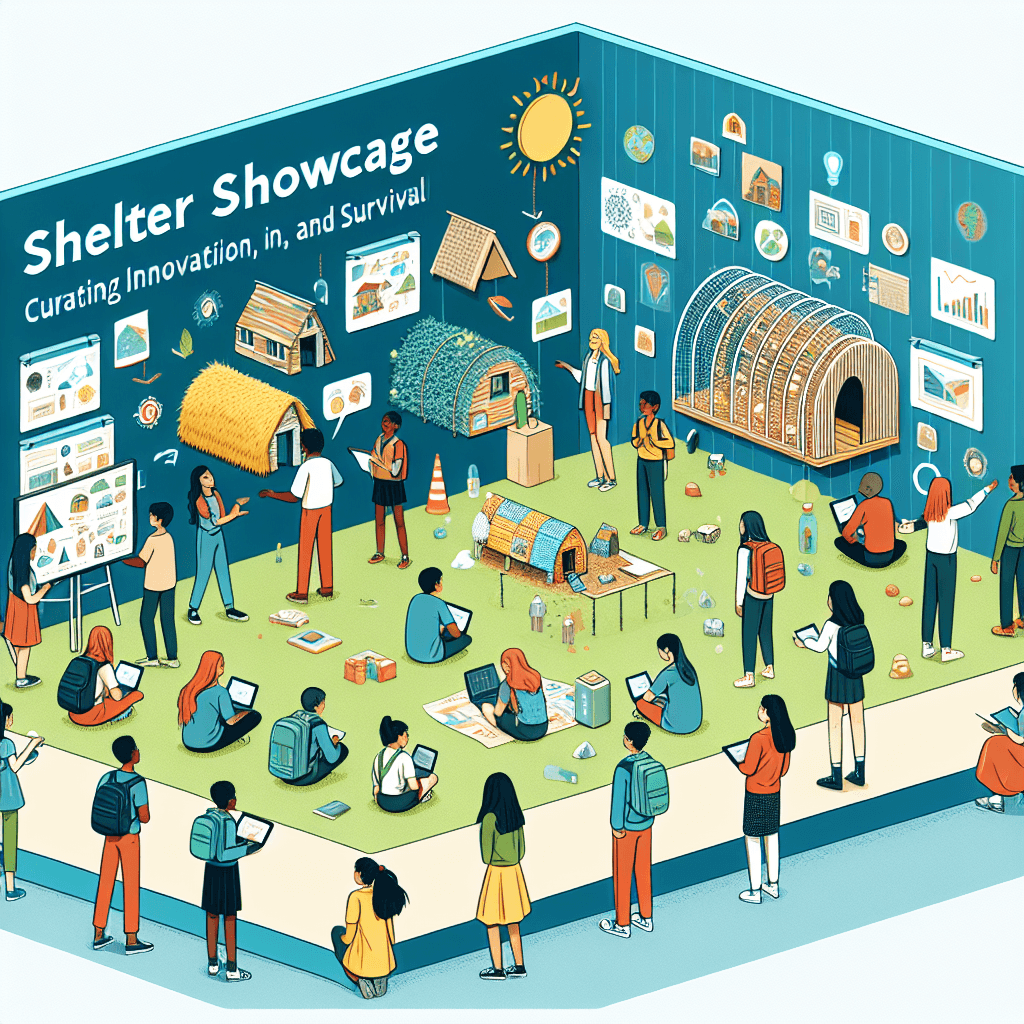
Shelter Showcase: Curating Innovation, Change, and Survival
Inquiry Framework
Question Framework
Driving Question
The overarching question that guides the entire project.How can we, as museum curators, design an interactive exhibit that shows how Texans have used math and science to innovate shelters that survive our changing environment?Essential Questions
Supporting questions that break down major concepts.- How do environmental factors (like weather, climate, and landforms) influence the materials and design of a shelter? (Science/TEKS 3.7)
- How have human shelters in Texas evolved over time to meet changing needs and survival challenges? (History/TEKS 3.2)
- How can we use geometry and measurement (area and perimeter) to design a shelter that is both functional and stable? (Math/TEKS 3.6)
- How can we combine research, writing, and visual design to teach museum visitors about the importance of innovation in survival? (ELAR/TEKS 3.13)
- How do humans use natural resources responsibly to build shelters that protect them from their environment? (Science/History/TEKS 3.7/3.4)
- How do the shapes and structures used in building design affect a shelter’s ability to withstand natural changes like erosion or extreme weather? (Science/Math/TEKS 3.7/3.6)
Standards & Learning Goals
Learning Goals
By the end of this project, students will be able to:- Design and construct a scale model of a shelter that demonstrates structural stability and uses specific geometric shapes to maximize efficiency and protection.
- Calculate the area and perimeter of shelter floor plans to ensure the design meets specific living requirements for different Texas environments.
- Research and compare historical Texas shelters (e.g., Caddo grass houses, Adobe structures) with modern innovations to explain how technology and materials have evolved.
- Analyze the impact of Texas-specific environmental factors—such as extreme heat, hurricanes, or soil erosion—on building material selection and architectural design.
- Compose clear, informative museum exhibit labels and scripts that synthesize research and explain the 'innovation, change, and survival' of their chosen shelter design to a public audience.
- Identify and categorize natural resources used in shelter construction and evaluate the sustainability of different materials in various Texas regions.
TEKS (Math)
TEKS (Science)
TEKS (Social Studies)
TEKS (ELAR)
Entry Events
Events that will be used to introduce the project to studentsThe 10-Minute Shelter Challenge
Students enter a room where a 'storm' is brewing (fans blowing, sound effects of rain/wind). They are immediately tasked with using 'junk' materials to build a protective covering for a fragile paper 'client' who must survive the night in a specific biome.Portfolio Activities
Portfolio Activities
These activities progressively build towards your learning goals, with each submission contributing to the student's final portfolio.Chronicles of the Texas Hearth: A History of Survival
In this opening portfolio activity, students act as historical researchers. They will investigate how early Texans (such as the Caddo or the Jumano) used their environment to build shelters. Students will explore the 'why' behind these structures—focusing on security, weather protection, and available natural resources—to understand how innovation is driven by necessity.Steps
Here is some basic scaffolding to help students complete the activity.Final Product
What students will submit as the final product of the activityA 'Discovery Flip-Book' that compares a historical Texas shelter with a modern one, highlighting three major changes in design or materials.Alignment
How this activity aligns with the learning objectives & standardsThis activity aligns with SS 3.2.A (identifying reasons for communities/security), SS 3.2.C (describing changes over time), and ELAR 3.13.C (gathering relevant information from sources).Precision Pads: The Blueprint Challenge
Now that students understand the history of Texas shelters, they must step into the role of an architect. Students will use mathematical precision to design the floor plan of their innovative shelter. They must ensure their design provides enough 'survival space' (area) while accounting for the 'boundary materials' (perimeter) needed to secure the site.Steps
Here is some basic scaffolding to help students complete the activity.Final Product
What students will submit as the final product of the activityA 'Blue-Ribbon Blueprint' drawn on grid paper with labeled dimensions, showing the area and perimeter calculations for at least two different rooms or sections.Alignment
How this activity aligns with the learning objectives & standardsThis activity aligns with MATH 3.6.C (determining area of rectangles) and MATH 3.7.B (determining perimeter of a polygon).Earth-Friendly Fortresses: Material Science
In this activity, students become 'Material Scientists.' They must decide which materials will be used to build their 3D museum model. They will analyze the weather patterns of their chosen Texas region and select materials that are both durable and sustainable, focusing on the conservation of natural resources.Steps
Here is some basic scaffolding to help students complete the activity.Final Product
What students will submit as the final product of the activityA 'Material Sustainability Map'—a visual chart that lists each material chosen for the model, whether it is a natural resource or a reused item, and why it is the best choice for the regional weather.Alignment
How this activity aligns with the learning objectives & standardsThis activity aligns with SCI 3.7.B (impact of natural resources and reuse) and SCI 3.8.A (weather patterns and precipitation).Voices of the Vault: The Curator's Script
As the final step before the grand opening, students assume their role as Museum Curators. They will synthesize everything they have learned about history, math, and science to write the official 'Exhibit Label' for their shelter model. This text must explain the innovation behind their design and how it helps humans survive and adapt.Steps
Here is some basic scaffolding to help students complete the activity.Final Product
What students will submit as the final product of the activityA professional 'Curator's Exhibit Plaque'—a polished informational text that will be displayed next to their 3D shelter model.Alignment
How this activity aligns with the learning objectives & standardsThis activity aligns with ELAR 3.12.B (composing informational texts with a clear central idea and genre characteristics).Rubric & Reflection
Portfolio Rubric
Grading criteria for assessing the overall project portfolioMuseum Curator: Texas Shelter Innovation Rubric
Integrated Exhibit Design & Curatorial Practice
Assessment of the student's ability to integrate history, math, science, and literacy into a cohesive museum exhibit design.Historical Evolution & Continuity
The ability to research historical Texas shelters and analyze how they evolved to meet changing community needs and environmental challenges. (TEKS SS 3.2.A, 3.2.C)
Exemplary
4 PointsProvides a sophisticated comparison of historical and modern shelters; identifies specific natural resources and provides an insightful explanation of how these materials ensured survival in a specific Texas region. Demonstrates deep understanding of innovation over time.
Proficient
3 PointsAccurately compares a historical Texas shelter with a modern version; correctly identifies natural resources used and explains their relationship to weather protection and community needs.
Developing
2 PointsIdentifies a historical and modern shelter but comparison is surface-level; lists some natural resources but provides a limited explanation of how they protected the inhabitants from weather.
Beginning
1 PointsIdentifies shelters with significant errors or omissions; struggles to name natural resources used or explain the purpose of the design. Comparison is incomplete.
Geometric Precision & Spatial Planning
The application of geometric principles to design a functional floor plan, including accurate calculation of area and perimeter using appropriate units. (TEKS MATH 3.6.C, 3.7.B)
Exemplary
4 PointsCalculates area and perimeter for multiple rooms with 100% accuracy; uses grid paper to show complex, innovative spatial planning; labels all dimensions and units clearly and professionally.
Proficient
3 PointsCalculates area and perimeter for at least two rooms correctly; demonstrates a clear understanding of the difference between area (square units) and perimeter (linear units) in a functional design.
Developing
2 PointsCalculates area or perimeter with minor errors; floor plan is drawn but may lack clear labels or fail to meet the two-room requirement; shows emerging understanding of measurement.
Beginning
1 PointsSignificant errors in area and perimeter calculations; floor plan lacks logical dimensions or fails to use the grid paper effectively to determine size.
Material Science & Environmental Adaptation
The ability to analyze regional weather patterns and select/classify materials based on their properties, sustainability, and survival utility. (TEKS SCI 3.7.B, 3.8.A)
Exemplary
4 PointsProvides a sophisticated justification for material selection based on specific weather data; flawlessly categorizes all materials; demonstrates leadership in thinking about sustainability and resource conservation.
Proficient
3 PointsCorrectly classifies materials as natural, reused, or man-made; provides a clear justification for why each material was chosen for a specific Texas region's weather (e.g., heat, rain).
Developing
2 PointsAttempts to classify materials but makes some errors; justification for weather protection is vague or inconsistent with the chosen Texas region.
Beginning
1 PointsFails to classify materials correctly; choice of materials shows little connection to the environment or survival needs of the region.
Curatorial Communication & Synthesis
The synthesis of research into a professional, clear, and engaging informational text that communicates the 'innovation' story to a museum audience. (TEKS ELAR 3.12.B, 3.13.C)
Exemplary
4 PointsComposes a compelling narrative with a powerful central idea; integrates math, science, and history concepts seamlessly; uses sophisticated vocabulary and professional museum-quality formatting.
Proficient
3 PointsWrites a clear informational text with a central idea, specific details about math/science integration, and a 'fun fact' regarding historical change; uses professional language and correct mechanics.
Developing
2 PointsDrafts a text that conveys basic information but lacks a strong central idea; details about the shelter's innovation are present but may be repetitive or disorganized.
Beginning
1 PointsText is incomplete or lacks clarity; fails to explain how the shelter works or why it is innovative; significant errors in grammar or spelling hinder the visitor's understanding.