
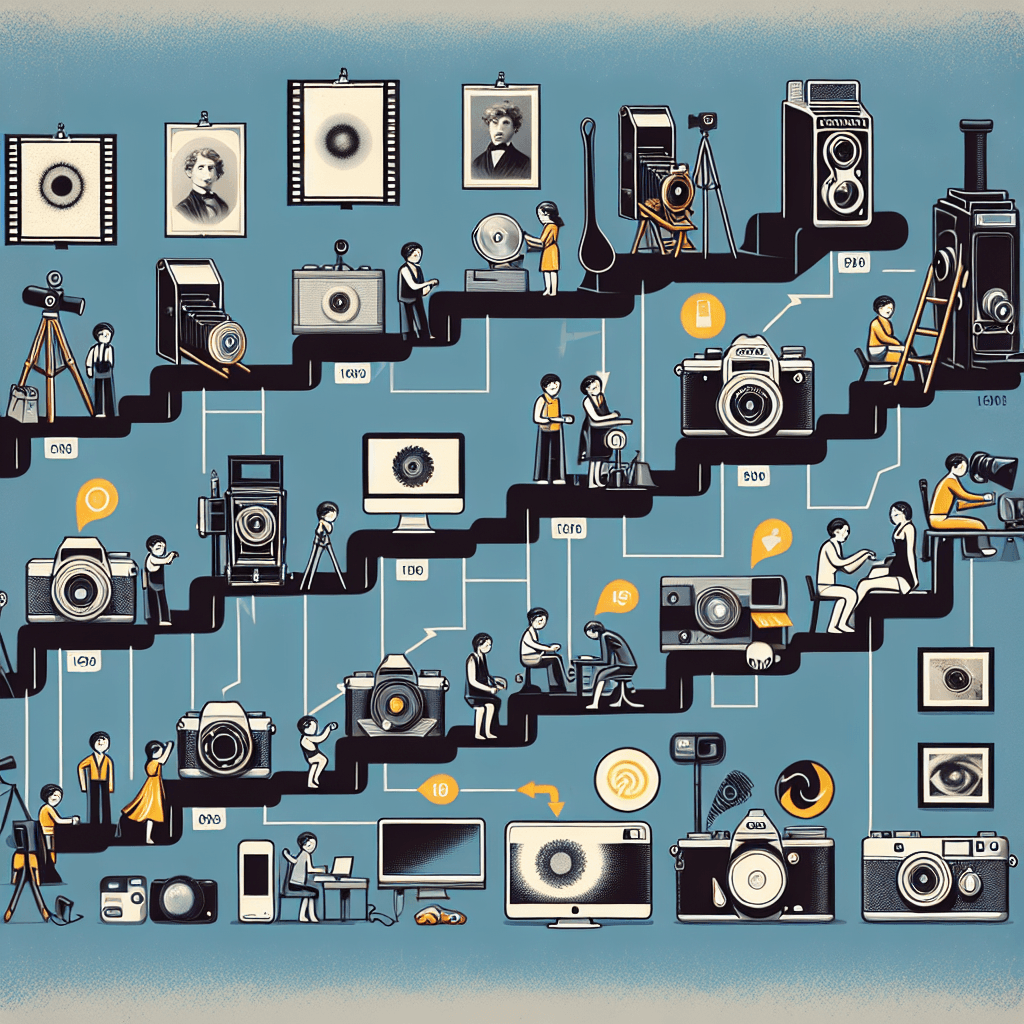
Shutter and Survival: Curating the Evolution of Photography
Inquiry Framework
Question Framework
Driving Question
The overarching question that guides the entire project.How can we, as museum curators, design an immersive exhibit that uses the evolution of camera technology—from the physics of optics to the digital revolution—to tell a compelling story of how humanity documents survival and defines historical truth?Essential Questions
Supporting questions that break down major concepts.- How does the evolution of camera technology reflect the scientific understanding of light and optics over time? (Science/History)
- How can mathematical ratios and geometric perspectives be used to curate an exhibit that accurately represents scale and visual depth? (Math)
- In what ways has the transition from film to digital photography changed the way we preserve historical memory and 'truth'? (History/English)
- How do curators use persuasive writing and visual rhetoric to convey a narrative of 'survival and change' to a diverse audience? (English)
- How do the physical properties of lenses and apertures relate to the mathematical calculations needed for a perfectly exposed photograph? (Science/Math)
- How has the 'democratization' of photography—moving from a rare skill to a common tool—impacted our ability to document social and political change? (History/English)
Standards & Learning Goals
Learning Goals
By the end of this project, students will be able to:- Analyze the impact of photography on historical documentation and the perception of social and political truth over time.
- Apply principles of physics, including light behavior, optics, and lens mechanics, to explain the evolution of camera technology.
- Utilize geometric principles of scale and proportion to design an accurate physical or digital museum exhibit layout.
- Compose persuasive and informative exhibit labels and narratives that effectively communicate the theme of 'survival and change' using visual rhetoric.
- Evaluate the shift from analog to digital technology through the lens of mathematical ratios and data preservation.
- Synthesize interdisciplinary research to curate a cohesive narrative that links technological innovation with human experience and historical memory.
Texas Essential Knowledge and Skills (TEKS) - Social Studies Grade 8
Texas Essential Knowledge and Skills (TEKS) - World History
Texas Essential Knowledge and Skills (TEKS) - English I
Texas Essential Knowledge and Skills (TEKS) - Integrated Physics and Chemistry (IPC)
Texas Essential Knowledge and Skills (TEKS) - Physics
Texas Essential Knowledge and Skills (TEKS) - Geometry
Texas Essential Knowledge and Skills (TEKS) - Math Grade 8
Entry Events
Events that will be used to introduce the project to studentsThe Curator’s Evolutionary Crate
Students enter the classroom to find a series of 'Mystery Crates' representing different eras: 1840, 1900, 1950, and 2024. Inside each crate is a specific camera type—a Daguerreotype plate, a Kodak Brownie, a 35mm SLR, and a modern mirrorless sensor. Students must use 'curator gloves' to examine the artifacts and use mathematical ratios to compare the size of the camera to the resolution of the image produced, sparking questions about why humanity evolved these tools to capture 'truth.'The 'Camera DNA' Forensic Lab
Students are presented with a 'Ghost Gallery'—a series of portraits ranging from grainy 19th-century tintypes to high-definition AI-enhanced digital photos. They are tasked with acting as forensic historians to identify the 'Camera DNA' of each image by analyzing the science of light, lens distortion, and chemical artifacts. They must debate: does the type of camera used change the historical 'survival' of the person in the portrait?Portfolio Activities
Portfolio Activities
These activities progressively build towards your learning goals, with each submission contributing to the student's final portfolio.The Curator's Forensic Dossier
Before building the exhibit, curators must understand their artifacts. In this activity, students select one of the 'eras' from the entry event (1840, 1900, 1950, or modern day) and conduct a 'forensic' historical investigation. They will research the specific camera technology of that time and, more importantly, the historical context of survival and change that the camera was used to document (e.g., the Civil War, the Industrial Revolution, or the Digital Age).Steps
Here is some basic scaffolding to help students complete the activity.Final Product
What students will submit as the final product of the activityAn 'Artifact Forensic Dossier' that includes a historical timeline of the camera, a technical specification sheet, and an analysis of one 'survival' photograph from that era.Alignment
How this activity aligns with the learning objectives & standardsAligns with TEKS.SS.8.29 (Organizing information from valid sources) and TEKS.ELA.I.8.E (Analyzing multimodal texts). Students must evaluate how the 'multimodal' nature of photography (image + text) was used historically to document survival.The Light-Bending Blueprint
To explain technology to museum visitors, curators must understand the science behind it. In this lab-based activity, students experiment with lenses to understand how light is manipulated to capture an image. They will explore the relationship between focal length, aperture (ratios), and image clarity. This activity bridges the gap between the 'magic' of a photo and the 'math/science' of the tool.Steps
Here is some basic scaffolding to help students complete the activity.Final Product
What students will submit as the final product of the activityA 'Technical Blueprint Poster' that illustrates ray-tracing diagrams for their specific camera lens and a mathematical table showing aperture/shutter speed ratios.Alignment
How this activity aligns with the learning objectives & standardsAligns with TEKS.SCI.IPC.5.F (Focus of light using lenses), TEKS.SCI.PHY.7.D (Images formed by convex/concave lenses), and TEKS.MATH.8.2.D (Solving problems with ratios). Students apply physics to understand image formation and math to calculate exposure ratios.Scale & Sightlines: The Gallery Architect
Museum design is an art of geometry. Students must design the physical or digital layout of their exhibit space. They will use geometric principles to ensure that the artifacts are spaced correctly, sightlines are optimized for visitors, and the scale of the camera models relates correctly to the size of the gallery. This activity ensures students can apply abstract geometry to a professional, real-world spatial problem.Steps
Here is some basic scaffolding to help students complete the activity.Final Product
What students will submit as the final product of the activityA 'Scale Gallery Floor Plan' (physical model or digital CAD) with a corresponding 'Geometric Justification Report' explaining the scale factors used.Alignment
How this activity aligns with the learning objectives & standardsAligns with TEKS.MATH.GEO.7.B (Using similarity to solve problems and justify relationships). Students must use geometric transformations and scale factors to ensure the exhibit design is mathematically sound.Voices of the Frame: Crafting the Narrative
An exhibit is nothing without its narrative. Students will now step into the role of storytellers. They will write the informational placards and the 'Grand Narrative' of their exhibit section. They must use persuasive writing to convince the audience of the significance of their era’s photography in documenting human survival and 'historical truth.' This involves crafting clear, punchy, and evocative prose that balances technical facts with emotional history.Steps
Here is some basic scaffolding to help students complete the activity.Final Product
What students will submit as the final product of the activityA set of professionally designed 'Exhibit Placards' and a 'Curator’s Introduction Script' that would be used for an audio guide or opening speech.Alignment
How this activity aligns with the learning objectives & standardsAligns with TEKS.ELA.I.10.B (Composing informational texts) and TEKS.SS.WH.14 (Analyzing the impact of technology on world history). Students must use persuasive language and historical evidence to tell a story.The Grand Opening: Survival Through the Lens
In this final phase, students assemble their dossiers, blueprints, and narratives into a cohesive, immersive exhibit. This is where the 'curator' truly shines. They will present their work to an audience (peers, parents, or local historians), explaining how the evolution of camera technology—from physics to digital pixels—parallels the evolution of how we document our own survival and define what is 'true.'Steps
Here is some basic scaffolding to help students complete the activity.Final Product
What students will submit as the final product of the activityThe 'Survival & Change' Immersive Exhibit—a multimodal presentation featuring the physical layout, the technical science, the historical artifacts, and the persuasive narrative.Alignment
How this activity aligns with the learning objectives & standardsSynthesizes all previous standards: TEKS.ELA.I.8.E, TEKS.SCI.IPC.5.F, TEKS.MATH.GEO.7.B, and TEKS.SS.WH.14. This is the summative assessment where all components come together to answer the Driving Question.Rubric & Reflection
Portfolio Rubric
Grading criteria for assessing the overall project portfolioSurvival Through the Lens: Museum Curator Rubric
Historical & Narrative Curation
Focuses on the student's ability to synthesize historical facts, technological impact, and persuasive storytelling to create a meaningful museum narrative.Historical Research & Contextualization (TEKS SS 8.29, WH.14)
Students organize and use information from valid sources to analyze how a specific camera's limitations or strengths influenced the recording of historical 'survival' or 'change.'
Exemplary
4 PointsThe dossier provides a sophisticated analysis of the interplay between camera technology and historical truth. Research is extensive, using diverse primary sources to build an innovative argument regarding 'survival.'
Proficient
3 PointsThe dossier provides a thorough analysis of how a camera recorded historical events. It uses valid sources and clearly links technology to the historical context of change.
Developing
2 PointsThe dossier shows emerging understanding but the link between the camera's technical specs and the historical event is inconsistent or lacks depth in research.
Beginning
1 PointsThe dossier provides limited historical information and fails to connect the specific camera technology to a meaningful context of survival or change.
Multimodal Composition & Narrative (TEKS ELA I.8.E, I.10.B)
The ability to compose informative and persuasive museum labels that use visual rhetoric to convey the theme of 'survival and change' to a diverse audience.
Exemplary
4 PointsLabels are professional, evocative, and demonstrate advanced visual rhetoric. They seamlessly integrate technical data with a compelling human narrative of survival.
Proficient
3 PointsLabels are clear, engaging, and effectively communicate the theme. They follow genre characteristics of informational museum text and include accurate technical descriptions.
Developing
2 PointsLabels show basic informational writing but lack persuasive 'hook' or fail to maintain a consistent narrative voice throughout the exhibit.
Beginning
1 PointsLabels are incomplete, contain significant errors in fact or grammar, or fail to address the intended audience effectively.
Technical Science & Architectural Design
Evaluates the application of physics and mathematics to the technical aspects of camera technology and exhibit architecture.Optical Physics & Mathematical Ratios (TEKS SCI IPC 5.F, PHY 7.D, MATH 8.2.D)
Accuracy in describing light behavior, creating ray-tracing diagrams, and calculating mathematical ratios (f-stops) for perfectly exposed photographs.
Exemplary
4 PointsTechnical blueprint is flawless, showing complex ray-tracing and advanced application of ratios. Student innovatively explains the physics-math connection for visitors.
Proficient
3 PointsBlueprint accurately identifies images formed by lenses and uses ratios correctly to solve exposure problems. Ray-tracing diagrams are clear and labeled correctly.
Developing
2 PointsBlueprint shows partial understanding of lens behavior; diagrams or ratio calculations may contain minor errors or lack complete labels.
Beginning
1 PointsBlueprint demonstrates significant misconceptions regarding light behavior, or the mathematical calculations for f-stops are missing or incorrect.
Geometric Scale & Spatial Design (TEKS MATH GEO 7.B)
Application of geometric similarity and scale factors to design a physical or digital museum layout with mathematically justified visitor sightlines.
Exemplary
4 PointsThe floor plan demonstrates exceptional use of scale and geometric transformations. Justification report shows sophisticated reasoning for visitor sightlines and spatial flow.
Proficient
3 PointsThe floor plan uses properties of similarity correctly to create an accurate scale model. Sightlines are considered and mathematically justified.
Developing
2 PointsThe floor plan uses scale inconsistently. Geometric justifications are present but may lack clarity or contain minor errors in measurement.
Beginning
1 PointsThe floor plan fails to use a consistent scale factor or lacks a geometric justification for the placement of exhibit components.
Capston Synthesis & Presentation
Assesses the final integration of research, science, math, and literacy into a professional museum experience.Synthesis & The Grand Opening (Multidisciplinary)
The ability to synthesize all components into a cohesive, immersive exhibit that answers the driving question regarding technology and historical 'truth.'
Exemplary
4 PointsThe final exhibit is a masterpiece of interdisciplinary synthesis. The curator's tour provides a visionary answer to the driving question, linking pixels to human survival.
Proficient
3 PointsThe final exhibit is cohesive and professionally presented. All components (dossier, blueprint, placards) are integrated to tell a clear story of survival and change.
Developing
2 PointsThe exhibit is assembled but lacks a strong unifying theme. The connection between technology and the definition of 'truth' is mentioned but not fully explored.
Beginning
1 PointsThe exhibit is a collection of unrelated parts. The presentation fails to address the driving question or the core theme of the project.