
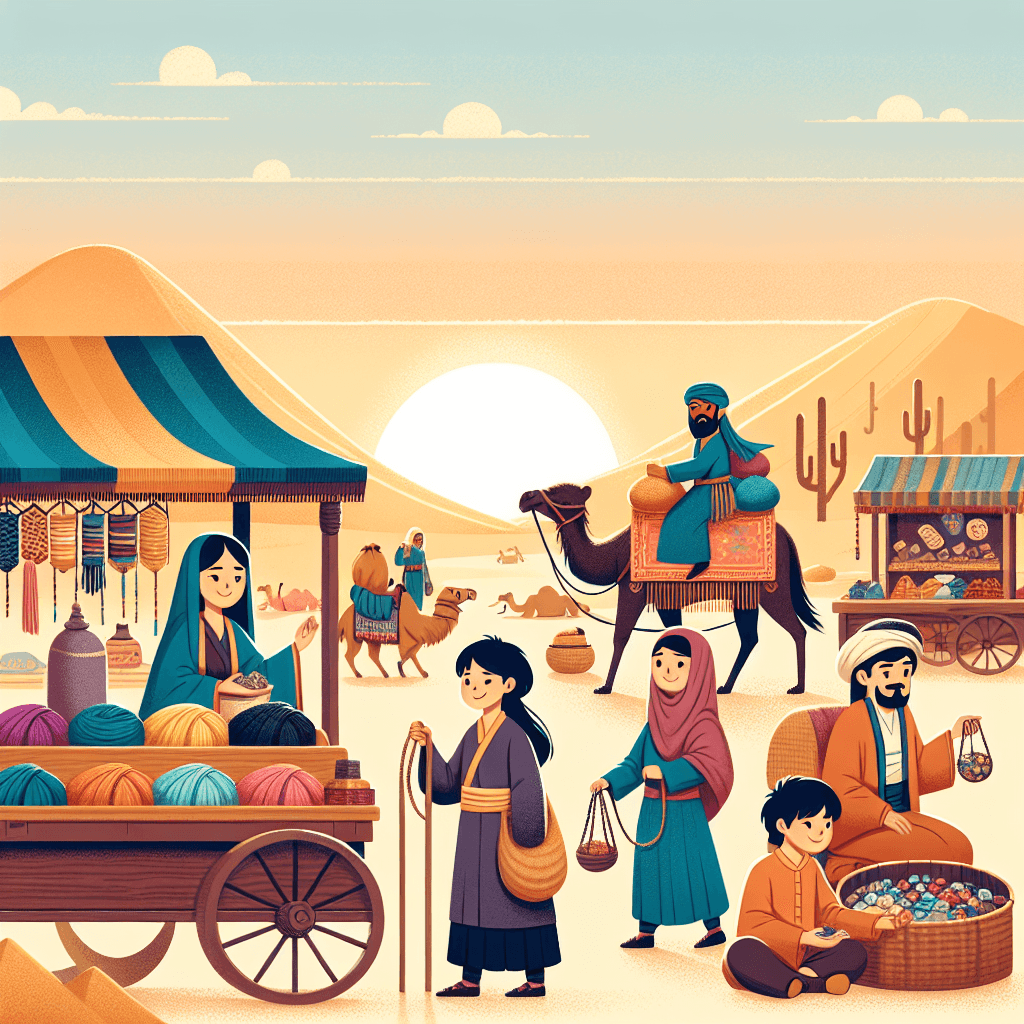
Silk Road Traders: A Quest for Commerce
Inquiry Framework
Question Framework
Driving Question
The overarching question that guides the entire project.How did the exchange of goods, ideas, and culture along the Silk Road transform the societies and landscapes it connected, and what challenges did traders face in this process?Essential Questions
Supporting questions that break down major concepts.- What were the major trade goods along the Silk Road, and what made them valuable?
- How did geographical factors influence trade routes and the goods exchanged?
- What were the cultural impacts of the Silk Road?
- How did different societies along the Silk Road benefit from or adapt to trade?
- In what ways did trade along the Silk Road lead to exchange of ideas, technologies, and artistic styles?
- What were the risks and challenges associated with traveling and trading on the Silk Road, and how did traders mitigate these?
- How did the Silk Road contribute to the development of cities and empires?
- How did the decline of the Silk Road impact the societies that depended on it?
Standards & Learning Goals
Learning Goals
By the end of this project, students will be able to:- Understand the main goods traded along the Silk Road and their value.
- Analyze the impact of geographical factors on trade routes.
- Evaluate the cultural effects of the Silk Road.
- Assess how different societies benefited from or adapted to trade.
- Investigate the exchange of ideas, technologies and artistic styles.
- Identify the risks and challenges of Silk Road trade and how traders dealt with them.
- Explain the Silk Road's contribution to the growth of cities and empires.
- Analyze the effects of the Silk Road's decline on dependent societies.
Entry Events
Events that will be used to introduce the project to studentsThe Silk Road Marketplace
The class is transformed into a bustling Silk Road marketplace, complete with themed decorations and simulated trading posts. Students assume the roles of merchants from different regions, each with unique goods and trading objectives, fostering competition and collaboration as they navigate the challenges of supply and demand.The Recreated Journey
An anonymous benefactor challenges students to recreate a famous journey along the Silk Road, but with a twist: they must document their progress through a series of journal entries, artistic renderings, and multimedia presentations, showcasing their understanding of the historical context and cultural exchange.Portfolio Activities
Portfolio Activities
These activities progressively build towards your learning goals, with each submission contributing to the student's final portfolio.Silk Road Merchant Profile
Students will research and create a merchant profile detailing their origin, goods traded, and the value of those goods in different regions.Steps
Here is some basic scaffolding to help students complete the activity.Final Product
What students will submit as the final product of the activityA detailed merchant profile presented as a character card, including origin, goods, and trade values.Alignment
How this activity aligns with the learning objectives & standardsAddresses the learning goal: Understand the main goods traded along the Silk Road and their value.Mapping the Challenges
Students will analyze maps of the Silk Road to identify geographical challenges and how traders adapted to them.Steps
Here is some basic scaffolding to help students complete the activity.Final Product
What students will submit as the final product of the activityA map analysis report detailing geographical challenges and adaptations made by traders.Alignment
How this activity aligns with the learning objectives & standardsAddresses the learning goal: Analyze the impact of geographical factors on trade routes.Cultural Crossroads
Students will research and present on the cultural exchange that occurred along the Silk Road, focusing on the spread of religions, languages, and artistic styles.Steps
Here is some basic scaffolding to help students complete the activity.Final Product
What students will submit as the final product of the activityA presentation (e.g., slideshow, video) showcasing the cultural exchange along the Silk Road.Alignment
How this activity aligns with the learning objectives & standardsAddresses the learning goal: Evaluate the cultural effects of the Silk Road.Societal Case Study
Students will select a specific society along the Silk Road and investigate how it benefited from or adapted to trade, considering economic, social, and political impacts.Steps
Here is some basic scaffolding to help students complete the activity.Final Product
What students will submit as the final product of the activityA case study report on a selected society, detailing its benefits and adaptations related to Silk Road trade.Alignment
How this activity aligns with the learning objectives & standardsAddresses the learning goal: Assess how different societies benefited from or adapted to trade.Innovation Timeline
Students will investigate the spread of a specific idea, technology, or artistic style along the Silk Road, tracing its origin, dissemination, and impact on different cultures.Steps
Here is some basic scaffolding to help students complete the activity.Final Product
What students will submit as the final product of the activityAn interactive timeline showcasing the spread of an idea, technology, or artistic style.Alignment
How this activity aligns with the learning objectives & standardsAddresses the learning goal: Investigate the exchange of ideas, technologies and artistic styles.Silk Road Survival Guide
Students will research the various risks and challenges faced by traders on the Silk Road, such as bandits, weather, and disease, and explore the strategies they used to mitigate these risks.Steps
Here is some basic scaffolding to help students complete the activity.Final Product
What students will submit as the final product of the activityA survival guide for Silk Road traders, outlining the risks and strategies for overcoming them.Alignment
How this activity aligns with the learning objectives & standardsAddresses the learning goal: Identify the risks and challenges of Silk Road trade and how traders dealt with them.Cities & Empires
Students will examine how the Silk Road contributed to the growth and prosperity of cities and empires along its routes, focusing on economic, political, and cultural factors.Steps
Here is some basic scaffolding to help students complete the activity.Final Product
What students will submit as the final product of the activityA comparative analysis of two cities or empires, highlighting the Silk Road's impact on their growth.Alignment
How this activity aligns with the learning objectives & standardsAddresses the learning goal: Explain the Silk Road's contribution to the growth of cities and empires.The Fading Road
Students will investigate the decline of the Silk Road and its impact on societies that had become dependent on it, considering economic, social, and political consequences.Steps
Here is some basic scaffolding to help students complete the activity.Final Product
What students will submit as the final product of the activityA documentary-style video exploring the decline of the Silk Road and its consequences on dependent societies.Alignment
How this activity aligns with the learning objectives & standardsAddresses the learning goal: Analyze the effects of the Silk Road's decline on dependent societies.Rubric & Reflection
Portfolio Rubric
Grading criteria for assessing the overall project portfolioSilk Road Merchant Profile Rubric
Merchant Profile Creation
Focuses on the student's ability to accurately research, clearly articulate, and creatively present a merchant profile relevant to Silk Road trade.Accuracy of Information
Accuracy of Information: How accurately and thoroughly does the profile represent the origin, production, and demand for the chosen good?
Exemplary
4 PointsDemonstrates exceptional accuracy and depth of understanding regarding the origin, production, and demand for the chosen good. Shows innovative insights and goes beyond basic information.
Proficient
3 PointsDemonstrates accurate and thorough understanding of the origin, production, and demand for the chosen good.
Developing
2 PointsShows emerging understanding of the origin, production, and demand for the chosen good, with some inaccuracies or omissions.
Beginning
1 PointsShows initial understanding of the origin, production, and demand for the chosen good, but contains significant inaccuracies or lacks essential details.
Clarity and Detail of Merchant Profile
Clarity and Detail of Merchant Profile: How clearly and comprehensively does the merchant profile detail the merchant's origin, goods traded, and trade values?
Exemplary
4 PointsPresents a highly detailed and exceptionally clear merchant profile, creatively showcasing the merchant's origin, goods traded, and trade values with innovative flair.
Proficient
3 PointsPresents a detailed and clear merchant profile, showcasing the merchant's origin, goods traded, and trade values effectively.
Developing
2 PointsPresents a merchant profile with some details about the merchant's origin, goods traded, and trade values, but clarity is lacking in some areas.
Beginning
1 PointsPresents a vague and incomplete merchant profile with minimal details about the merchant's origin, goods traded, and trade values.
Presentation Quality
Presentation Quality: How well is the merchant profile presented as a character card, including visual appeal and organization?
Exemplary
4 PointsThe character card is visually stunning and exceptionally well-organized, demonstrating sophisticated design principles and enhancing the overall impact.
Proficient
3 PointsThe character card is visually appealing and well-organized, enhancing the overall presentation.
Developing
2 PointsThe character card is adequately presented, but lacks visual appeal or has some organizational issues.
Beginning
1 PointsThe character card is poorly presented, lacking visual appeal and organization.