
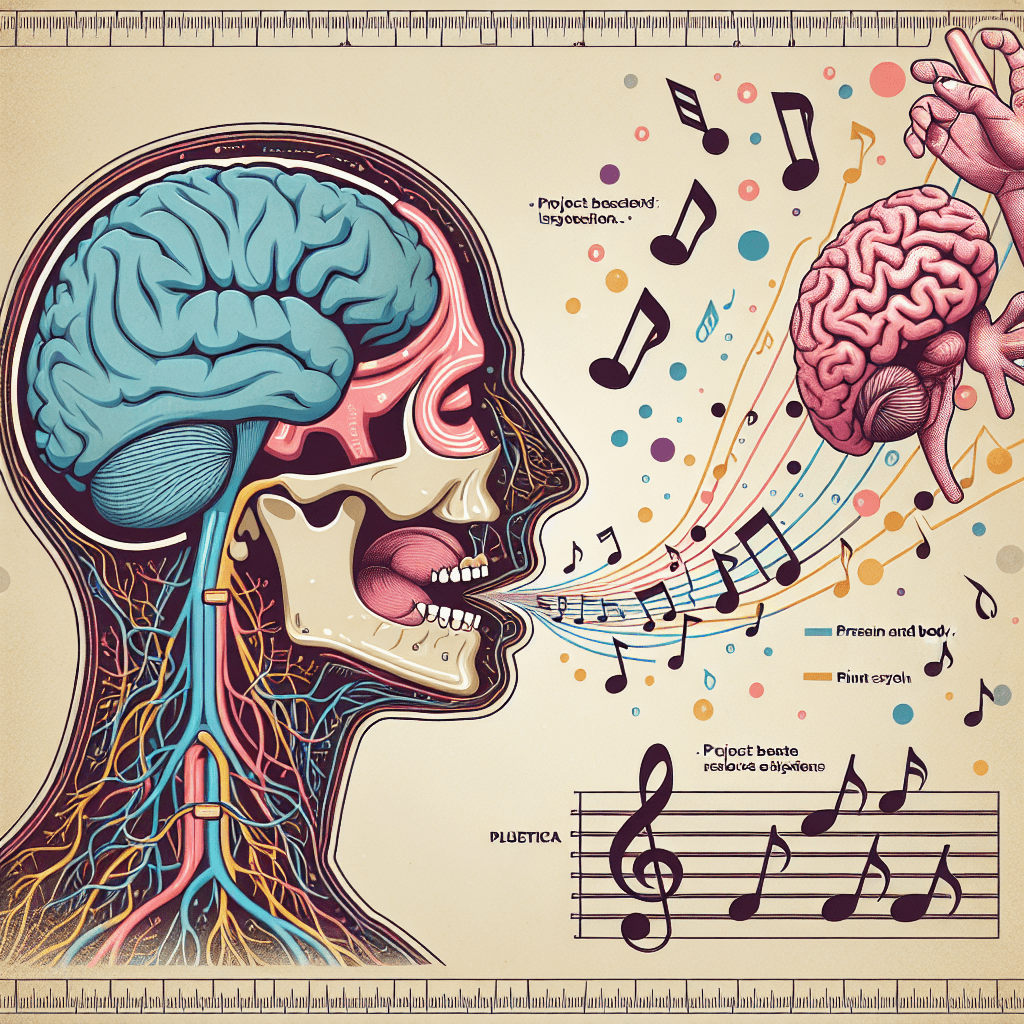
Sing the Systems: Brain and Body in Action
Inquiry Framework
Question Framework
Driving Question
The overarching question that guides the entire project.How can we creatively use music and movement to explain the complex interactions between human body systems and the brain in a way that enhances both understanding and engagement?Essential Questions
Supporting questions that break down major concepts.- How do different human body systems interact to support overall health and function?
- What are the main functions of the brain and its different parts?
- How can music and movement enhance our understanding of complex scientific concepts?
- In what ways can creative expression be used to communicate scientific knowledge?
Standards & Learning Goals
Learning Goals
By the end of this project, students will be able to:- Students will understand and explain the interactions between different human body systems and the functions of various parts of the brain.
- Students will demonstrate their understanding of human anatomy through creating lyrics that describe how the body systems and brain functions work.
- Students will enhance their learning and engagement by creatively using music and movement to illustrate scientific concepts.
- Students will collaborate in groups to create a cohesive musical performance that communicates scientific content effectively.
Next Generation Science Standards
Common Core Standards
National Science Education Standards
Entry Events
Events that will be used to introduce the project to studentsThe Body Harmony Concert Challenge
Students enter the classroom to find it transformed into a concert venue, complete with stage lights and music equipment. A guest speaker, who is a musician and science enthusiast, introduces the concert challenge: creating a song about the human body systems and performing it at a school event. This event taps into students' creative, musical, and scientific interests while providing an authentic and engaging entry into the project.Portfolio Activities
Portfolio Activities
These activities progressively build towards your learning goals, with each submission contributing to the student's final portfolio.Song Lyric Composer
Students write creative lyrics for a song about human body systems and brain functions, enhancing their understanding of anatomy through poetic expression.Steps
Here is some basic scaffolding to help students complete the activity.Final Product
What students will submit as the final product of the activityCompleted song lyrics that accurately and creatively describe human body systems and brain functions.Alignment
How this activity aligns with the learning objectives & standardsAligns with 5-PS3-1 and CCSS.ELA-LITERACY.CCRA.SL.5 as students use language to describe scientific concepts and enhance understanding through music.Musical Movement & Prop Design
Students design movements and create props to accompany their song, using these elements to deepen understanding of human body systems and brain functions.Steps
Here is some basic scaffolding to help students complete the activity.Final Product
What students will submit as the final product of the activityChoreographed movements and crafted props that complement the lyrics and performance theme.Alignment
How this activity aligns with the learning objectives & standardsSupports CCSS.ELA-LITERACY.CCRA.SL.5 as students use creative expression to enhance understanding of presentations.Rehearsal & Feedback Loop
Students rehearse their performances, incorporating teacher and peer feedback to refine and enhance their understanding and presentation.Steps
Here is some basic scaffolding to help students complete the activity.Final Product
What students will submit as the final product of the activityA refined musical performance ready for presentation at the school event.Alignment
How this activity aligns with the learning objectives & standardsAligns with NS.5-8.3 and CCSS.ELA-LITERACY.CCRA.SL.5 as students apply feedback to improve informational and expressive accuracy.Rubric & Reflection
Portfolio Rubric
Grading criteria for assessing the overall project portfolioCreative Expression in Science
Scientific Understanding
Assess the depth of comprehension of human body systems and brain functions as evidenced in the lyrics and performance.Accuracy of Information
Measure how accurately the lyrics describe the scientific concepts relating to body systems and brain functions.
Exemplary
4 PointsLyrics offer a detailed and nuanced description of body systems and brain functions, reflecting deep understanding and accurate scientific information.
Proficient
3 PointsLyrics correctly describe body systems and brain functions, showing competent understanding and adherence to scientific facts.
Developing
2 PointsLyrics provide a basic description of body systems and brain functions, with some inaccuracies in scientific information.
Beginning
1 PointsLyrics contain several inaccuracies or misconceptions about body systems and brain functions.
Integration of Concepts
Evaluate how creatively and accurately the scientific concepts are woven into the song.
Exemplary
4 PointsScientific concepts are seamlessly integrated into the song with creativity, enhancing both educational value and artistic appeal.
Proficient
3 PointsScientific concepts are well-integrated into the song, maintaining a good balance between educational content and musical elements.
Developing
2 PointsThere is an attempt to integrate scientific concepts into the song, although somewhat lacking in creativity or coherence.
Beginning
1 PointsScientific concepts are poorly integrated, resulting in a disjointed song with little educational value.
Creative Expression
Examine the use of music, movement, and props to enhance understanding of human body systems and brain functions.Musicality and Rhythmic Expression
Assess the song's rhythmic quality and how effectively it uses musical elements to convey scientific concepts.
Exemplary
4 PointsSong employs rhythmic and musical elements in an innovative way, perfectly aligning with the scientific content to enhance understanding.
Proficient
3 PointsSong effectively uses rhythm and musical elements to convey scientific concepts, contributing to understanding.
Developing
2 PointsSong uses basic rhythmic and musical elements, with some influence on scientific understanding.
Beginning
1 PointsSong displays minimal use of musical elements, with little impact on the communication of scientific concepts.
Movement and Prop Use
Evaluate the effectiveness of movements and props in representing scientific concepts during the performance.
Exemplary
4 PointsMovements and props are thoughtfully chosen and executed to clearly and creatively represent scientific concepts.
Proficient
3 PointsMovements and props are well-selected and support the representation of scientific concepts effectively.
Developing
2 PointsSome effective movements and props are used, but choices may lack consistency or clarity.
Beginning
1 PointsMovements and props are ineffective or haphazardly chosen, adding little to the representation of scientific concepts.
Collaboration and Reflection
Focus on the process of working together in groups and incorporating feedback to improve the performance.Collaboration Skills
Assess the ability to work effectively within a group to achieve common goals.
Exemplary
4 PointsDemonstrates leadership and contributes significantly to group discussions and the overall project outcome.
Proficient
3 PointsActively participates in group efforts, contributing to discussions and project completion.
Developing
2 PointsParticipates in group efforts with some prompting, limited contribution to discussions.
Beginning
1 PointsRarely participates in group efforts or discussions, providing little to no contribution.
Reflection and Improvement
Evaluate how students use feedback to improve their understanding and performance.
Exemplary
4 PointsConsistently seeks, applies feedback constructively, makes thoughtful adjustments to improve understanding and presentation.
Proficient
3 PointsApplies feedback constructively and makes adjustments to improve understanding and presentation.
Developing
2 PointsMakes minimal adjustments based on feedback, limited improvements in understanding or presentation.
Beginning
1 PointsDoes not apply feedback constructively, resulting in little to no improvement.