
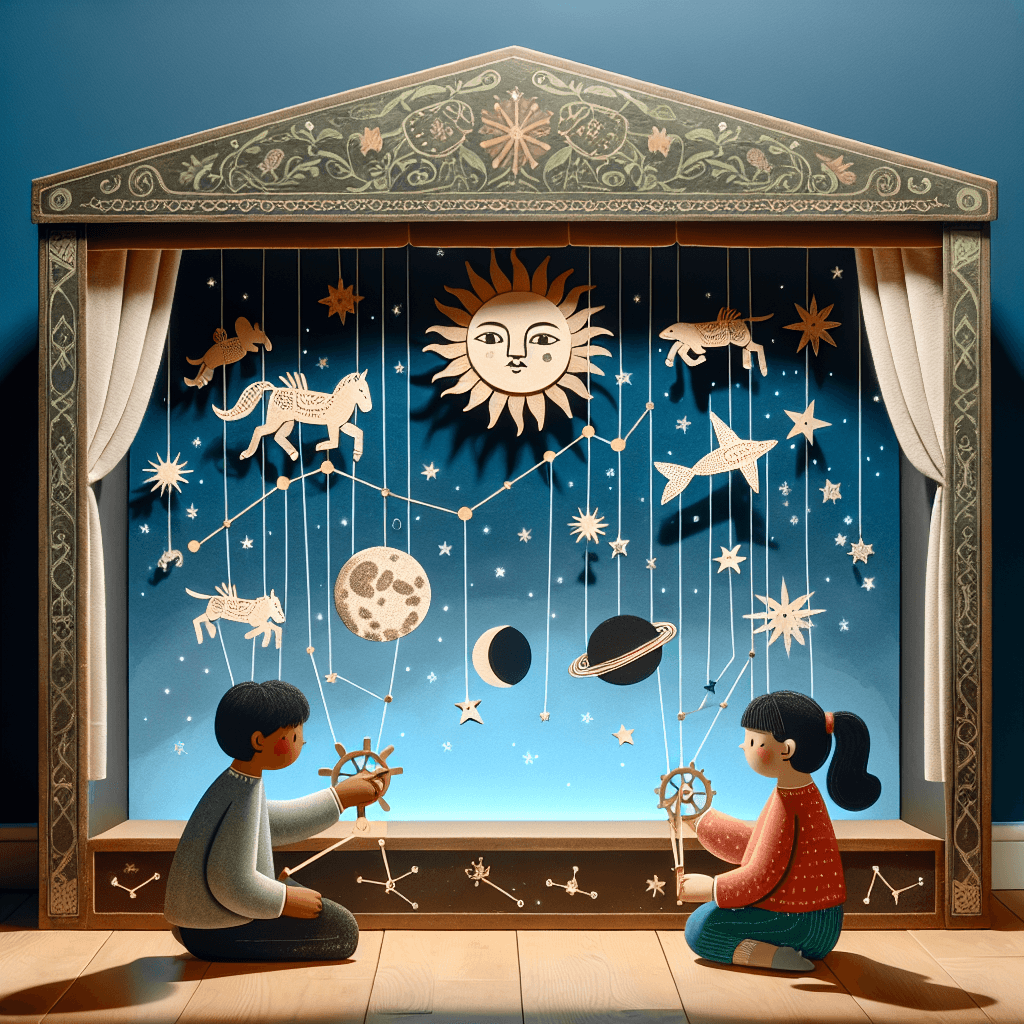
Sky Storytellers: Shadow Puppet Patterns Through the Seasons
Inquiry Framework
Question Framework
Driving Question
The overarching question that guides the entire project.How can we, as sky storytellers, design shadow puppets and stories to show how the patterns of the sun and moon change our world throughout the four seasons?Essential Questions
Supporting questions that break down major concepts.- What patterns do we see in the position of the sun and the shape of the moon over time?
- How does the amount of daylight and the temperature change from summer to winter?
- How can we use numbers and measurement to compare the length of shadows and the hours of daylight?
- How does light interact with objects to create shadows of different shapes and sizes?
- How can we use a story structure (beginning, middle, and end) to explain a scientific change?
- How do the changes in the sky and the seasons affect the way people live, dress, and play?
Standards & Learning Goals
Learning Goals
By the end of this project, students will be able to:- Students will observe and record patterns of the sun and moon to predict future movements and seasonal positions.
- Students will analyze data to explain the relationship between the time of year, the amount of daylight, and relative temperature.
- Students will conduct investigations to understand how shadows are formed and how their size/shape changes based on the position of a light source.
- Students will use measurement tools and data representation to compare lengths of shadows or daylight hours across different seasons.
- Students will write a structured narrative for their shadow puppet show that includes a clear beginning, middle, and end.
- Students will construct functional shadow puppets and sets to communicate scientific concepts through artistic performance.
- Students will explain how human behaviors, such as clothing choices and activities, adapt to the seasonal patterns observed in the sky.
Next Generation Science Standards (NGSS)
Common Core State Standards for ELA
Common Core State Standards for Math
College, Career, and Civic Life (C3) Framework for Social Studies State Standards
National Core Arts Standards
Entry Events
Events that will be used to introduce the project to studentsThe Traveler’s Seasonal Suitcase Muddle
Students arrive to find a 'Season Suitcase' delivered by a confused traveler who packed a heavy coat for a 7:00 PM sunset and a swimsuit for a 4:00 PM sunset. Students must use 'Sky Storytelling' to teach the traveler how the amount of daylight and the temperature are connected to the sun’s journey across the sky in different seasons.The Sun and Moon’s 'Work Schedule' Dispute
Students receive a formal, slightly 'grumpy' letter from the Sun and the Moon. The Sun complains about working too many hours in the summer and feeling rushed in the winter, while the Moon is confused about why it sometimes appears during the day, challenging students to explain their 'work schedules' through a shadow performance.The Case of the Shrinking Shadows
The teacher transforms the classroom into a dark 'Sky Laboratory' where a mysterious flashlight shines on a rotating globe, creating long and short shadows. Students are given 'Shadow Detective' badges and must figure out why the shadows of the same objects change length and direction, leading to a discussion on how the sun’s position dictates our daily and seasonal lives.Portfolio Activities
Portfolio Activities
These activities progressively build towards your learning goals, with each submission contributing to the student's final portfolio.The Daily Sky Watcher’s Log
To become master storytellers, students must first understand the patterns of the characters in their story: the Sun and the Moon. In this activity, students become 'Sky Observers,' tracking where the sun is at different times of the school day and observing the moon's shape over several evenings. They will use a specialized journal to sketch their observations, noting that the sun 'travels' across the sky and the moon changes its look.Steps
Here is some basic scaffolding to help students complete the activity.Final Product
What students will submit as the final product of the activityA 'Sky Watcher’s Log' containing sketches of the sun’s path (Morning, Noon, Afternoon) and a week-long moon phase tracker.Alignment
How this activity aligns with the learning objectives & standardsThis activity aligns with NGSS 1-ESS1-1, as students are observing and recording the sun's position and the moon's appearance to identify predictable patterns over time.The Sun’s Work Schedule Chart
How does the Sun’s 'work schedule' change throughout the year? In this activity, students use data strips to represent daylight hours in Summer, Fall, Winter, and Spring. They will color-code hours of light (yellow) and hours of darkness (blue) to see why we have more time to play outside in the summer and why it gets dark so early in the winter. They will also match temperature 'feeling' words to each season.Steps
Here is some basic scaffolding to help students complete the activity.Final Product
What students will submit as the final product of the activityA 'Seasonal Daylight Comparison Chart' using color-coded strips and temperature icons to show the relationship between daylight, heat, and the time of year.Alignment
How this activity aligns with the learning objectives & standardsThis activity aligns with NGSS 1-ESS1-2 and Math standard 1.MD.C.4. Students relate the amount of daylight and temperature to the time of year while organizing data into categories to compare differences.Shadow Shape-Shifters Lab
Before building the puppets, students must master the science of shadows. In the 'Sky Lab,' students will use flashlights (representing the Sun) and simple blocks to see how shadows are made. They will move the flashlight from low to high and side to side to see how the 'Sun’s position' in the sky changes the length and direction of the shadows on the ground.Steps
Here is some basic scaffolding to help students complete the activity.Final Product
What students will submit as the final product of the activityA 'Shadow Secret' Poster that illustrates three rules: how to make a shadow bigger, how to make it longer, and how to make it disappear.Alignment
How this activity aligns with the learning objectives & standardsThis activity aligns with NGSS 1-PS4-3, as students investigate how placing opaque objects in front of a light source creates shadows and how the angle of that light changes the shadow's properties.The Seasonal Suitcase Fixer
The traveler from the entry event still needs help! In this activity, students connect their knowledge of sky patterns to human behavior. They will sort clothing items, tools (like umbrellas or sunglasses), and activities (like sledding or swimming) into the four seasons based on the amount of sun and the temperature they previously studied.Steps
Here is some basic scaffolding to help students complete the activity.Final Product
What students will submit as the final product of the activityA 'Seasonal Suitcase Guide'—a foldable brochure that recommends what to wear and do based on the sun's patterns in each season.Alignment
How this activity aligns with the learning objectives & standardsThis activity aligns with Social Studies standard D2.Geo.2.K-2 by identifying how environmental characteristics (the seasons/sky patterns) affect human life and culture.Scripting the Sky Story
Every great shadow show needs a script! Students will now draft the story for their performance. The story must follow a character (like a tree or a child) through the four seasons, describing how the sun and moon look in the sky and what the character does in response. They will focus on using 'order words' like First, Next, and Finally.Steps
Here is some basic scaffolding to help students complete the activity.Final Product
What students will submit as the final product of the activityA 'Sky Story' Storyboard featuring three scenes with a written script at the bottom of each panel.Alignment
How this activity aligns with the learning objectives & standardsThis activity aligns with ELA standard W.1.3. Students write a sequenced narrative with a beginning, middle, and end, using temporal words and including scientific details about the seasons.The Great Sky Storyteller Performance
It's time for the grand finale! Students will build their shadow box stage using a cardboard box and parchment paper. They will then design and cut out shadow puppets (opaque cardstock) for their characters, the sun, and the moon. Finally, they will perform their 'Sky Story' for an audience, using their flashlights to recreate the seasonal patterns they’ve learned.Steps
Here is some basic scaffolding to help students complete the activity.Final Product
What students will submit as the final product of the activityThe 'Sky Storyteller’s Shadow Box' and a live puppet performance narrated by the student.Alignment
How this activity aligns with the learning objectives & standardsThis activity aligns with Arts standard VA:Cr2.1.1a and serves as the cumulative project. Students use tools and materials to create a functional work of art that communicates their scientific findings.Rubric & Reflection
Portfolio Rubric
Grading criteria for assessing the overall project portfolioThe Sky Storyteller's Shadow Box Rubric
Scientific Inquiry & Math Foundation
Measures the student's ability to track celestial movements and interpret seasonal data.Patterns and Data Analysis
Accuracy of sky observations and the ability to represent seasonal data through the daylight comparison chart.
Exemplary
4 PointsSketches are highly detailed with clear landmarks; daylight chart is perfectly colored and the student provides insightful comparisons between seasons and temperatures.
Proficient
3 PointsSketches accurately show the sun's path; daylight chart is mostly correct and identifies which season has more light and is colder.
Developing
2 PointsSketches show the sun in different spots but lack landmarks; daylight chart has some errors in coloring or counting.
Beginning
1 PointsSketches are incomplete; daylight chart is not filled out or comparison questions are not answered.
Light & Shadow Investigation
Assesses the investigation of physical science concepts related to light and shadow.Shadow Mechanics and Light Properties
Understanding how light placement creates shadows and how the angle of light changes shadow length and shape.
Exemplary
4 PointsClearly explains and demonstrates how moving the 'sun' high or low changes shadow length; 'Shadow Secret' poster is comprehensive and accurate.
Proficient
3 PointsDemonstrates how to make a shadow bigger or longer and correctly identifies the difference between morning and noon shadows.
Developing
2 PointsCan make a shadow with a flashlight but struggles to explain why the shadow length changes with the angle.
Beginning
1 PointsStruggles to create a shadow or follow the arc movement; cannot describe the relationship between light and shadow.
Narrative & Communication
Evaluates the student's narrative writing and logical flow of information.Story Structure and Sequencing
The ability to sequence events and use temporal words to describe seasonal changes in a story format.
Exemplary
4 PointsThe script features a compelling story with a clear B/M/E, sophisticated use of temporal words, and deep integration of scientific facts.
Proficient
3 PointsThe storyboard follows a logical sequence (First, Next, Last) and describes seasonal changes accurately.
Developing
2 PointsThe story has some sequence but may be missing a clear middle or end; temporal words are used inconsistently.
Beginning
1 PointsThe story is disjointed or missing scenes; no clear use of order words to show time passing.
Real-World Application
Focuses on the social studies aspect of how people adapt to their environment.Environmental Adaptation Connections
Ability to connect seasonal sky patterns to human choices in clothing and activities.
Exemplary
4 PointsProvides complex reasons for seasonal gear choices, linking them specifically to daylight hours and temperature patterns.
Proficient
3 PointsCorrectly sorts gear for all four seasons and writes clear sentences explaining the 'why' behind the choices.
Developing
2 PointsSorts most gear correctly but has difficulty explaining the relationship between the sun's patterns and the activity.
Beginning
1 PointsGear is sorted incorrectly or without regard for the seasons; cannot explain why we wear different clothes.
Artistic Design & Technical Skill
Evaluates the artistic construction and the student's ability to perform their scientific narrative.Technical Design and Performance
Skill in using materials to build the shadow box and puppets, and the effectiveness of the final performance.
Exemplary
4 PointsBox and puppets are exceptionally sturdy and creative; performance perfectly mimics the sun’s seasonal path through light manipulation.
Proficient
3 PointsConstructs a functional shadow box and opaque puppets; performs the script while successfully using the light source to create shadows.
Developing
2 PointsShadow box or puppets are fragile or partially functional; performance is hesitant or light source is used incorrectly.
Beginning
1 PointsThe shadow box is not completed; puppets do not create clear shadows; no performance is given.