
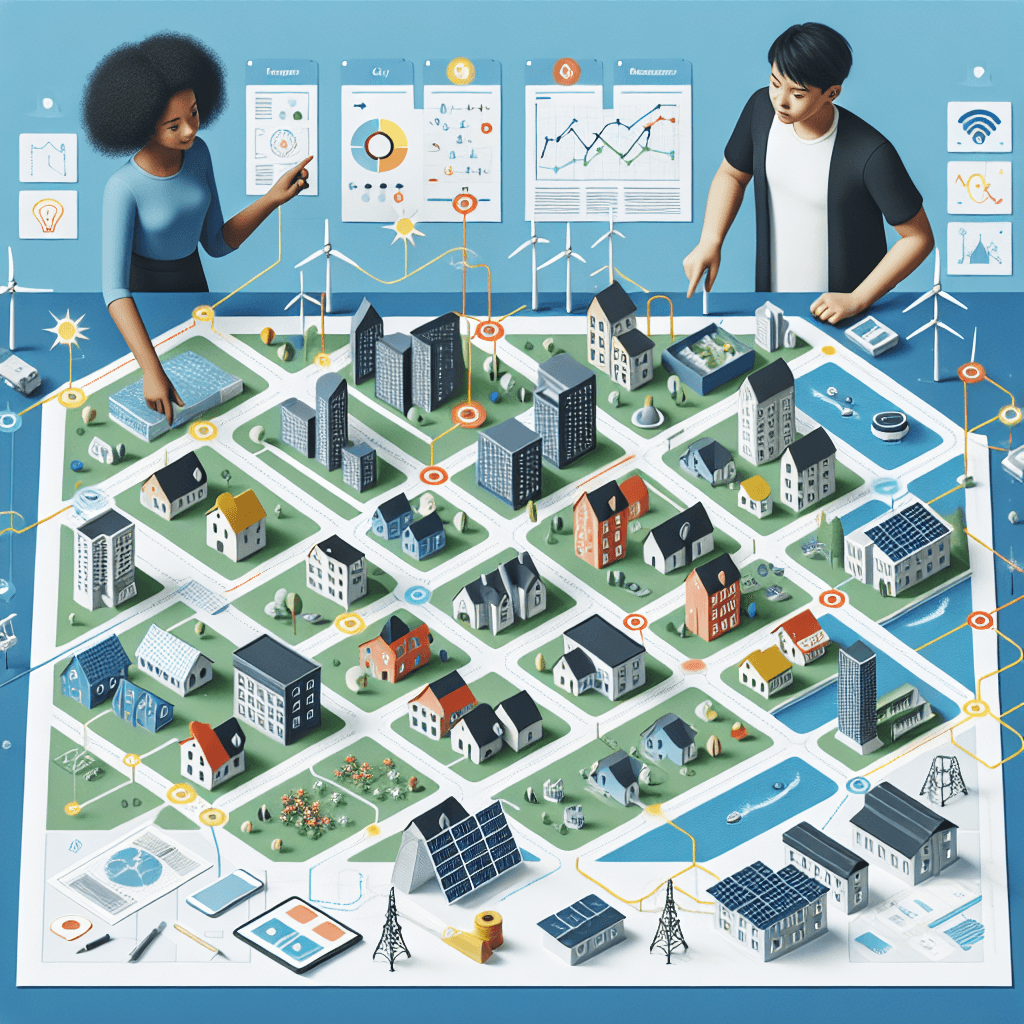
Smart City Energy Grid Design
Inquiry Framework
Question Framework
Driving Question
The overarching question that guides the entire project.How can we design a smart city energy grid that maximizes renewable energy integration and minimizes energy waste, while addressing the unique challenges and opportunities of urban implementation?Essential Questions
Supporting questions that break down major concepts.- How can smart grids improve energy efficiency and reduce waste in a city?
- What are the key components of a smart city energy grid, and how do they interact?
- How can renewable energy sources be integrated effectively into a smart city energy grid?
- What are the challenges and opportunities in implementing smart grid technologies in urban environments?
- How can data analytics and IoT devices be used to optimize energy distribution and consumption in a smart city?
Standards & Learning Goals
Learning Goals
By the end of this project, students will be able to:- Students will be able to design a smart city energy grid model.
- Students will be able to explain how smart grids improve energy efficiency.
- Students will be able to identify the key components of a smart city energy grid.
- Students will be able to describe how renewable energy sources can be integrated into a smart city energy grid.
Entry Events
Events that will be used to introduce the project to students"The Blackout Challenge"
A simulated city-wide blackout plunges students into darkness. They must analyze the cascading effects, identify vulnerabilities in the existing grid, and propose immediate solutions using limited resources, sparking urgent inquiry into resilient energy systems.Portfolio Activities
Portfolio Activities
These activities progressively build towards your learning goals, with each submission contributing to the student's final portfolio.Smart Grid Blueprint
Students will create a detailed blueprint of their smart city energy grid model, labeling all key components and energy flow pathways.Steps
Here is some basic scaffolding to help students complete the activity.Final Product
What students will submit as the final product of the activityA comprehensive blueprint of the smart city energy grid model, including labeled components and energy flow pathways.Alignment
How this activity aligns with the learning objectives & standardsAddresses learning goals related to designing a smart city energy grid model and identifying key components of a smart city energy grid.Renewable Energy Integration Report
Students will write a report detailing how renewable energy sources are integrated into their smart city energy grid, explaining the benefits and challenges of each source.Steps
Here is some basic scaffolding to help students complete the activity.Final Product
What students will submit as the final product of the activityA detailed report on renewable energy integration into the smart city energy grid, including analysis of benefits and challenges.Alignment
How this activity aligns with the learning objectives & standardsAddresses learning goals related to describing how renewable energy sources can be integrated into a smart city energy grid.Energy Efficiency Optimization Plan
Students will develop a plan to optimize energy efficiency and reduce waste in their smart city energy grid, using data analytics and IoT devices.Steps
Here is some basic scaffolding to help students complete the activity.Final Product
What students will submit as the final product of the activityA comprehensive plan to optimize energy efficiency and reduce waste in the smart city energy grid, using data analytics and IoT devices.Alignment
How this activity aligns with the learning objectives & standardsAddresses learning goals related to explaining how smart grids improve energy efficiency.Rubric & Reflection
Portfolio Rubric
Grading criteria for assessing the overall project portfolioSmart City Energy Grid Portfolio Rubric
Smart Grid Blueprint Design
Evaluates the clarity, accuracy, and completeness of the smart city energy grid blueprint, including the identification and labeling of key components and energy flow pathways.Component Identification & Labeling
Accuracy and completeness of identifying and labeling key smart grid components (sensors, smart meters, substations, renewable energy sources, control systems).
Exemplary
4 PointsAll components are correctly identified and clearly labeled with detailed annotations.
Proficient
3 PointsMost components are correctly identified and labeled with sufficient annotations.
Developing
2 PointsSome components are identified and labeled, but accuracy or completeness is lacking.
Beginning
1 PointsFew components are identified or labeled, and there are significant inaccuracies.
Energy Flow Pathways
Clarity and accuracy of indicating energy flow pathways with arrows and annotations.
Exemplary
4 PointsEnergy flow pathways are clearly and accurately depicted with detailed annotations explaining the flow of energy throughout the grid.
Proficient
3 PointsEnergy flow pathways are generally clear and accurate with sufficient annotations.
Developing
2 PointsEnergy flow pathways are partially depicted, but clarity or accuracy is lacking.
Beginning
1 PointsEnergy flow pathways are poorly depicted or inaccurate.
Blueprint Completeness & Organization
Overall completeness and organization of the blueprint, including clarity and visual appeal.
Exemplary
4 PointsBlueprint is exceptionally complete, well-organized, and visually appealing, demonstrating a thorough understanding of smart grid design.
Proficient
3 PointsBlueprint is complete, well-organized, and visually clear.
Developing
2 PointsBlueprint is partially complete or lacks organization, making it difficult to understand.
Beginning
1 PointsBlueprint is incomplete, disorganized, and difficult to interpret.
Renewable Energy Integration Report
Assesses the depth of research, analysis, and recommendations for integrating renewable energy sources into the smart city energy grid.Renewable Energy Source Selection
Appropriateness and justification of selected renewable energy sources for an urban environment.
Exemplary
4 PointsSelected renewable energy sources are highly appropriate for the urban environment, and the justification is comprehensive and well-supported.
Proficient
3 PointsSelected renewable energy sources are appropriate for the urban environment, and the justification is clear and supported.
Developing
2 PointsSelected renewable energy sources are somewhat appropriate, but the justification is weak or incomplete.
Beginning
1 PointsSelected renewable energy sources are inappropriate for the urban environment, and the justification is lacking.
Integration Strategies & Analysis
Depth and clarity of describing how renewable energy sources are integrated into the smart city energy grid, including location, infrastructure, and energy storage solutions.
Exemplary
4 PointsIntegration strategies are detailed, innovative, and well-analyzed, demonstrating a deep understanding of renewable energy technologies.
Proficient
3 PointsIntegration strategies are clearly described and analyzed with sufficient detail.
Developing
2 PointsIntegration strategies are vaguely described or lack sufficient analysis.
Beginning
1 PointsIntegration strategies are poorly described or missing.
Benefits & Challenges
Thoroughness and accuracy of analyzing the benefits and challenges of using each renewable energy source in an urban environment.
Exemplary
4 PointsAnalysis of benefits and challenges is exceptionally thorough, insightful, and supported by evidence.
Proficient
3 PointsAnalysis of benefits and challenges is thorough and accurate.
Developing
2 PointsAnalysis of benefits and challenges is superficial or incomplete.
Beginning
1 PointsAnalysis of benefits and challenges is missing or inaccurate.
Energy Efficiency Optimization Plan
Evaluates the effectiveness and feasibility of the plan to optimize energy efficiency and reduce waste in the smart city energy grid using data analytics and IoT devices.Identification of Energy Waste Areas
Accuracy and completeness of identifying potential areas of energy waste in the smart city energy grid.
Exemplary
4 PointsIdentifies all significant areas of energy waste with detailed explanations.
Proficient
3 PointsIdentifies most significant areas of energy waste.
Developing
2 PointsIdentifies some areas of energy waste, but with limited detail.
Beginning
1 PointsFails to identify significant areas of energy waste.
Technology Implementation Plan
Clarity and feasibility of the plan to implement data analytics and IoT devices to monitor and optimize energy consumption.
Exemplary
4 PointsPlan is highly detailed, innovative, and feasible, demonstrating a strong understanding of data analytics and IoT technologies.
Proficient
3 PointsPlan is clear, feasible, and well-organized.
Developing
2 PointsPlan is vague, lacks feasibility, or is poorly organized.
Beginning
1 PointsPlan is missing, unclear, or infeasible.
Quantification of Energy Savings
Accuracy and justification of quantifying the potential energy savings and environmental benefits of the proposed optimization plan.
Exemplary
4 PointsQuantification is highly accurate, well-justified, and supported by data, demonstrating a strong understanding of energy efficiency principles.
Proficient
3 PointsQuantification is accurate and well-justified.
Developing
2 PointsQuantification is inaccurate or lacks sufficient justification.
Beginning
1 PointsQuantification is missing or completely inaccurate.