
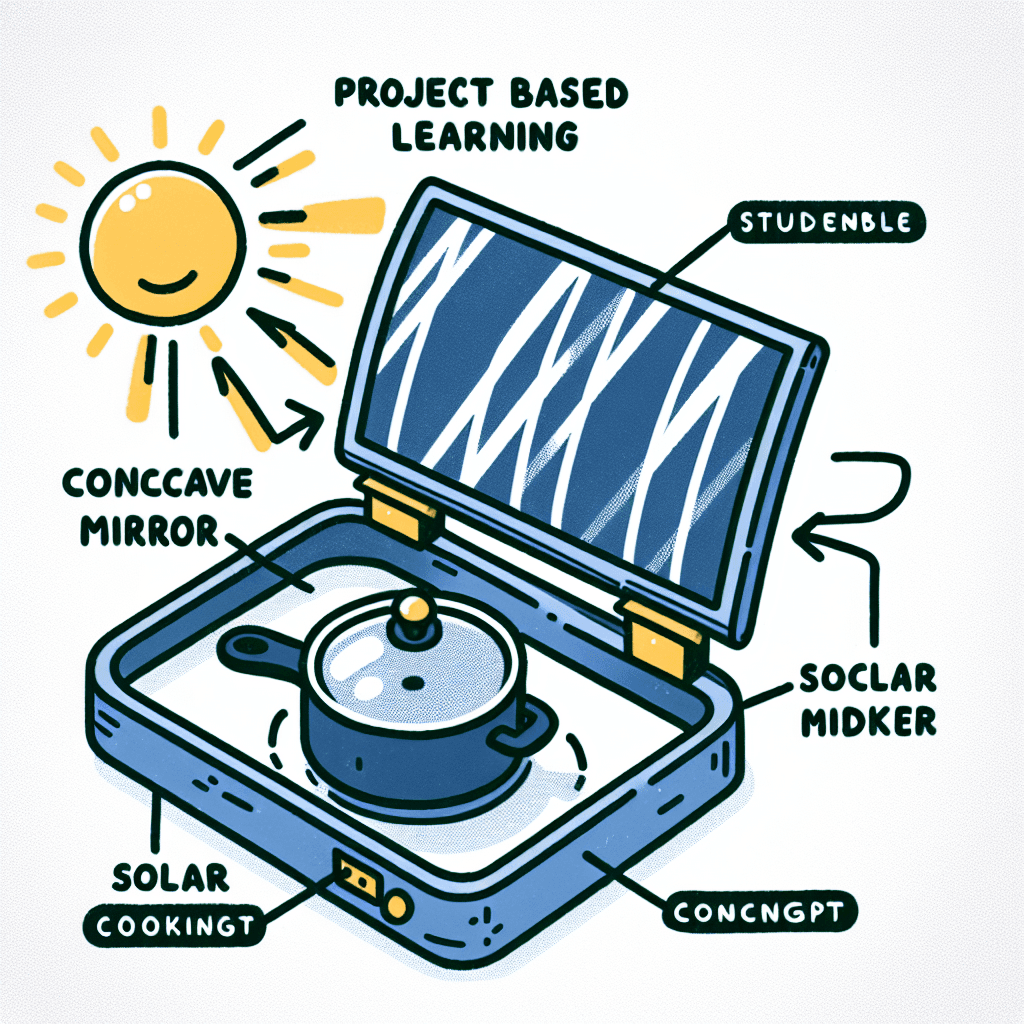
Solar Heat Hero: Designing Portable Concave Mirror Cookers
Inquiry Framework
Question Framework
Driving Question
The overarching question that guides the entire project.How can we apply the science of concave mirrors and light reflection to design an efficient, portable solar cooker for families living in energy-poor regions?Essential Questions
Supporting questions that break down major concepts.- How can we manipulate light rays to transform solar radiation into concentrated thermal energy?
- Why is the focal point of a concave mirror considered the 'sweet spot' for solar cooking, and how can it be calculated?
- How does the curvature of a mirror dictate whether light rays will converge or diverge?
- In what ways can we apply the laws of reflection to design a low-cost, portable solution for families in energy-poor regions?
- How do the properties of concave mirrors differ from convex and plane mirrors when it comes to harnessing energy?
Standards & Learning Goals
Learning Goals
By the end of this project, students will be able to:- Explain the laws of reflection and how they apply specifically to concave and convex surfaces.
- Identify and calculate the focal point of a concave mirror to optimize heat concentration for cooking.
- Apply the engineering design process to build, test, and iterate on a portable solar cooker prototype.
- Compare and contrast the behavior of light rays when interacting with concave versus convex and plane mirrors.
- Evaluate the effectiveness of a solar cooker design based on its ability to increase temperature over a set period using solar energy.
- Discuss the real-world application of solar technology as a sustainable solution for energy poverty.
Next Generation Science Standards (NGSS)
Next Generation Science Standards (NGSS) - Science and Engineering Practices
Common Core State Standards (ELA/Literacy)
Entry Events
Events that will be used to introduce the project to studentsThe Silent Fire Mystery
Students enter to find a single, intense beam of light from a concave mirror melting a chocolate bar or popping popcorn without any visible flame or electricity. This 'silent fire' sparks a debate about how light can be concentrated into heat and why this technology could be a lifesaver for families without access to modern fuels.Portfolio Activities
Portfolio Activities
These activities progressively build towards your learning goals, with each submission contributing to the student's final portfolio.Mission Brief: The Global Energy Detective
Before building, students must understand the 'why.' In this activity, students research energy poverty in specific regions of the world where traditional cooking fuels are scarce or dangerous. They will investigate how solar energy can provide a sustainable alternative and identify the specific needs of families in these regions (e.g., portability, low cost, safety).Steps
Here is some basic scaffolding to help students complete the activity.Final Product
What students will submit as the final product of the activityA digital 'Energy Poverty Profile' or infographic that identifies a target region, the challenges families face with current cooking methods, and a list of design requirements (constraints) for their solar cooker.Alignment
How this activity aligns with the learning objectives & standardsThis activity aligns with CCSS.ELA-LITERACY.WHST.6-8.7 by requiring students to conduct a short research project, and it addresses MS-ETS1-1 by helping students define the human and environmental impact of the design problem.Mirror Magic: The Ray Diagram Lab
Students explore the physics of light by experimenting with plane, convex, and concave mirrors. They will use ray boxes or laser pointers to visualize how light behaves when hitting different curvatures. The goal is to discover which mirror type concentrates energy (converges) versus spreads it out (diverges), which is essential for the solar cooker design.Steps
Here is some basic scaffolding to help students complete the activity.Final Product
What students will submit as the final product of the activityA 'Light Reflection Lab Portfolio' containing three annotated ray diagrams showing the path of incident and reflected rays for plane, convex, and concave mirrors.Alignment
How this activity aligns with the learning objectives & standardsThis activity directly aligns with MS-PS4-2, as students model how light waves are reflected through different materials and surfaces (concave vs. convex).The Sweet Spot Blueprint
Now that students understand how concave mirrors work, they must calculate and plan their specific prototype. Students will determine the radius of curvature for their intended cooker and use the formula (F = R/2) to find the 'sweet spot' where their cooking vessel must be placed to receive maximum thermal energy.Steps
Here is some basic scaffolding to help students complete the activity.Final Product
What students will submit as the final product of the activityA technical 'Solar Blueprint' that includes a cross-section drawing of their cooker, the calculated focal point, and a materials list with a budget.Alignment
How this activity aligns with the learning objectives & standardsThis activity aligns with MS-ETS1-1 (defining criteria and constraints) and MS-PS4-2 (modeling wave reflection), specifically focusing on the mathematical application of the focal point.Heat Wave: The Prototype Pitch
Students build their prototypes and take them outdoors (or use a high-powered lamp) to test their efficiency. They will measure the temperature increase of a set amount of water over 20 minutes. After testing, students will analyze their data, compare it with classmates, and propose one specific iteration to improve their design.Steps
Here is some basic scaffolding to help students complete the activity.Final Product
What students will submit as the final product of the activityA 'Performance & Pitch Deck'—a multimedia presentation that includes a time-lapse or photos of the build, a line graph of temperature data, and a persuasive argument for why their design is a viable solution.Alignment
How this activity aligns with the learning objectives & standardsThis activity aligns with MS-ETS1-2 (evaluating competing solutions) and MS-PS4-3.SEP7 (constructing arguments supported by empirical evidence).Rubric & Reflection
Portfolio Rubric
Grading criteria for assessing the overall project portfolioSolar Heat Hero: Concave Mirror Engineering Rubric
Solar Heat Hero Assessment Domains
This category assesses the core scientific and engineering competencies required to design, test, and justify a solar cooker using the properties of concave mirrors.Scientific Modeling: Ray Diagrams (MS-PS4-2)
Accuracy and clarity of ray diagrams for plane, convex, and concave mirrors, illustrating the laws of reflection and the behavior of light rays.
Exemplary
4 PointsDiagrams are impeccably drawn and labeled; demonstrates a sophisticated understanding of incident and reflected rays, the principal axis, and the focal point. Explains the physics of convergence versus divergence with high precision.
Proficient
3 PointsDiagrams are accurate and clearly labeled for all three mirror types. Correctly identifies the focal point and illustrates the laws of reflection consistently across all models.
Developing
2 PointsDiagrams show an emerging understanding but may contain minor errors in ray angles or labeling. The distinction between converging and diverging rays is present but inconsistent.
Beginning
1 PointsDiagrams are incomplete or contain significant misconceptions regarding how light reflects off curved surfaces. Labels for the focal point or principal axis are missing or incorrect.
Engineering Context & Constraints (MS-ETS1-1)
The depth of research into energy poverty and the precision of the design constraints identified for the target region.
Exemplary
4 PointsProvides a comprehensive Energy Poverty Profile with nuanced research into a specific region. Constraints (cost, portability, materials) are highly specific, innovative, and directly address the cultural/environmental needs of the region.
Proficient
3 PointsConducts clear research into a specific region and identifies logical constraints. The 'Mission Brief' successfully connects the design problem to the real-world needs of families in energy-poor areas.
Developing
2 PointsIdentifies a region and basic challenges, but research is surface-level. Constraints are identified but may be generic or lack a clear connection to the specific region's needs.
Beginning
1 PointsResearch is minimal or missing a specific target region. Design constraints are vague or do not address the requirements of the engineering challenge.
Technical Planning & The Sweet Spot
The application of mathematical principles (F = R/2) and technical drawing to determine the optimal placement of the cooking vessel.
Exemplary
4 PointsTechnical blueprint is of professional quality, including a precise cross-section. Mathematical calculations for the focal point are flawless and integrated into a logical materials/budget list that maximizes efficiency.
Proficient
3 PointsThe blueprint includes a clear cross-section and accurate focal point calculations. The plan demonstrates a thorough understanding of how the mirror's curvature dictates the 'sweet spot' for heating.
Developing
2 PointsThe blueprint provides a basic sketch and a focal point calculation, but there may be minor mathematical errors or the drawing lacks technical detail regarding the mirror's depth.
Beginning
1 PointsThe blueprint is a simple drawing without technical specifications. Calculation for the focal point is missing, incorrect, or not applied to the placement of the cooking vessel.
Iterative Testing & Data Analysis (MS-ETS1-2)
The systematic testing of the prototype, data collection (temperature over time), and the comparison of design effectiveness.
Exemplary
4 PointsExecutes a rigorous testing process with meticulous data recording. Analysis includes a sophisticated comparison of variables (e.g., insulation, mirror angle) and proposes highly effective iterations based on empirical data.
Proficient
3 PointsSuccessfully tests the prototype and records temperature data over the full 20-minute duration. Analysis includes a clear line graph and a logical comparison to peer designs to evaluate efficiency.
Developing
2 PointsConducts a test and records data, but the data set may be incomplete or the graph lacks clarity. Analysis of why the design performed the way it did is limited.
Beginning
1 PointsTesting is disorganized or incomplete. Temperature data is missing or not graphed. Comparison to other designs is superficial or absent.
Scientific Argumentation & Communication (SEP 7)
The ability to construct a persuasive argument using empirical evidence to explain why the design is an effective solution for energy poverty.
Exemplary
4 PointsPitch is exceptionally persuasive and professional. Seamlessly integrates scientific principles of concave mirrors with test data to prove the design's viability. Demonstrates advanced leadership in presenting the human impact.
Proficient
3 PointsThe 'Pitch Deck' provides a clear, evidence-based argument for the design. Uses temperature data and mirror science effectively to explain why the prototype would help families in the target region.
Developing
2 PointsPresentation is descriptive but lacks a strong persuasive argument supported by data. Science concepts (concave mirrors) are mentioned but not clearly linked to the prototype's performance.
Beginning
1 PointsThe final presentation is incomplete or lacks scientific reasoning. It fails to use data from the testing phase to support claims about the cooker's effectiveness.