
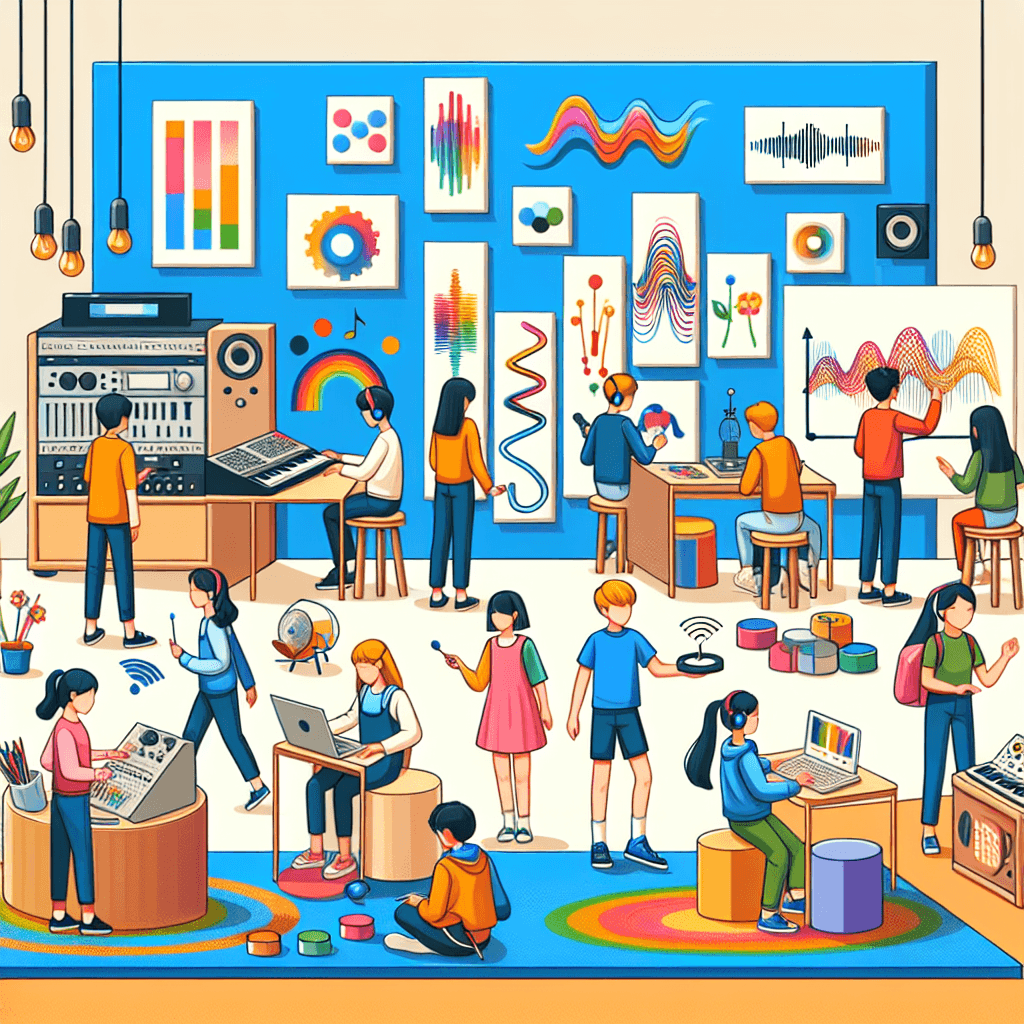
Sound Wave Art Exploration
Inquiry Framework
Question Framework
Driving Question
The overarching question that guides the entire project.How can we use our understanding of sound waves and vibrations to create beautiful and expressive art?Essential Questions
Supporting questions that break down major concepts.- What is a sound wave?
- How do sound waves create art?
- What does vibration mean?
- How can we see vibrations in different materials?
- How do vibrations create different sounds?
- What happens to sound when it travels through different objects?
Standards & Learning Goals
Learning Goals
By the end of this project, students will be able to:- Students will understand what sound waves are and how they are related to vibrations.
- Students will explore how sound waves can create vibrations in different materials.
- Students will recognize the connection between vibrations and sound, enhancing sensory exploration through art and music.
- Students will use creativity to express understanding of scientific concepts through visual and auditory art forms.
- Students will investigate the properties of materials through observation of sound-induced vibrations.
NGSS
Entry Events
Events that will be used to introduce the project to studentsSound Detectives: Uncovering Sound Waves
Introduce a mystery-solving mission where students become sound detectives to uncover how sound waves create invisible patterns. They use simple tools to 'capture' and make these sound waves visible through art, recording their observations in creative journals.Portfolio Activities
Portfolio Activities
These activities progressively build towards your learning goals, with each submission contributing to the student's final portfolio.Vibration Art Explorers
Students will engage in hands-on exploration to understand sound waves and vibrations by creating art that visually represents vibration patterns. This foundational activity helps students grasp the basic concepts of sound and vibration through playful artistic expression.Steps
Here is some basic scaffolding to help students complete the activity.Final Product
What students will submit as the final product of the activityStudents create a physical piece of 'vibration art' using colored sand or paint to show how sound waves affect different materials.Alignment
How this activity aligns with the learning objectives & standardsAligns with K-PS4-1 as students investigate vibrations caused by sound and create evidence of this through art.Sound Wave Symphony
In this activity, students will explore how different sounds can produce different vibration patterns and how these can be represented musically. They will create musical instruments using materials that show distinct vibration qualities.Steps
Here is some basic scaffolding to help students complete the activity.Final Product
What students will submit as the final product of the activityStudents present their homemade musical instruments and a short musical composition demonstrating their understanding of vibrations and sound.Alignment
How this activity aligns with the learning objectives & standardsCovers K-PS4-1 by having students create evidence of sound-induced vibrations and K-PS3-1 as they observe energy transfer through different materials.Vibration Viewfinders
This activity focuses on exploring and documenting the effect of sound traveling through different materials using visual aids. Students learn how sounds are affected by materials and creatively document their findings.Steps
Here is some basic scaffolding to help students complete the activity.Final Product
What students will submit as the final product of the activityStudents create a visual and written record in their creative journals detailing how sound interacts with different materials through the use of vibration viewfinders.Alignment
How this activity aligns with the learning objectives & standardsAligns with K-PS3-1 as students observe energy transfer and K-PS4-1 as they explore sound vibrations through different materials.Rubric & Reflection
Portfolio Rubric
Grading criteria for assessing the overall project portfolioSound Wave Art and Vibration Learning
Understanding of Sound Waves and Vibrations
Assesses the student's grasp of basic sound wave and vibration concepts as demonstrated through activities.Conceptual Grasp
Student's ability to explain sound waves and vibrations through their activities and discussion.
Exemplary
4 PointsStudent demonstrates a strong understanding of sound waves and vibrations, confidently explaining how they relate to created art and instruments, using specific terminology accurately.
Proficient
3 PointsStudent shows a good understanding of sound waves and vibrations, explains the relation to created work with minor prompting, using mostly accurate terminology.
Developing
2 PointsStudent shows a basic understanding with inconsistent use of terminology, needing help to connect concepts to their work.
Beginning
1 PointsStudent struggles to understand basic concepts and cannot articulate the connection between concepts and their projects without assistance.
Observation and Documentation
Student's ability to observe and document the effect of sound waves on different materials.
Exemplary
4 PointsStudent observes and documents detailed and comprehensive findings, accurately capturing vibration patterns and effects.
Proficient
3 PointsStudent makes clear observations and documentation, capturing most key aspects of vibration patterns.
Developing
2 PointsStudent provides basic observations with incomplete documentation, missing some key elements of the patterns.
Beginning
1 PointsStudent struggles to observe and document effectively, with little detail or understanding evident in their records.
Creative Expression through Art and Music
Evaluates the creativity and effort in creating art and music that demonstrates understanding of vibrations and sound.Artistic Representation
Quality and creativity of art produced to represent sound waves and vibrations.
Exemplary
4 PointsArtwork is highly creative and clearly represents sound waves and vibrations, showing exceptional effort and understanding.
Proficient
3 PointsArtwork shows creativity and represents sound waves and vibrations clearly, completed with good effort.
Developing
2 PointsArtwork shows some creativity, representing sound waves or vibrations with basic effort and understanding.
Beginning
1 PointsArtwork lacks creativity and fails to clearly represent sound waves or vibrations, completed with minimal effort.
Musical Composition
Creativity and concept demonstration through student-created musical instruments and compositions demonstrating vibrations.
Exemplary
4 PointsStudent produces an innovative composition that effectively shows understanding of vibrations using the created instruments.
Proficient
3 PointsStudent creates a coherent composition showing good understanding of vibrations with clear usage of the instruments.
Developing
2 PointsStudent produces a basic composition showing some understanding of vibrations but with limited exploration.
Beginning
1 PointsComposition is incomplete or lacks understanding of vibrations, showing minimal use of created instruments.
Collaboration and Discussion
Assesses student participation in group discussions and collaborative activities.Peer Interaction
Participation and interaction in group discussions and collaborative exploration.
Exemplary
4 PointsStudent actively participates in discussions, shares insightful observations, and leads peers in collaborative tasks.
Proficient
3 PointsStudent participates regularly in discussions, shares observations, and contributes positively to group tasks.
Developing
2 PointsStudent occasionally participates with basic observations and limited interaction in group tasks.
Beginning
1 PointsStudent rarely participates in discussions and struggles with collaboration, needing frequent support.