
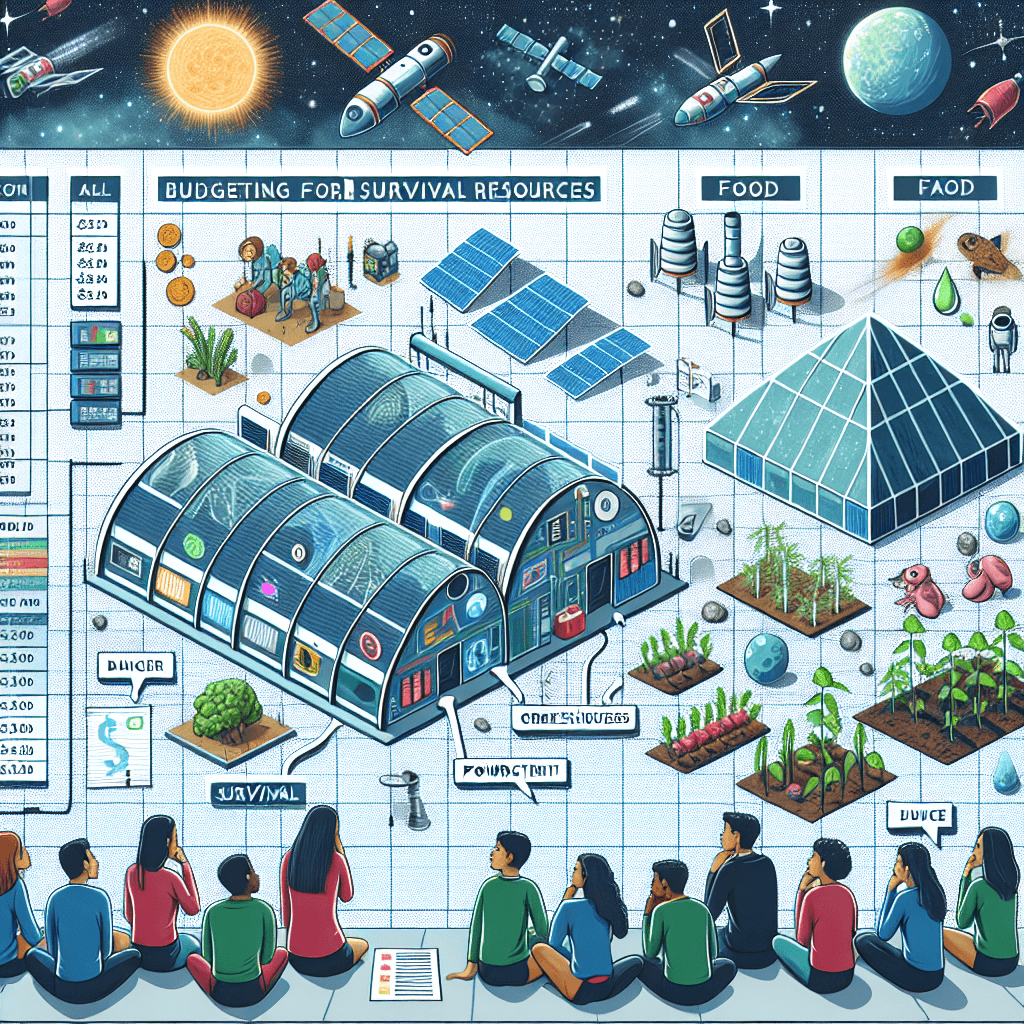
Space Colony Survival: Budgeting for Survival Resources
Inquiry Framework
Question Framework
Driving Question
The overarching question that guides the entire project.How can we design a sustainable and balanced budget for a space colony that ensures the well-being of its inhabitants, navigates unexpected financial challenges, and integrates lessons from historical colonization?Essential Questions
Supporting questions that break down major concepts.- How would you allocate resources in a space colony to ensure all members' needs are met while staying within a budget?
- What strategies can be used to differentiate between necessary and optional expenditures in a space colony?
- How can historical examples of colonization inform modern approaches to resource management in a space colony?
- What steps would you take to make sure your space colony can handle unexpected financial challenges?
- How do differing values and cultural perspectives influence financial decision-making in a space colony context?
Standards & Learning Goals
Learning Goals
By the end of this project, students will be able to:- Students will be able to create a balanced budget for a fictional space colony, considering various resource needs and unexpected challenges.
- Students will differentiate between essential needs and wants in budget planning for sustainable living.
- Students will analyze historical colonization events to draw lessons for managing resources and finances in a space colony.
- Students will develop strategies to manage unexpected financial challenges in a hypothetical space environment.
- Students will evaluate the influence of cultural and personal values on financial decision-making in a space colony context.
Social Studies Standards
Common Core Standards for Mathematics
Common Core Standards for History/Social Studies
Entry Events
Events that will be used to introduce the project to studentsSpace Colony Budget Crisis Simulation
Kick off with a surprise announcement: students are now the financial advisors to a newly established space colony facing a budget crisis. The colony's survival depends on their ability to prioritize spending on essentials like oxygen, food, and safety versus desired comforts. This simulation provides a thrilling start to understanding budget management and decision-making.Portfolio Activities
Portfolio Activities
These activities progressively build towards your learning goals, with each submission contributing to the student's final portfolio.Historical Colonization Case Study
Students will examine historical examples of colonization to learn how past leaders managed resources and financial challenges. They will apply these lessons to a space colony context.Steps
Here is some basic scaffolding to help students complete the activity.Final Product
What students will submit as the final product of the activityA group presentation that analyzes a historical colonization event with applied lessons for a space colony.Alignment
How this activity aligns with the learning objectives & standardsSupports CCSS.ELA-LITERACY.RH.6-8.1 by requiring students to cite textual evidence from historical sources.Space Colony Debate: Needs vs. Wants
Students engage in a structured debate to articulate and defend their views on what should be classified as 'needs' versus 'wants' in a space colony.Steps
Here is some basic scaffolding to help students complete the activity.Final Product
What students will submit as the final product of the activityAn organized debate session with evidence-backed arguments distinguishing needs from wants.Alignment
How this activity aligns with the learning objectives & standardsAligns with learning goals of differentiating essential needs and wants, enhancing understanding of responsible resource management.Financial Strategy Planning
In this activity, students will develop strategies for handling unexpected financial challenges using their space colony budget. This includes brainstorming solutions for potential crises like resource shortages.Steps
Here is some basic scaffolding to help students complete the activity.Final Product
What students will submit as the final product of the activityA revised budget plan and strategic approach for managing a financial crisis in the space colony.Alignment
How this activity aligns with the learning objectives & standardsAligns with 8.E1.7 by having students analyze and respond to economic growth and challenges.Cultural Values and Financial Decisions
Students explore how cultural and personal values influence financial decisions in the space colony, fostering understanding of diverse perspectives.Steps
Here is some basic scaffolding to help students complete the activity.Final Product
What students will submit as the final product of the activityA proposal incorporating cultural perspectives into budget decisions, emphasizing the importance of diversity.Alignment
How this activity aligns with the learning objectives & standardsConnects with the learning goal of evaluating cultural influences on financial decision-making, promoting inclusivity.Budget Prioritization Challenge
This activity introduces students to the concept of budgeting by asking them to prioritize spending in a space colony. Students will learn to differentiate between essential needs and desires.Steps
Here is some basic scaffolding to help students complete the activity.Final Product
What students will submit as the final product of the activityA prioritized list of resources and a basic initial budget allocation for the space colony.Alignment
How this activity aligns with the learning objectives & standardsAligns with 8.E1.5 by teaching students how economic decisions impact resource allocation.Rubric & Reflection
Portfolio Rubric
Grading criteria for assessing the overall project portfolioSpace Colony Budget Project Rubric
Historical Analysis and Application
Evaluates the student's ability to analyze historical colonization events and apply relevant lessons to the space colony budget project.Understanding of Historical Context
Measures the comprehension of historical colonization examples and the ability to articulate key resource management strategies used.
Exemplary
4 PointsThoroughly understands historical contexts and effectively applies multiple strategies to the space colony scenario.
Proficient
3 PointsUnderstands major aspects of historical contexts and applies several relevant strategies to the project.
Developing
2 PointsShows basic understanding with limited application of historical strategies to the project.
Beginning
1 PointsShows minimal understanding with little to no application of historical strategies.
Use of Textual Evidence
Evaluates the use of textual evidence from historical sources to support arguments and analyses.
Exemplary
4 PointsEffectively uses a variety of textual evidence to support arguments, showing clear synthesis of information.
Proficient
3 PointsUses sufficient textual evidence to support arguments, with some synthesis of information.
Developing
2 PointsUses limited or somewhat irrelevant textual evidence, showing minimal synthesis.
Beginning
1 PointsRarely uses textual evidence, with no synthesis of information.
Budget Planning and Allocation
Assesses the student's ability to prioritize resources and create a balanced budget in a space colony scenario.Prioritization of Needs and Wants
Evaluates how well students distinguish between essential needs and optional wants when creating their budget.
Exemplary
4 PointsClearly distinguishes needs from wants with a detailed, rational budget that balances survival and comfort effectively.
Proficient
3 PointsDistinguishes needs from wants with a rational budget that mostly balances survival and comfort.
Developing
2 PointsSomewhat distinguishes needs from wants but demonstrates inconsistency in budget allocation.
Beginning
1 PointsStruggles to distinguish needs from wants, leading to an unbalanced budget.
Crisis Management and Adaptability
Measures the ability to adjust budget plans to handle unexpected challenges in the space colony.
Exemplary
4 PointsDemonstrates excellent adaptability with innovative solutions and effective resource reallocation in crisis scenarios.
Proficient
3 PointsShows good adaptability with sensible solutions and resource reallocation during crises.
Developing
2 PointsShows limited adaptability with basic solutions and some resource reallocation.
Beginning
1 PointsStruggles to adapt plans and resource allocation in response to crises.
Cultural Analysis and Inclusion
Evaluates the student's understanding of how cultural values impact financial decision-making in the space colony context.Integration of Cultural Perspectives
Assesses the degree to which students incorporate diverse cultural views into their budgeting process.
Exemplary
4 PointsThoroughly integrates various cultural perspectives, demonstrating respect and understanding in budget decisions.
Proficient
3 PointsIncorporates several cultural perspectives with adequate respect and understanding.
Developing
2 PointsIncludes limited cultural perspectives with basic respect and understanding.
Beginning
1 PointsShows minimal integration of cultural perspectives, lacking depth and understanding.