
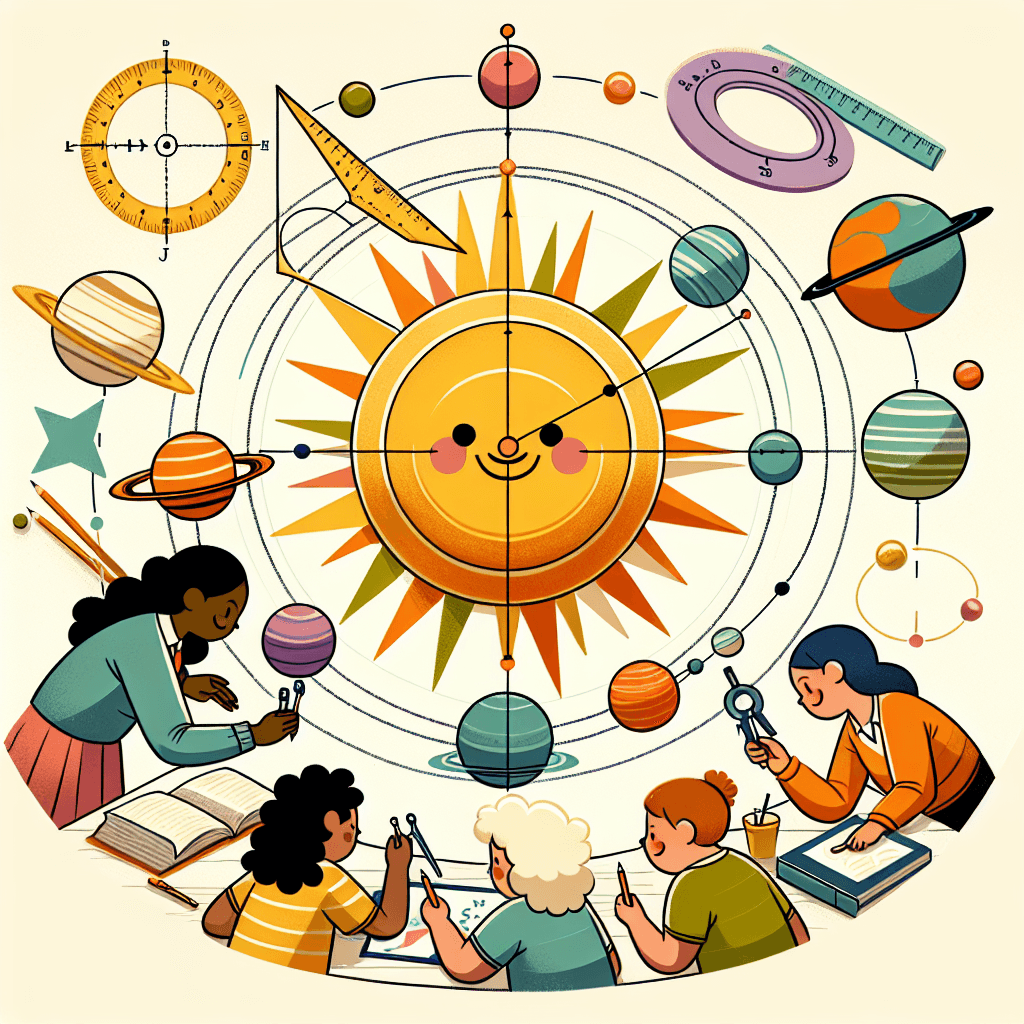
Space Triangulation: Mapping a Mini Solar System
Inquiry Framework
Question Framework
Driving Question
The overarching question that guides the entire project.How can we use the principles of trigonometry, like sines, cosines, and tangents, to accurately map the distances and angles in a mini solar system, and what does this teach us about space exploration?Essential Questions
Supporting questions that break down major concepts.- How can trigonometry help us understand the vastness of space and the layout of solar systems?
- What are the key principles of trigonometry that can be applied to map out distances and angles?
- How do the concepts of sines, cosines, and tangents apply to real-world space exploration scenarios?
Standards & Learning Goals
Learning Goals
By the end of this project, students will be able to:- Students will understand and apply trigonometric ratios to determine distances between points in a model of a solar system.
- Students will be able to use the Pythagorean theorem and sine, cosine, and tangent functions to solve real-world spatial problems.
- Students will learn to derive and apply the formula for the area of a triangle using trigonometric principles.
- Students will gain insight into the application of trigonometry in space exploration and mapping of celestial objects.
- Students will develop critical thinking and problem-solving skills through the application of trigonometry in a project-based learning scenario.
Common Core Mathematics
Entry Events
Events that will be used to introduce the project to studentsThe Triangulation Escape Room
Transform the classroom into an escape room filled with maps, tools, and celestial clues. Students must solve trigonometric problems to unlock parts of the solar system map and 'escape' by reconstructing it completely.Portfolio Activities
Portfolio Activities
These activities progressively build towards your learning goals, with each submission contributing to the student's final portfolio.Trigonometric Area Artists
This activity involves students deriving the area for triangles formed by celestial coordinates within the mini solar system model utilizing the formula A = 1/2 ab sin(C).Steps
Here is some basic scaffolding to help students complete the activity.Final Product
What students will submit as the final product of the activityRepresentations of triangles with calculated areas demonstrating application of the trigonometric area formula.Alignment
How this activity aligns with the learning objectives & standardsCovers CCSS.MATH.CONTENT.HSG.SRT.D.9 by deriving and using the area formula for triangles using trigonometric principles.Solar System Scale Model Engineers
Students put all their knowledge together to construct a comprehensive scale model of a mini solar system, integrating all the trigonometric learnings from previous activities.Steps
Here is some basic scaffolding to help students complete the activity.Final Product
What students will submit as the final product of the activityA complete, accurate scale model of a mini solar system representing cumulative work and trigonometric applications.Alignment
How this activity aligns with the learning objectives & standardsThis comprehensive activity aligns students' skills with the overall project goal, addressing comprehensive understanding of standards CCSS.MATH.CONTENT.HSG.SRT.D.9, HSG.SRT.C.8, and HSG.SRT.C.7 by synthesizing all learned concepts in a real-world application.Rubric & Reflection
Portfolio Rubric
Grading criteria for assessing the overall project portfolioTrigonometry in Space Exploration
Conceptual Understanding
Assesses students' grasp of trigonometric principles and their application in real-world contexts, such as space exploration.Trigonometric Principles
Ability to understand and apply key trigonometric concepts such as sines, cosines, tangents, and their real-world applications in space mapping.
Exemplary
4 PointsDemonstrates a sophisticated understanding and innovative application of sines, cosines, and tangents in accurately mapping celestial distances and angles.
Proficient
3 PointsDemonstrates thorough understanding and appropriate application of trigonometric principles to solve for distances and angles in the model solar system.
Developing
2 PointsShows emerging understanding with inconsistent application of trigonometric principles in mapping celestial distances and angles.
Beginning
1 PointsShows initial understanding but struggles to apply trigonometric concepts to space mapping scenarios.
Real-World Application
Effectively links mathematical formulae and theories to real-world space exploration and mapping scenarios.
Exemplary
4 PointsApplies mathematical formulae innovatively to solve complex problems in space exploration scenarios, demonstrating high-level critical thinking.
Proficient
3 PointsSuccessfully applies mathematical formulae to solve problems related to space exploration, demonstrating solid understanding.
Developing
2 PointsApplies mathematical formulae inconsistently in real-world contexts, showing partial understanding.
Beginning
1 PointsStruggles to connect mathematical formulae to real-world problems in space scenarios.
Critical Thinking and Problem-Solving
Evaluates students' ability to use critical thinking and problem-solving skills to apply trigonometric knowledge in space exploration contexts.Problem Solving
Effectively solves problems through logical reasoning and trigonometric calculations related to mapping the solar system.
Exemplary
4 PointsExhibits outstanding problem-solving skills by accurately and effectively resolving all trigonometric challenges in space mapping.
Proficient
3 PointsResolves trigonometric problems effectively, showing logical reasoning and good use of trigonometric calculations.
Developing
2 PointsShows basic problem-solving skills with partial success in resolving trigonometric challenges.
Beginning
1 PointsStruggles with the problem-solving process, showing minimal logical reasoning or successful application of trigonometry.
Collaboration and Communication
Measures students' effectiveness in collaborating with peers and communicating their findings clearly.Collaboration
Ability to work effectively with peers to create a scaled model of the solar system and solve trigonometric tasks collaboratively.
Exemplary
4 PointsLeads group activities, facilitates peer contributions, and collaborates effectively to produce a high-quality model.
Proficient
3 PointsWorks well within the group, contributing valuable insights, and effectively collaborates to achieve the project goals.
Developing
2 PointsShows participation in group activities with some willingness to collaborate or support peers.
Beginning
1 PointsParticipates minimally, struggling with effective collaboration, often requiring guidance.