
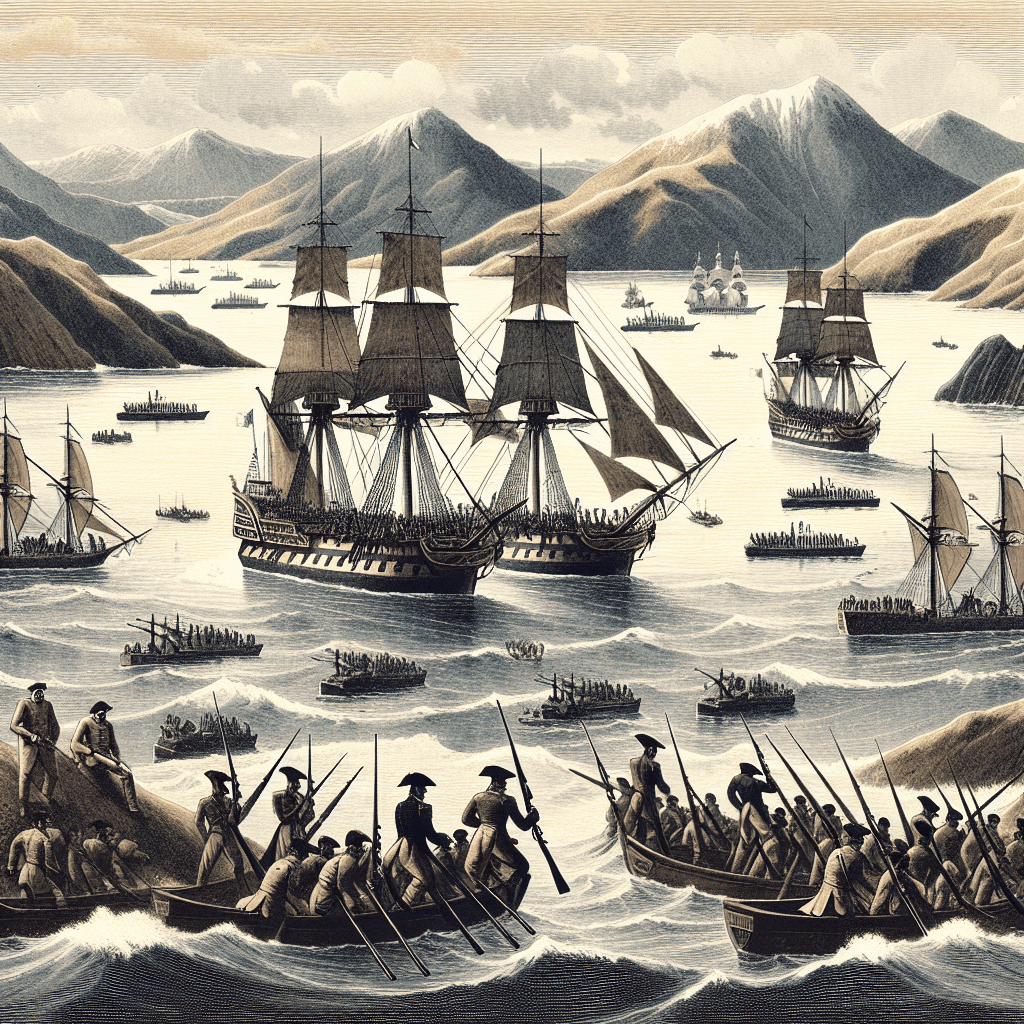
Spanish-American War and U.S. Expansion in the South Pacific
Inquiry Framework
Question Framework
Driving Question
The overarching question that guides the entire project.To what extent did the Spanish-American War and subsequent U.S. expansion in the South Pacific mark a turning point in American foreign policy and its emergence as a global power?Essential Questions
Supporting questions that break down major concepts.- What were the main causes of the Spanish-American War?
- What role did yellow journalism play in igniting the conflict?
- What were the key battles and events of the Spanish-American War?
- What were the terms of the Treaty of Paris that ended the war?
- How did the Spanish-American War lead to U.S. expansion in the South Pacific?
- What were the political, economic, and social effects of U.S. expansion on the Philippines, Guam, and other Pacific territories?
- How did the Spanish-American War impact the relationship between the United States and other world powers?
- To what extent was the Spanish-American War a turning point in U.S. foreign policy?
- How did the war contribute to the emergence of the U.S. as a global power?
Standards & Learning Goals
Learning Goals
By the end of this project, students will be able to:- Students will be able to describe the causes, key events, and consequences of the Spanish-American War.
- Students will be able to analyze the role of yellow journalism in igniting the conflict.
- Students will be able to evaluate the impact of the Treaty of Paris on U.S. expansion in the South Pacific.
- Students will be able to explain the political, economic, and social effects of U.S. expansion on Pacific territories.
- Students will be able to assess the extent to which the Spanish-American War marked a turning point in American foreign policy and its emergence as a global power.
Entry Events
Events that will be used to introduce the project to students'War Room' Simulation
Divide the class into groups representing different factions involved in the conflict: the U.S. government, the Spanish government, Cuban rebels, Filipino nationalists, and American businesses. Each group receives a briefing on their goals and resources, and then must negotiate and make strategic decisions as key events unfold. This experiential activity immerses students in the complex geopolitical landscape of the era.Portfolio Activities
Portfolio Activities
These activities progressively build towards your learning goals, with each submission contributing to the student's final portfolio.Cause and Effect Exploration: Mapping the Road to War
Students will investigate the main causes of the Spanish-American War, creating a detailed cause-and-effect map to illustrate the factors that led to the conflict.Steps
Here is some basic scaffolding to help students complete the activity.Final Product
What students will submit as the final product of the activityA detailed cause-and-effect map with a paragraph summarizing the key causes of the Spanish-American War.Alignment
How this activity aligns with the learning objectives & standardsAddresses the learning goal: Students will be able to describe the causes, key events, and consequences of the Spanish-American War; and essential question: What were the main causes of the Spanish-American War?Yellow Journalism: Fact vs. Fiction
Students will analyze primary source examples of yellow journalism from the period, comparing them to factual accounts to understand the role of sensationalism in shaping public opinion and igniting the war.Steps
Here is some basic scaffolding to help students complete the activity.Final Product
What students will submit as the final product of the activityA comparative analysis of yellow journalism articles and factual accounts, along with a reflective essay on the impact of yellow journalism.Alignment
How this activity aligns with the learning objectives & standardsAddresses the learning goal: Students will be able to analyze the role of yellow journalism in igniting the conflict; and essential question: What role did yellow journalism play in igniting the conflict?Treaty of Paris: A New World Order?
Students will examine the terms of the Treaty of Paris and analyze its impact on U.S. expansion in the South Pacific, focusing on the acquisition of territories like the Philippines and Guam.Steps
Here is some basic scaffolding to help students complete the activity.Final Product
What students will submit as the final product of the activityAn argumentative essay analyzing the impact of the Treaty of Paris on U.S. expansion and the acquired territories.Alignment
How this activity aligns with the learning objectives & standardsAddresses the learning goal: Students will be able to evaluate the impact of the Treaty of Paris on U.S. expansion in the South Pacific; and essential question: What were the terms of the Treaty of Paris that ended the war? How did the Spanish-American War lead to U.S. expansion in the South Pacific?Pacific Territories: Voices from the Islands
Students will explore the political, economic, and social effects of U.S. expansion on the Philippines, Guam, and other Pacific territories by researching and presenting diverse perspectives from the inhabitants of these islands.Steps
Here is some basic scaffolding to help students complete the activity.Final Product
What students will submit as the final product of the activityA presentation summarizing the effects of U.S. expansion on a Pacific territory, incorporating the voices of its inhabitants.Alignment
How this activity aligns with the learning objectives & standardsAddresses the learning goal: Students will be able to explain the political, economic, and social effects of U.S. expansion on Pacific territories; and essential question: What were the political, economic, and social effects of U.S. expansion on the Philippines, Guam, and other Pacific territories?Turning Point or Continuation? Debating U.S. Foreign Policy
Students will participate in a structured debate to assess the extent to which the Spanish-American War marked a turning point in American foreign policy and its emergence as a global power.Steps
Here is some basic scaffolding to help students complete the activity.Final Product
What students will submit as the final product of the activityA structured debate with well-researched arguments and rebuttals, along with a concluding statement summarizing each team's position.Alignment
How this activity aligns with the learning objectives & standardsAddresses the learning goal: Students will be able to assess the extent to which the Spanish-American War marked a turning point in American foreign policy and its emergence as a global power; and essential questions: To what extent was the Spanish-American War a turning point in U.S. foreign policy? How did the war contribute to the emergence of the U.S. as a global power?Rubric & Reflection
Portfolio Rubric
Grading criteria for assessing the overall project portfolioSpanish-American War and U.S. Expansion Portfolio Rubric
Historical Analysis and Understanding
Demonstrates accurate and comprehensive knowledge of the causes, events, and consequences of the Spanish-American War and U.S. expansion.Cause and Effect Relationships
Identifies and explains the cause-and-effect relationships that led to the Spanish-American War and U.S. expansion.
Exemplary
4 PointsDemonstrates a sophisticated understanding of complex cause-and-effect relationships, providing insightful analysis of the factors leading to the war and expansion.
Proficient
3 PointsDemonstrates a thorough understanding of cause-and-effect relationships, accurately identifying and explaining the key factors leading to the war and expansion.
Developing
2 PointsShows an emerging understanding of cause-and-effect relationships, identifying some factors but lacking depth in explanation.
Beginning
1 PointsShows a limited understanding of cause-and-effect relationships, struggling to identify the key factors leading to the war and expansion.
Historical Accuracy
Presents accurate historical information and avoids factual errors.
Exemplary
4 PointsPresents consistently accurate historical information with no factual errors; demonstrates a deep understanding of the historical context.
Proficient
3 PointsPresents mostly accurate historical information with only minor factual errors.
Developing
2 PointsPresents some accurate historical information but contains several factual errors.
Beginning
1 PointsPresents inaccurate historical information with numerous factual errors.
Critical Thinking and Analysis
Demonstrates the ability to analyze primary and secondary sources, evaluate different perspectives, and form well-supported arguments.Source Analysis
Analyzes primary and secondary sources effectively, identifying bias, perspective, and reliability.
Exemplary
4 PointsDemonstrates sophisticated source analysis, identifying subtle biases and perspectives, and evaluating the reliability of sources with nuanced reasoning.
Proficient
3 PointsDemonstrates effective source analysis, identifying biases and perspectives, and evaluating the reliability of sources.
Developing
2 PointsShows emerging source analysis skills, identifying some biases and perspectives, but struggling to evaluate the reliability of sources consistently.
Beginning
1 PointsShows limited source analysis skills, struggling to identify biases and perspectives or evaluate the reliability of sources.
Argumentation
Constructs well-supported arguments with clear evidence and logical reasoning.
Exemplary
4 PointsConstructs exceptionally well-supported arguments with compelling evidence, insightful reasoning, and effective counterarguments.
Proficient
3 PointsConstructs well-supported arguments with clear evidence and logical reasoning.
Developing
2 PointsConstructs arguments with some evidence, but reasoning may be unclear or incomplete.
Beginning
1 PointsStruggles to construct arguments with limited evidence and flawed reasoning.
Communication and Presentation
Communicates effectively through writing, presentations, and discussions, demonstrating clarity, organization, and persuasive skills.Clarity and Organization
Presents information in a clear, concise, and organized manner.
Exemplary
4 PointsPresents information with exceptional clarity, conciseness, and organization, creating a highly engaging and easily understandable presentation.
Proficient
3 PointsPresents information in a clear, concise, and organized manner.
Developing
2 PointsPresents information with some clarity and organization, but may be difficult to follow at times.
Beginning
1 PointsPresents information in a disorganized and unclear manner, making it difficult to understand.
Use of Evidence
Effectively uses evidence to support claims and arguments.
Exemplary
4 PointsSkillfully integrates compelling evidence to support claims and arguments, enhancing the persuasiveness and credibility of the presentation.
Proficient
3 PointsEffectively uses evidence to support claims and arguments.
Developing
2 PointsUses some evidence to support claims, but the connection may not always be clear.
Beginning
1 PointsUses limited or irrelevant evidence to support claims.