
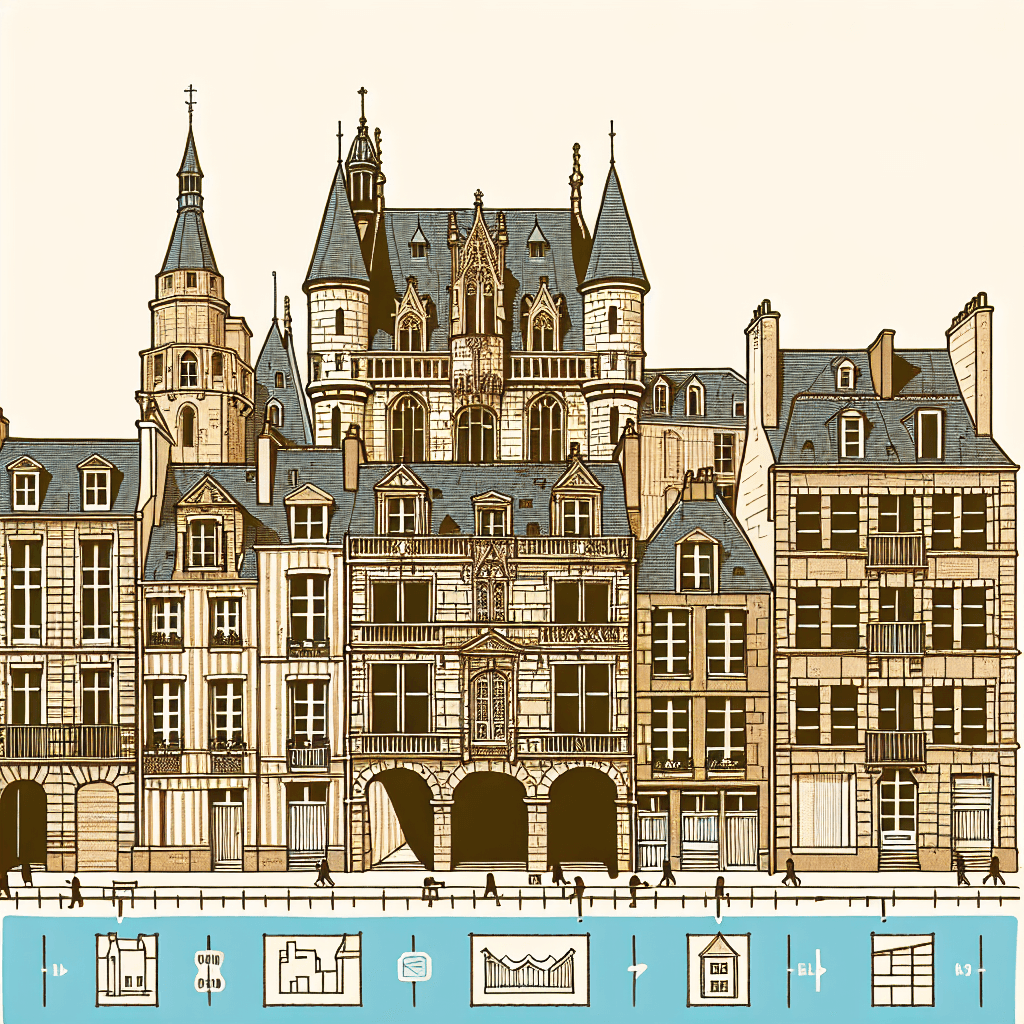
St. Malo Architecture: Sketching History Through Art
Inquiry Framework
Question Framework
Driving Question
The overarching question that guides the entire project.How can we, as mindful artists, capture the essence of St. Malo's architecture to reveal its historical and cultural significance into a scketch?Essential Questions
Supporting questions that break down major concepts.- How does the architecture of St. Malo reflect its history and culture?
- What are the key architectural styles and features present in St. Malo?
- How can art be used to interpret and represent architectural spaces?
- What role did St. Malo play in history?
Standards & Learning Goals
Learning Goals
By the end of this project, students will be able to:- Students will learn about the history and culture of St. Malo.
- Students will identify and analyze key architectural styles and features in St. Malo.
- Students will create sketches or paintings that interpret and represent the architecture of St. Malo.
- Students will understand the relationship between art and architectural representation.
Entry Events
Events that will be used to introduce the project to students"Guided Architectural Tour of St. Malo"
Students embark on a guided walking tour of a famous area in St. Malo, led by a knowledgeable tour guide. The tour focuses on key architectural landmarks, historical context, and cultural significance. Students are encouraged to take notes and capture initial sketches, setting the stage for deeper artistic exploration and interpretation.Portfolio Activities
Portfolio Activities
These activities progressively build towards your learning goals, with each submission contributing to the student's final portfolio.Artistic Interpretation
Students develop a final sketch or painting that reflects their personal interpretation of St. Malo's architecture, integrating historical and cultural insights.Steps
Here is some basic scaffolding to help students complete the activity.Final Product
What students will submit as the final product of the activityA finished sketch or painting that artistically represents and interprets the architecture of St. Malo.Alignment
How this activity aligns with the learning objectives & standardsAddresses the learning goal: Students will create sketches or paintings that interpret and represent the architecture of St. Malo AND Students will understand the relationship between art and architectural representation.Sketchbook Explorations
Students create a series of sketchbook studies focusing on different architectural elements and perspectives in St. Malo.Steps
Here is some basic scaffolding to help students complete the activity.Final Product
What students will submit as the final product of the activityA sketchbook filled with observational drawings and annotations of St. Malo's architecture.Alignment
How this activity aligns with the learning objectives & standardsAddresses the learning goal: Students will create sketches or paintings that interpret and represent the architecture of St. Malo.Rubric & Reflection
Portfolio Rubric
Grading criteria for assessing the overall project portfolioSt. Malo Architecture Portfolio Rubric
Architectural Representation & Accuracy
Focuses on the accurate depiction of architectural elements and the effective use of artistic techniques to represent form and space.Accuracy of Depiction
How accurately does the artwork represent the architectural features of St. Malo?
Exemplary
4 PointsDemonstrates exceptional accuracy in representing architectural details, showcasing a deep understanding of form and proportion. The artwork captures the essence of St. Malo's architecture with precision.
Proficient
3 PointsRepresents architectural details accurately, demonstrating a good understanding of form and proportion. Minor inaccuracies do not detract from the overall representation.
Developing
2 PointsShows some understanding of architectural forms, but inaccuracies are present and affect the overall representation. Proportions may be inconsistent.
Beginning
1 PointsStruggles to accurately represent architectural forms. Significant inaccuracies and distortions are evident.
Use of Artistic Techniques
How effectively does the student use sketching or painting techniques to represent architectural form, space, and texture?
Exemplary
4 PointsSkillfully uses a variety of artistic techniques (e.g., line, shading, perspective) to create depth, texture, and visual interest. Techniques enhance the architectural representation effectively.
Proficient
3 PointsEffectively uses sketching or painting techniques to represent form and space. Techniques are applied competently and contribute to the overall quality of the artwork.
Developing
2 PointsDemonstrates basic sketching or painting techniques, but application is inconsistent. The use of techniques may not fully enhance the architectural representation.
Beginning
1 PointsStruggles to use sketching or painting techniques effectively. The artwork lacks depth, texture, and visual interest.
Historical & Cultural Integration
Assesses the student's ability to integrate historical and cultural elements of St. Malo into their artistic interpretation.Integration of Historical Context
How effectively does the artwork incorporate historical elements or references related to St. Malo's architecture and history?
Exemplary
4 PointsArtwork seamlessly integrates historical and cultural elements, demonstrating a deep understanding of St. Malo's heritage. The artwork tells a story about the city's past.
Proficient
3 PointsIncorporates historical and cultural elements appropriately, showing a good understanding of St. Malo's history. The artwork reflects the city's heritage.
Developing
2 PointsIncludes some historical or cultural references, but the integration is superficial or lacks depth. The connection to St. Malo's history may be unclear.
Beginning
1 PointsShows little or no awareness of St. Malo's historical or cultural context. The artwork lacks any connection to the city's heritage.
Personal Interpretation & Expression
How effectively does the artwork express the student's personal interpretation and artistic vision of St. Malo's architecture?
Exemplary
4 PointsThe artwork is a powerful and original expression of the student's personal interpretation. It demonstrates a unique artistic vision and conveys a strong sense of place and emotion.
Proficient
3 PointsExpresses a clear personal interpretation of St. Malo's architecture. The artwork reflects the student's artistic vision and conveys a sense of place.
Developing
2 PointsShows some personal interpretation, but the artistic vision is not fully developed. The artwork may lack originality or emotional impact.
Beginning
1 PointsLacks personal interpretation or artistic vision. The artwork appears to be a simple copy without any individual expression.
Sketchbook Development & Process
Evaluates the quality and thoroughness of the student's sketchbook explorations, including observational drawings, annotations, and experimentation.Observational Drawings & Detail
How detailed and accurate are the observational drawings in the sketchbook? Do they demonstrate careful attention to architectural details?
Exemplary
4 PointsSketchbook contains highly detailed and accurate observational drawings that demonstrate exceptional attention to architectural details. Annotations are thorough and insightful.
Proficient
3 PointsSketchbook contains detailed observational drawings with accurate representations of architectural elements. Annotations provide relevant information.
Developing
2 PointsSketchbook includes some observational drawings, but details may be lacking or inaccurate. Annotations are minimal or incomplete.
Beginning
1 PointsSketchbook contains few or poorly executed observational drawings. Annotations are absent or irrelevant.
Experimentation & Exploration
How effectively does the sketchbook demonstrate experimentation with different perspectives, compositions, and artistic techniques?
Exemplary
4 PointsSketchbook demonstrates extensive experimentation with various perspectives, compositions, and artistic techniques. The student actively explores different approaches to representing St. Malo's architecture.
Proficient
3 PointsSketchbook shows evidence of experimentation with different perspectives, compositions, and techniques. The student explores various approaches to representing the architecture.
Developing
2 PointsSketchbook includes some experimentation, but the range of perspectives, compositions, or techniques is limited. The student may rely on a single approach.
Beginning
1 PointsSketchbook lacks experimentation or exploration. The student shows little or no attempt to try different approaches.