
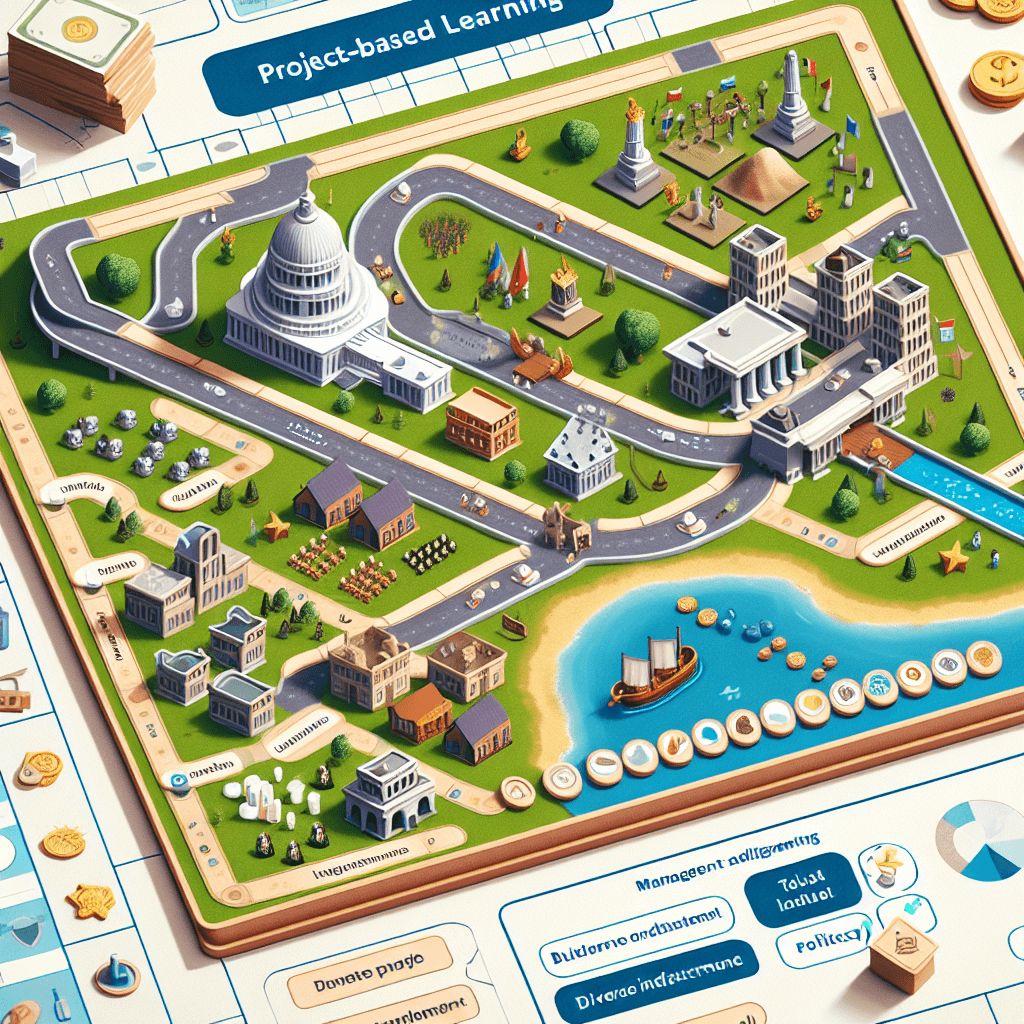
State Building Simulator: A Nation Design Game
Inquiry Framework
Question Framework
Driving Question
The overarching question that guides the entire project.How can we design a state-building simulation game that demonstrates the impact of social, cultural, and environmental factors, conflicts, and historical events on a nation's formation, growth, and potential dissolution?Essential Questions
Supporting questions that break down major concepts.- How do social, cultural, and environmental factors influence the formation, growth, and decline of nations?
- What are the short-term and long-term consequences of conflicts and their resolutions on state building?
- In what ways can historical events, such as revolutions and wars, shape the trajectory of a nation's development?
- What factors contribute to the rise and fall of leaders and empires?
- How do internal and external pressures impact a nation's stability and survival?
Standards & Learning Goals
Learning Goals
By the end of this project, students will be able to:- Understand the multifaceted factors influencing state building.
- Analyze the short- and long-term impacts of conflicts.
- Apply knowledge of historical events to game design.
Teacher Specified
Common Core Standards
Entry Events
Events that will be used to introduce the project to studentsNation Creation Challenge
Students receive a limited set of resources and conflicting societal values to establish a thriving nation, sparking debate and strategic decision-making. Initial nations quickly face crises, mirroring real-world state-building challenges and prompting deeper investigation.Portfolio Activities
Portfolio Activities
These activities progressively build towards your learning goals, with each submission contributing to the student's final portfolio.Nation Profile Creation
Students will create a detailed profile of their chosen nation, outlining its social, cultural, and environmental characteristics. This profile will serve as the foundation for understanding how these factors influence the nation's development and trajectory.Steps
Here is some basic scaffolding to help students complete the activity.Final Product
What students will submit as the final product of the activityA comprehensive nation profile document that includes a description of its social, cultural, and environmental characteristics.Alignment
How this activity aligns with the learning objectives & standardsAddresses HS.H1.2 by requiring students to explain how social, cultural, and environmental factors influence state-building.Conflict Analysis Report
Students will analyze a significant historical conflict that impacted their nation, evaluating its short-term and long-term consequences on state building and stability.Steps
Here is some basic scaffolding to help students complete the activity.Final Product
What students will submit as the final product of the activityA detailed conflict analysis report that evaluates the short-term and long-term impacts of the conflict.Alignment
How this activity aligns with the learning objectives & standardsAddresses HS.H2.3 by requiring students to evaluate the short-term and long-term impacts of conflicts and their resolutions.Revolutionary Event Simulation
Students will design a simulation of a major revolution or war of independence that occurred within their nation's history, focusing on the causes, significance, and impact on the nation's trajectory.Steps
Here is some basic scaffolding to help students complete the activity.Final Product
What students will submit as the final product of the activityA simulation scenario of a revolutionary event, including a description of the causes, significance, and impact on the nation's development.Alignment
How this activity aligns with the learning objectives & standardsReinforces understanding of historical events by applying knowledge to game design, aligning with the learning goal to apply knowledge of historical events to game design.Rubric & Reflection
Portfolio Rubric
Grading criteria for assessing the overall project portfolioState Building Simulation Game Rubric
Nation Profile
Assessment of the nation profile document, focusing on the depth and accuracy of the social, cultural, and environmental characteristics.Social Factors
Evaluation of the description and analysis of social structures and dynamics within the nation.
Exemplary
4 PointsProvides a comprehensive and nuanced analysis of the nation's social structures, including detailed explanations of social hierarchies, institutions, and interactions. Demonstrates a sophisticated understanding of how these factors influence state-building. Reason: Demonstrates in-depth understanding of social complexities.
Proficient
3 PointsProvides a thorough description of the nation's social structures, including key social hierarchies, institutions, and interactions. Explains how these factors influence state-building. Reason: Shows clear understanding of social influence.
Developing
2 PointsDescribes basic social structures within the nation, but lacks depth in explaining social hierarchies, institutions, and interactions. Shows limited understanding of how these factors influence state-building. Reason: Indicates basic understanding of social elements.
Beginning
1 PointsProvides a superficial description of the nation's social structures, missing key elements and lacking explanation of their influence on state-building. Reason: Shows limited awareness of social structures.
Cultural Values
Assessment of the identification and analysis of cultural values, beliefs, and traditions.
Exemplary
4 PointsProvides a profound analysis of the nation's cultural values, beliefs, and traditions, demonstrating a sophisticated understanding of their impact on state-building and national identity. Reason: Provides comprehensive cultural insight.
Proficient
3 PointsProvides a clear and detailed description of the nation's cultural values, beliefs, and traditions, explaining their impact on state-building and national identity. Reason: Demonstrates thorough cultural knowledge.
Developing
2 PointsIdentifies some cultural values, beliefs, and traditions, but lacks depth in explaining their impact on state-building and national identity. Reason: Shows emerging cultural awareness.
Beginning
1 PointsProvides a superficial overview of cultural values, beliefs, and traditions, missing key elements and lacking explanation of their impact on state-building and national identity. Reason: Shows limited understanding of cultural factors.
Environmental Conditions
Evaluation of the description and analysis of environmental factors, including geography, climate, and resources.
Exemplary
4 PointsProvides a comprehensive analysis of the nation's environmental conditions, demonstrating a sophisticated understanding of their influence on state-building, resource management, and sustainability. Reason: Shows advanced environmental awareness.
Proficient
3 PointsProvides a thorough description of the nation's environmental conditions, explaining their influence on state-building, resource management, and sustainability. Reason: Demonstrates solid environmental knowledge.
Developing
2 PointsDescribes basic environmental conditions, but lacks depth in explaining their influence on state-building, resource management, and sustainability. Reason: Indicates basic environmental understanding.
Beginning
1 PointsProvides a superficial overview of environmental conditions, missing key elements and lacking explanation of their influence on state-building, resource management, and sustainability. Reason: Shows limited environmental awareness.
Conflict Analysis
Assessment of the conflict analysis report, focusing on the depth and accuracy of the analysis of short-term and long-term impacts of a major historical conflict.Identification of Conflict
Accuracy and relevance of the chosen conflict to the nation's history.
Exemplary
4 PointsIdentifies a highly relevant and significant historical conflict, demonstrating a deep understanding of its connection to the nation's development. Reason: Shows excellent contextual understanding.
Proficient
3 PointsIdentifies a relevant historical conflict and explains its connection to the nation's development. Reason: Conflict is appropriate and clearly linked.
Developing
2 PointsIdentifies a historical conflict, but the connection to the nation's development is not clearly explained. Reason: Connection to national development is weak.
Beginning
1 PointsIdentifies a historical conflict that is not clearly relevant to the nation's history or development. Reason: Conflict choice is inappropriate.
Analysis of Short-Term Impacts
Depth and accuracy of the analysis of the conflict's immediate consequences.
Exemplary
4 PointsProvides a comprehensive and nuanced analysis of the conflict's short-term impacts, including political, economic, and social consequences, demonstrating a sophisticated understanding of their interconnectedness. Reason: Demonstrates exceptional analytical skills.
Proficient
3 PointsProvides a thorough analysis of the conflict's short-term impacts, including political, economic, and social consequences. Reason: Thoroughly analyzes immediate consequences.
Developing
2 PointsIdentifies some short-term impacts of the conflict, but lacks depth in explaining their political, economic, and social consequences. Reason: Basic understanding of immediate impacts.
Beginning
1 PointsProvides a superficial overview of the conflict's short-term impacts, missing key consequences and lacking explanation of their political, economic, and social effects. Reason: Shows limited awareness of immediate consequences.
Analysis of Long-Term Impacts
Depth and accuracy of the analysis of the conflict's lasting consequences.
Exemplary
4 PointsProvides a comprehensive and nuanced analysis of the conflict's long-term impacts, including political, economic, and social consequences, demonstrating a sophisticated understanding of their enduring effects on state-building and stability. Reason: Excellent long-term impact analysis.
Proficient
3 PointsProvides a thorough analysis of the conflict's long-term impacts, including political, economic, and social consequences. Reason: Thorough analysis of lasting consequences.
Developing
2 PointsIdentifies some long-term impacts of the conflict, but lacks depth in explaining their political, economic, and social consequences. Reason: Basic understanding of long-term impacts.
Beginning
1 PointsProvides a superficial overview of the conflict's long-term impacts, missing key consequences and lacking explanation of their political, economic, and social effects. Reason: Limited awareness of long-term consequences.
Revolutionary Event Simulation
Assessment of the simulation scenario, focusing on the historical accuracy, engagement, and understanding of the revolution's impact on the nation's trajectory.Historical Accuracy
Evaluation of the simulation's representation of key events, figures, and turning points.
Exemplary
4 PointsDemonstrates exceptional historical accuracy in the simulation, with meticulous attention to detail in the representation of key events, figures, and turning points. Provides insightful context and avoids anachronisms. Reason: Demonstrates expert-level historical knowledge.
Proficient
3 PointsAccurately represents key events, figures, and turning points in the simulation, demonstrating a solid understanding of the historical context. Reason: Historically sound representation of revolution.
Developing
2 PointsPresents a basic representation of key events, figures, and turning points in the simulation, but may contain some inaccuracies or lack historical context. Reason: Some inaccuracies present.
Beginning
1 PointsDemonstrates significant historical inaccuracies or omissions in the simulation, lacking a clear understanding of the key events, figures, and turning points. Reason: Shows poor understanding of historical context.
Engagement and Interactivity
Assessment of the simulation's ability to engage users and promote active learning.
Exemplary
4 PointsCreates a highly engaging and interactive simulation that immerses users in the challenges and decisions faced during the revolution, promoting active learning and critical thinking. Reason: Highly effective engagement.
Proficient
3 PointsCreates an engaging and interactive simulation that allows users to experience the challenges and decisions faced during the revolution. Reason: Engages users and promotes interactivity.
Developing
2 PointsPresents a simulation with some interactive elements, but lacks depth in engaging users and promoting active learning. Reason: Limited user engagement.
Beginning
1 PointsCreates a simulation with minimal interactive elements, failing to engage users or promote active learning. Reason: Simulation lacks engagement.
Impact on Nation's Trajectory
Evaluation of the simulation's ability to demonstrate the revolution's impact on the nation's development.
Exemplary
4 PointsDemonstrates a sophisticated understanding of the revolution's impact on the nation's trajectory, showcasing the complex and multifaceted consequences of the event on state-building and national identity. Reason: Deep understanding of revolutionary impact.
Proficient
3 PointsClearly demonstrates the revolution's impact on the nation's trajectory, explaining how the event shaped state-building and national identity. Reason: Clearly shows impact on national development.
Developing
2 PointsShows some understanding of the revolution's impact on the nation's trajectory, but lacks depth in explaining how the event shaped state-building and national identity. Reason: Basic understanding of revolutionary impact.
Beginning
1 PointsProvides a superficial overview of the revolution's impact on the nation's trajectory, missing key consequences and lacking explanation of its effect on state-building and national identity. Reason: Limited awareness of revolutionary impact.