
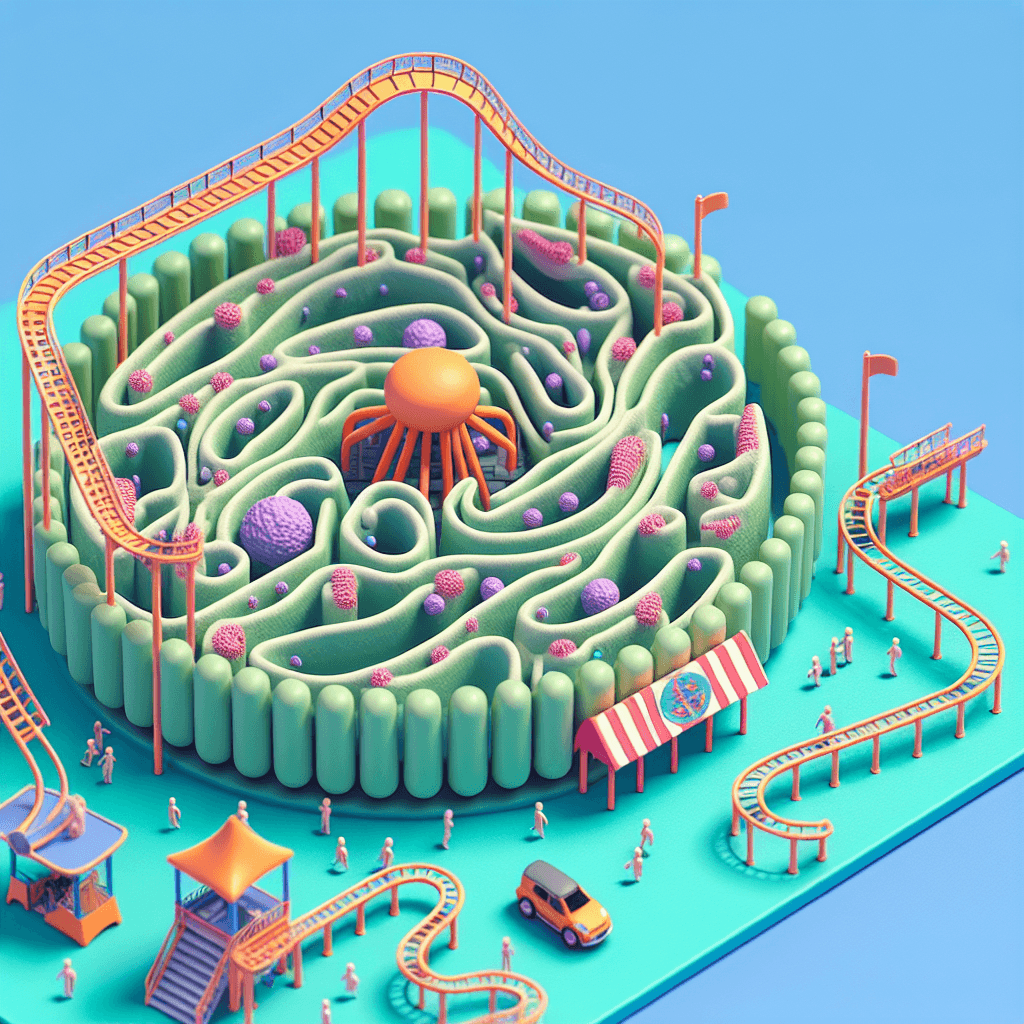
Stop Motion Video: Amusement Park Ride of a Cell Organelle
Inquiry Framework
Question Framework
Driving Question
The overarching question that guides the entire project.How can we design and create a stop motion video that effectively models the functions and structures of a plant or animal cell organelle, helping us understand its role in living organisms and evaluate how mathematical concepts can be applied throughout this process?Essential Questions
Supporting questions that break down major concepts.- What are the key functions and structures of a plant or animal cell organelle?
- How can we model the functions of a cell's organelle using stop motion video?
- How does understanding the structure and function of cell organelles help us in understanding living organisms better?
Standards & Learning Goals
Learning Goals
By the end of this project, students will be able to:- Students will be able to describe the key functions and structures of a selected plant or animal cell organelle.
- Students will create a stop motion video that models the function of a cell organelle.
- Students will apply mathematical concepts of geometry in the design and creation of their stop motion video scenes.
- Students will understand and explain the role of cell organelles in the context of the larger living organism.
- Students will develop skills in digital media creation, collaboration, and problem-solving through project-based learning.
Next Generation Science Standards
Common Core State Standards for Mathematics
Entry Events
Events that will be used to introduce the project to studentsVirtual Reality Adventure
Kick off with a Virtual Reality session where students explore a miniature amusement park inside a cell, experiencing rides that showcase different organelle functions, encouraging them to view cells from an engineer's perspective.Portfolio Activities
Portfolio Activities
These activities progressively build towards your learning goals, with each submission contributing to the student's final portfolio.Cell Organelle Adventure Map
In this activity, students will design and construct a 2D map of an amusement park themed around a specific cell organelle. This map will help them conceptualize how they will model the organelle's functions in a physical space, providing a foundation for their stop motion video.Steps
Here is some basic scaffolding to help students complete the activity.Final Product
What students will submit as the final product of the activityA detailed 2D amusement park map representing the chosen organelle and its functions, complete with calculated areas of various sections.Alignment
How this activity aligns with the learning objectives & standardsAligns with MS LS1-1 by having students investigate and model organelle structures and functions; aligns with 6.G.A.1 through the application of geometry in mapping.Stop Motion Scriptwriting Workshop
In this second activity, students will write a script that narrates the journey through their amusement park, detailing each organelle's function and its role in the larger organism context. This forms the narrative backbone for their stop motion video.Steps
Here is some basic scaffolding to help students complete the activity.Final Product
What students will submit as the final product of the activityA complete script that can be used to narrate the stop motion video, illustrating the functions of the organelle in an engaging manner.Alignment
How this activity aligns with the learning objectives & standardsAligns with MS LS1-1 by ensuring students articulate the role and function of cell organelles within a narrative.Animating the Organelle Odyssey
In this activity, students begin the production phase by creating a stop motion video. They will animate the amusement park rides they designed, ensuring accurate and creative representations of their chosen organelle's functions.Steps
Here is some basic scaffolding to help students complete the activity.Final Product
What students will submit as the final product of the activityA fully edited stop motion video showcasing the amusement park and its organelle-themed rides, with clear connections to the organelle's functions and roles.Alignment
How this activity aligns with the learning objectives & standardsCovers MS LS1-1 by modeling organelle functions in a dynamic format; involves 6.G.A.1 through spatial planning and geometry in creating sets.Rubric & Reflection
Portfolio Rubric
Grading criteria for assessing the overall project portfolioOrganelle Odyssey Project Rubric
Understanding of Cell Organelle Functions
Assessment of students' ability to identify and explain the key functions and structures of a selected plant or animal cell organelle.Identification of Key Structures
How well does the student identify and outline the key structures of the selected cell organelle?
Exemplary
4 PointsStudent provides detailed and accurate descriptions of all key structures of the selected organelle, with insightful connections to their roles within the cell.
Proficient
3 PointsStudent identifies most key structures of the selected organelle with accurate descriptions and clear connections to their roles.
Developing
2 PointsStudent identifies some key structures of the selected organelle but with limited descriptions and weak connections to their roles.
Beginning
1 PointsStudent struggles to identify key structures of the selected organelle and provides minimal or inaccurate descriptions.
Explanation of Functions
To what extent does the student's work explain the functions of the selected cell organelle?
Exemplary
4 PointsStudent thoroughly explains the functions of the organelle with clear, creative examples that demonstrate deep understanding.
Proficient
3 PointsStudent explains the functions of the organelle adequately, with appropriate examples demonstrating solid understanding.
Developing
2 PointsStudent provides limited explanations of the organelle's functions, with few examples illustrating basic understanding.
Beginning
1 PointsStudent provides minimal explanations of the organelle's functions with little evidence of understanding.
Application of Geometric Concepts
Evaluation of the student's ability to apply geometric concepts in mapping and designing the amusement park.Use of Geometric Shapes
How effectively does the student use and manipulate geometric shapes to create the amusement park map?
Exemplary
4 PointsStudent uses a wide variety of geometric shapes effectively, demonstrating advanced skill in composing and decomposing shapes.
Proficient
3 PointsStudent uses geometric shapes appropriately with good skill in composing and decomposing shapes.
Developing
2 PointsStudent uses geometric shapes inconsistently, with basic skill in composing and decomposing shapes.
Beginning
1 PointsStudent struggles to use geometric shapes correctly and demonstrates minimal skill in composing and decomposing shapes.
Calculation of Area
Assessment of the student's accuracy and understanding in calculating areas of the amusement park sections using geometric principles.
Exemplary
4 PointsStudent demonstrates accurate and precise calculations of all areas, with a thorough understanding of underlying geometric principles.
Proficient
3 PointsStudent accurately calculates most areas, showing good understanding of geometric principles.
Developing
2 PointsStudent calculates areas with some errors, showing partial understanding of geometric principles.
Beginning
1 PointsStudent struggles with area calculations, showing little understanding of geometric principles.
Creative Project Execution
Evaluation of the student's ability to creatively design and produce the stop motion video, reflecting their understanding of the organelle's role.Script Quality and Engagement
How engaging and coherent is the script that narrates the stop motion video?
Exemplary
4 PointsScript is highly engaging and coherent, clearly narrating the organelle's journey with creative flair and accuracy.
Proficient
3 PointsScript is coherent and engaging, effectively narrating the organelle's journey with accuracy.
Developing
2 PointsScript is somewhat engaging, with some parts that effectively narrate the organelle's journey but lacks clarity in others.
Beginning
1 PointsScript lacks engagement and coherent narration of the organelle's journey, with minimal structure.
Video Production and Creativity
Quality and creativity of the stop motion video in representing the organelle's functions and roles.
Exemplary
4 PointsVideo is highly creative, with smooth transitions, well-coordinated scenes, and a clear representation of the organelle's functions.
Proficient
3 PointsVideo is creative and well-coordinated, with clear representation of the organelle's functions.
Developing
2 PointsVideo shows some creativity, with varied coordination and only partially clear representation of the organelle's functions.
Beginning
1 PointsVideo lacks creativity and coordination, with unclear representation of the organelle's functions.