
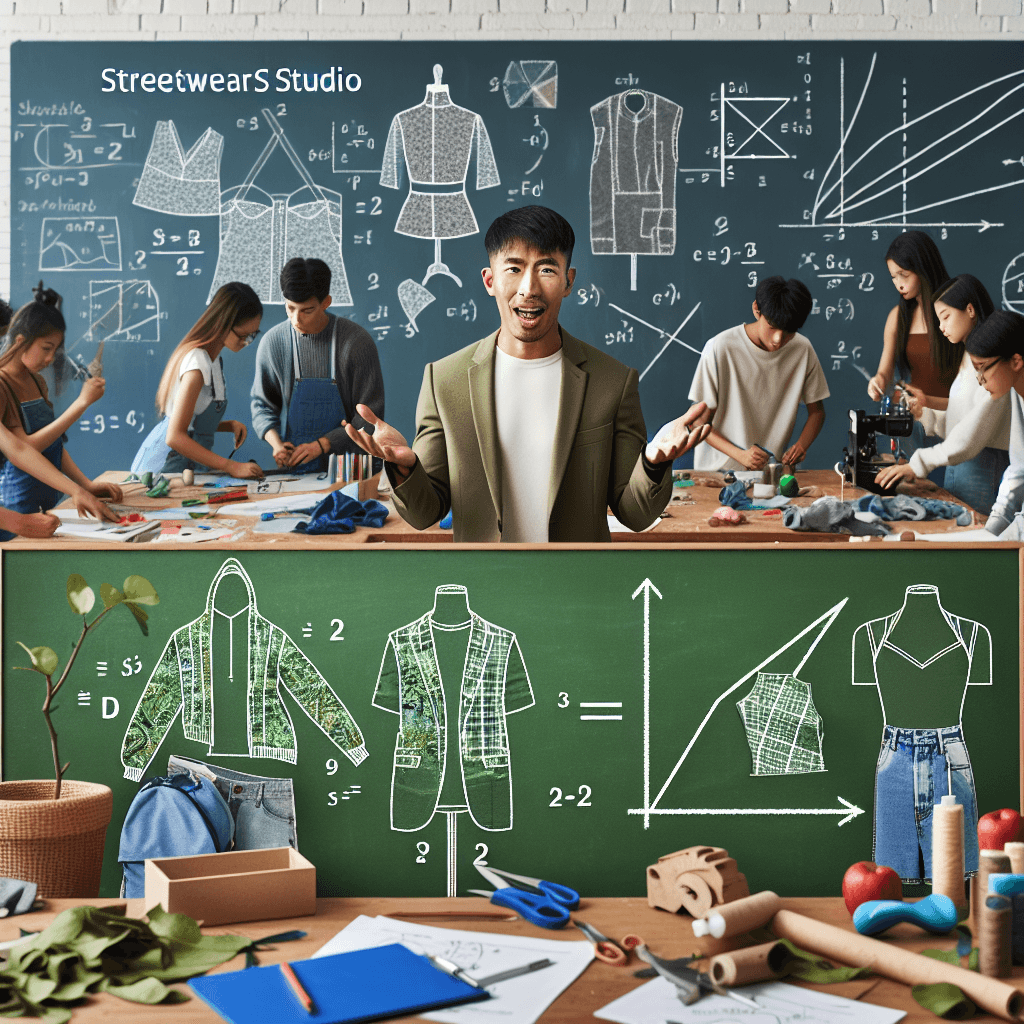
Streetwear Studio: Designing Sustainable Fashion Through Linear Equations
Inquiry Framework
Question Framework
Driving Question
The overarching question that guides the entire project.How can we, as ethical entrepreneurs, launch a sustainable streetwear brand that uses mathematical modeling and visual storytelling to prove that style doesn't have to cost the Earth?Essential Questions
Supporting questions that break down major concepts.- How can we translate real-world business costs (fixed vs. variable) into mathematical equations?
- What is the relationship between production scale, unit cost, and profit in a startup business?
- How do we use linear equations to determine our 'break-even point' and set sustainable prices?
- How can a brand's visual identity and logo communicate values of sustainability and social responsibility?
- In what ways does the 'story' of a product influence a consumer's willingness to pay a premium price?
- How do we use persuasive writing and data to pitch a business plan to potential investors?
- What are the environmental and ethical costs of the fashion industry, and how can we mitigate them through design?
Standards & Learning Goals
Learning Goals
By the end of this project, students will be able to:- Construct and solve linear equations (y = mx + b) to represent the relationship between fixed costs, variable costs, and total production costs in a business model.
- Identify and calculate the 'break-even point' for a product using algebraic methods to ensure business viability.
- Design a brand logo and visual identity that utilizes graphic design elements to communicate specific ethical and sustainable values.
- Write a persuasive business pitch that integrates mathematical data (pricing models) with narrative storytelling to convince an audience of a brand's value.
- Evaluate the environmental and social impacts of the fashion industry and propose specific sustainable mitigation strategies within a supply chain.
Common Core State Standards (Math)
Common Core State Standards (English Language Arts)
National Core Arts Standards (NCAS)
Next Generation Science Standards (NGSS)
Entry Events
Events that will be used to introduce the project to studentsThe Mystery Drop & Markup Reveal
Students walk into a classroom transformed into a high-end streetwear boutique 'drop' with a locked mystery crate. They must solve a series of linear equations representing production costs and retail markups to 'unlock' the brand's secret manifesto and the design challenge ahead.The $12 Hoodie Investigation
Students are presented with two identical-looking hoodies—one from a fast-fashion giant ($12) and one from a sustainable boutique ($85). They use linear equations to deconstruct the 'true cost' of each, investigating how labor, materials, and environmental taxes create the price gap, sparking a debate on value versus ethics.Portfolio Activities
Portfolio Activities
These activities progressively build towards your learning goals, with each submission contributing to the student's final portfolio.The Fast Fashion Autopsy: Designing for the Planet
Before designing a brand, students must understand the 'why.' In this activity, students research the lifecycle of a fast-fashion garment versus a sustainable one. They will investigate water usage, carbon footprint, and labor ethics, gathering the 'ethical data' needed to justify their future brand's higher price point.Steps
Here is some basic scaffolding to help students complete the activity.Final Product
What students will submit as the final product of the activityA 'Sustainability Scorecard' infographic comparing a fast-fashion hoodie to their proposed sustainable hoodie, highlighting three major environmental or social improvements.Alignment
How this activity aligns with the learning objectives & standardsAligns with MS-ESS3-3 (designing a method for minimizing human impact) and CCSS.ELA-LITERACY.W.7.1 (supporting claims with clear reasons and evidence).Icon of Ethics: The Visual Identity Lab
Every brand needs a soul. Students will develop their brand's name, mission statement, and a logo that visually represents sustainability. This activity bridges the gap between ethical research and visual communication, requiring students to explain how their design choices reflect their brand values.Steps
Here is some basic scaffolding to help students complete the activity.Final Product
What students will submit as the final product of the activityA Brand Style Guide including the logo, color palette (with symbolic meanings), and a 150-word brand manifesto.Alignment
How this activity aligns with the learning objectives & standardsAligns with VA:Cr2.1.7a (persistence in developing skills with materials/methods) and CCSS.ELA-LITERACY.W.7.1 (writing arguments to support claims).The Production Blueprint: Modeling the Studio
Now, students move into the 'Business Office.' They must determine what it actually costs to run their studio. They will categorize costs into 'Fixed' (q)—like renting a sewing space or buying a website domain—and 'Variable' (px)—like the cost of organic cotton per shirt. This activity teaches students how to build a mathematical model for their business.Steps
Here is some basic scaffolding to help students complete the activity.Final Product
What students will submit as the final product of the activityA 'Production Equation Sheet' that translates their business expenses into a formal linear equation (Total Cost = Variable Cost * x + Fixed Cost).Alignment
How this activity aligns with the learning objectives & standardsAligns with CCSS.Math.Content.7.EE.B.4.a (solving equations of the form px + q = r).The Break-Even Balance Sheet
Profit isn't just about price; it's about covering costs. Students will apply a markup to their production cost to determine a retail price. Then, they will use their linear equation to find the 'Break-Even Point'—the exact number of items they need to sell to reach a total revenue that covers all their initial costs.Steps
Here is some basic scaffolding to help students complete the activity.Final Product
What students will submit as the final product of the activityA 'Financial Viability Report' showing the markup calculations and a graph identifying the break-even point where Revenue = Total Cost.Alignment
How this activity aligns with the learning objectives & standardsAligns with CCSS.Math.Content.7.RP.A.3 (markups and percent problems) and CCSS.Math.Content.7.EE.B.4.a (comparing algebraic to arithmetic solutions).The 'Style with Soul' Investor Pitch
In this final capstone activity, students synthesize their research, design, and math. They will prepare a professional pitch for 'investors.' The pitch must prove that the brand is both environmentally responsible and financially viable, using their linear equations and logo as evidence.Steps
Here is some basic scaffolding to help students complete the activity.Final Product
What students will submit as the final product of the activityA 3-minute Multimedia Pitch Deck (e.g., PowerPoint, Video, or Poster) presented to the class and a panel of 'investors.'Alignment
How this activity aligns with the learning objectives & standardsAligns with CCSS.ELA-LITERACY.SL.7.4 (presenting claims and findings) and CCSS.Math.Content.7.EE.B.4.a (communicating the sequence of operations).Rubric & Reflection
Portfolio Rubric
Grading criteria for assessing the overall project portfolioSustainable Streetwear Studio: Comprehensive Project Rubric
Mathematical Modeling (7.EE.B.4.a & 7.RP.A.3)
Assessment of the mathematical precision and logical application of linear equations to the streetwear business model.Algebraic Modeling & Financial Analysis
Ability to translate business costs into linear equations of the form px + q = r and solve for the break-even point using algebraic methods.
Exemplary
4 PointsEquations perfectly model complex business scenarios; solutions are flawless; student provides a sophisticated comparison between algebraic and arithmetic solutions, demonstrating deep conceptual fluency.
Proficient
3 PointsEquations accurately represent fixed and variable costs; solving steps are clear and correct; break-even point is identified accurately based on the mathematical model.
Developing
2 PointsEquations are mostly correct but may contain minor errors in identifying 'p' or 'q'; break-even point is attempted but may contain calculation errors or logic gaps.
Beginning
1 PointsStruggles to translate business costs into the correct algebraic form; equations are incomplete or missing; significant support is needed to solve for the unknown.
Environmental & Social Impact (MS-ESS3-3)
Assessment of the student's understanding of human impact on the environment and the ethical justifications for sustainable business.Ethical Research & Sustainability Literacy
Ability to research, analyze, and communicate the environmental and social impacts of the fashion industry and propose sustainable mitigation strategies.
Exemplary
4 PointsInfographic provides a highly sophisticated analysis of 'hidden costs'; claims are supported by diverse, high-quality evidence; proposed solutions show innovative thinking in environmental science.
Proficient
3 PointsInfographic clearly compares fast-fashion to sustainable models; provides specific examples of environmental/social impact; claims are supported by relevant data and research.
Developing
2 PointsIdentifies basic differences between production models but lacks depth in research; infographic is partially complete or uses vague evidence to support claims.
Beginning
1 PointsMinimal research into environmental impacts; unable to clearly distinguish between fast-fashion and sustainable practices; infographic is incomplete.
Artistic Design & Branding (VA:Cr2.1.7a)
Assessment of the student's ability to use design elements and symbolism to create a cohesive brand identity.Visual Communication & Logo Design
Development of a brand logo and visual identity that effectively communicates the brand's ethical values through symbolic design and artistic persistence.
Exemplary
4 PointsLogo is professional, scalable, and rich with symbolic meaning; the brand manifesto is deeply evocative and perfectly aligns with the visual identity; shows exceptional craftsmanship.
Proficient
3 PointsLogo is clean, purposeful, and communicates brand values; style guide includes a clear color palette and a coherent brand manifesto.
Developing
2 PointsLogo is developed but symbolism is literal or underdeveloped; brand manifesto is brief or lacks a strong connection to the visual design elements.
Beginning
1 PointsVisual identity lacks clarity or connection to the sustainability theme; logo design shows minimal effort in iteration or refinement.
Strategic Communication (W.7.1 & SL.7.4)
Assessment of the student's ability to argue for their brand's viability using both qualitative storytelling and quantitative data.Persuasive Synthesis & Pitch Delivery
Synthesis of research, design, and math into a persuasive multimedia pitch delivered with professional oral communication skills.
Exemplary
4 PointsPitch is compelling and seamless; integrates data and storytelling masterfully; speaker exhibits commanding presence, exceptional eye contact, and handles complex investor questions with ease.
Proficient
3 PointsPitch is well-organized with clear claims and evidence; integrates math and design effectively; speaker maintains good volume, eye contact, and professional pronunciation.
Developing
2 PointsPitch includes most required elements but the argument lacks flow; data is present but not fully explained; speaker may struggle with volume, eye contact, or delivery.
Beginning
1 PointsPresentation is disorganized or incomplete; fails to integrate mathematical findings or brand story; speaker requires significant prompting and lacks professional delivery.