
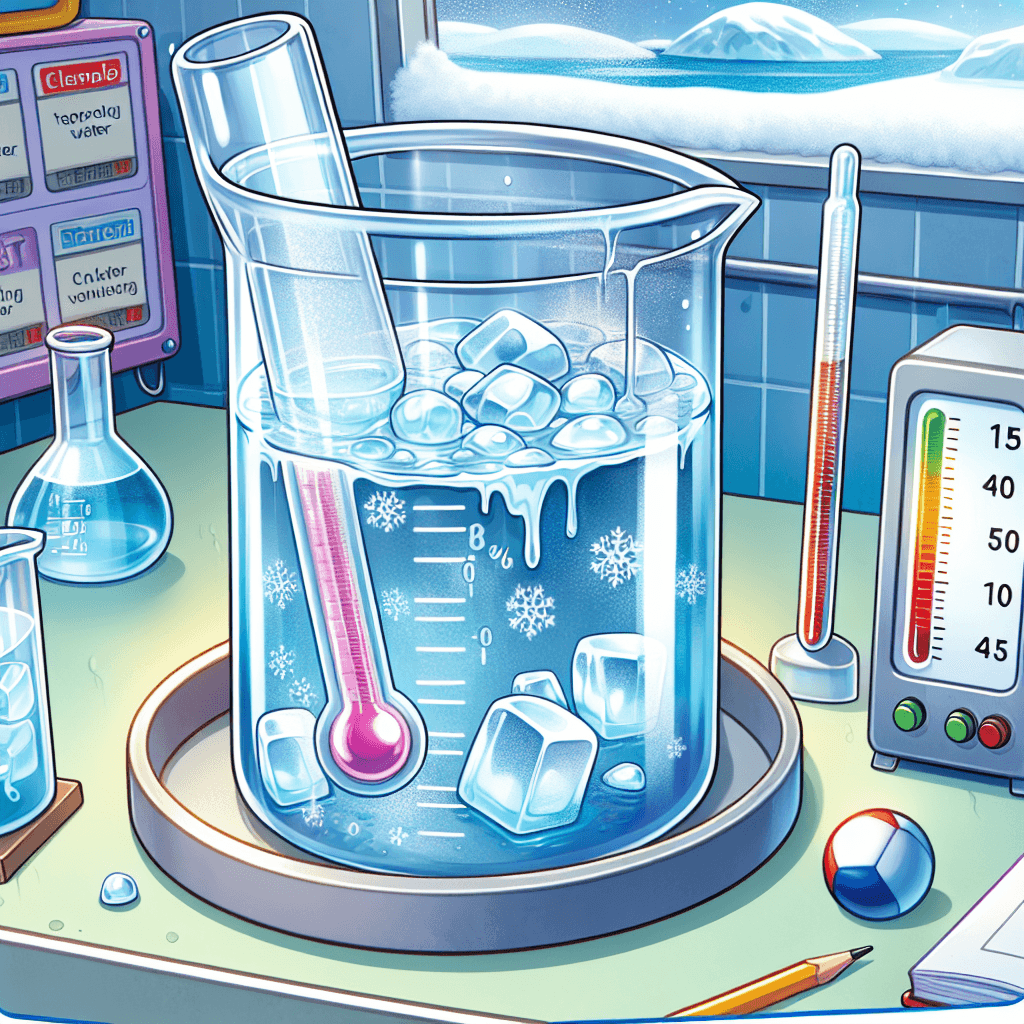
Supercooled Water: Exploring States of Matter
Inquiry Framework
Question Framework
Driving Question
The overarching question that guides the entire project.How can we use our understanding of energy transfer and particle behavior to explain and predict the fascinating phenomenon of supercooled water instantly freezing?Essential Questions
Supporting questions that break down major concepts.- How does the addition or removal of energy change the state of matter?
- How do particles behave differently in solids, liquids, and gases?
- What is the relationship between energy, temperature, and particle motion?
- How can we predict and explain changes in state of matter based on energy transfer?
Standards & Learning Goals
Learning Goals
By the end of this project, students will be able to:- Students will be able to explain how energy transfer affects the state of matter.
- Students will be able to describe the behavior of particles in solids, liquids, and gases.
- Students will be able to relate energy, temperature, and particle motion.
- Students will be able to predict and explain changes in the state of matter.
- Students will be able to explain the phenomenon of supercooled water instantly freezing in terms of energy transfer and particle behavior
NGSS
Entry Events
Events that will be used to introduce the project to studentsInstant Freeze Challenge
Students watch a video of supercooled water instantly freezing. They then receive a mysterious, sealed container of supercooled water and must design an experiment to investigate the conditions that cause it to freeze, connecting to particle arrangement and energy transfer. This challenges their assumptions about freezing points and encourages them to think like scientists.Portfolio Activities
Portfolio Activities
These activities progressively build towards your learning goals, with each submission contributing to the student's final portfolio.Phase Change Temperature Tracker
Students will conduct experiments to observe the temperature changes during melting and freezing. They will measure and record the temperature of water as it freezes and ice as it melts, graphing the data to visualize energy transfer.Steps
Here is some basic scaffolding to help students complete the activity.Final Product
What students will submit as the final product of the activityA lab report including a hypothesis, procedure, data table, graph of temperature vs. time, and a conclusion explaining the relationship between energy transfer and temperature during phase changes.Alignment
How this activity aligns with the learning objectives & standardsAddresses MS PS 1-4 by focusing on how energy is transferred during phase changes and how this relates to temperature changes.Supercooled Water Explained
Students will write a scientific explanation of supercooled water, detailing why it doesn't freeze at 0°C and what triggers the instant freezing. They should include diagrams and descriptions of molecular behavior and energy transfer.Steps
Here is some basic scaffolding to help students complete the activity.Final Product
What students will submit as the final product of the activityA written scientific explanation of supercooled water, including diagrams and descriptions of molecular behavior and energy transfer.Alignment
How this activity aligns with the learning objectives & standardsAddresses MS PS 1-1 and MS PS 1-4 by requiring students to explain the phenomenon of supercooled water in terms of molecular behavior and energy transfer.Molecular States Artist
Students create visual representations of water molecules in solid (ice), liquid (water), and gaseous (steam) states. They will illustrate the arrangement and movement of the molecules in each state.Steps
Here is some basic scaffolding to help students complete the activity.Final Product
What students will submit as the final product of the activityA set of three drawings or digital models illustrating water molecules in different states with annotations explaining the particle arrangement and movement in each state.Alignment
How this activity aligns with the learning objectives & standardsAddresses MS PS 1-1 by focusing on the arrangement of water molecules in different states (solid, liquid, gas).Rubric & Reflection
Portfolio Rubric
Grading criteria for assessing the overall project portfolioPhase Changes and Supercooled Water Rubric
Phase Change Experiment
Assesses the student's ability to collect and analyze temperature data during phase changes and to explain the relationship between energy transfer and temperature.Data Accuracy
Accuracy of temperature measurements and data recording.
Exemplary
4 PointsDemonstrates accurate and precise temperature measurements with meticulous data recording; Identifies and corrects potential sources of error.
Proficient
3 PointsRecords temperature measurements accurately with minimal errors; Demonstrates careful data collection.
Developing
2 PointsRecords temperature measurements with some inaccuracies; Data collection shows inconsistencies.
Beginning
1 PointsRecords temperature measurements inaccurately; Data collection is incomplete and inconsistent.
Graph Quality
Quality and clarity of the temperature vs. time graph.
Exemplary
4 PointsPresents a clear, well-organized graph with accurately labeled axes and data points; Graph effectively illustrates the relationship between energy transfer and temperature change.
Proficient
3 PointsPresents a graph with labeled axes and data points; Graph accurately represents the data collected.
Developing
2 PointsPresents a graph with some labeling errors or omissions; Graph partially represents the data collected.
Beginning
1 PointsPresents an incomplete or poorly labeled graph; Graph does not accurately represent the data collected.
Conclusion Explanation
Depth of understanding and explanation of the relationship between energy transfer and temperature in the conclusion.
Exemplary
4 PointsProvides a comprehensive and insightful explanation of the relationship between energy transfer and temperature change, linking observations to underlying scientific principles; Discusses limitations and future investigations.
Proficient
3 PointsProvides a clear and accurate explanation of the relationship between energy transfer and temperature change, supporting claims with evidence from the experiment.
Developing
2 PointsProvides a basic explanation of the relationship between energy transfer and temperature change, but lacks depth or supporting evidence.
Beginning
1 PointsProvides a limited or inaccurate explanation of the relationship between energy transfer and temperature change; Fails to connect observations to scientific principles.
Supercooled Water Explanation
Evaluates the student's ability to explain the scientific principles behind supercooled water, including its unique properties and behavior.Explanation Accuracy
Thoroughness and accuracy of the scientific explanation of supercooled water.
Exemplary
4 PointsProvides a comprehensive and accurate scientific explanation of supercooled water, including the reasons it doesn't freeze at the normal freezing point, the triggers for instant freezing, and the energy transfer involved; Explanation is supported by evidence and demonstrates deep understanding.
Proficient
3 PointsProvides an accurate scientific explanation of supercooled water, including the reasons it doesn't freeze at the normal freezing point, the triggers for instant freezing, and the energy transfer involved.
Developing
2 PointsProvides a partially accurate scientific explanation of supercooled water, but may be missing key details or contain minor inaccuracies.
Beginning
1 PointsProvides an incomplete or inaccurate scientific explanation of supercooled water; Fails to address key aspects of the phenomenon.
Diagram Quality
Clarity and effectiveness of diagrams illustrating molecular behavior and energy transfer.
Exemplary
4 PointsIncludes clear, detailed, and accurate diagrams illustrating molecular behavior and energy transfer during the instant freezing of supercooled water; Diagrams are effectively labeled and enhance understanding of the explanation.
Proficient
3 PointsIncludes clear and accurate diagrams illustrating molecular behavior and energy transfer during the instant freezing of supercooled water; Diagrams are labeled and support the explanation.
Developing
2 PointsIncludes diagrams illustrating molecular behavior and energy transfer, but the diagrams may lack detail or accuracy.
Beginning
1 PointsIncludes incomplete or inaccurate diagrams illustrating molecular behavior and energy transfer; Diagrams do not effectively support the explanation.
Molecular Description
Depth of understanding and description of the molecular behavior and energy transfer involved.
Exemplary
4 PointsProvides an insightful and detailed description of the molecular behavior and energy transfer involved in supercooled water; Explanation demonstrates a thorough understanding of the underlying scientific principles and connects them to the observed phenomenon.
Proficient
3 PointsProvides a clear and accurate description of the molecular behavior and energy transfer involved in supercooled water; Explanation demonstrates a good understanding of the underlying scientific principles.
Developing
2 PointsProvides a basic description of the molecular behavior and energy transfer involved in supercooled water, but lacks depth or detail.
Beginning
1 PointsProvides a limited or inaccurate description of the molecular behavior and energy transfer involved in supercooled water; Fails to connect the description to scientific principles.
Molecular States Representation
Assesses the student's ability to visually represent and explain the arrangement and movement of water molecules in different states of matter.Model Accuracy
Accuracy and detail in the visual representation of water molecules in solid, liquid, and gas states.
Exemplary
4 PointsCreates highly accurate and detailed visual representations of water molecules in solid, liquid, and gas states; Models demonstrate a sophisticated understanding of molecular arrangement and movement.
Proficient
3 PointsCreates accurate visual representations of water molecules in solid, liquid, and gas states; Models demonstrate a clear understanding of molecular arrangement and movement.
Developing
2 PointsCreates visual representations of water molecules in solid, liquid, and gas states, but the models may lack detail or contain minor inaccuracies.
Beginning
1 PointsCreates incomplete or inaccurate visual representations of water molecules in solid, liquid, and gas states; Models do not effectively demonstrate molecular arrangement and movement.
Annotation Quality
Clarity and completeness of annotations explaining particle arrangement and movement in each state.
Exemplary
4 PointsProvides clear, concise, and comprehensive annotations explaining the particle arrangement and movement in each state; Annotations demonstrate a deep understanding of the kinetic molecular theory.
Proficient
3 PointsProvides clear and complete annotations explaining the particle arrangement and movement in each state; Annotations demonstrate a good understanding of the kinetic molecular theory.
Developing
2 PointsProvides annotations explaining the particle arrangement and movement in each state, but the annotations may lack detail or clarity.
Beginning
1 PointsProvides incomplete or unclear annotations explaining the particle arrangement and movement in each state; Annotations do not effectively demonstrate understanding of the kinetic molecular theory.
Communication Effectiveness
Overall effectiveness of the models in communicating the differences between molecular states.
Exemplary
4 PointsModels are highly effective in communicating the differences between molecular states, demonstrating a sophisticated understanding of the properties of solids, liquids, and gases.
Proficient
3 PointsModels are effective in communicating the differences between molecular states, demonstrating a good understanding of the properties of solids, liquids, and gases.
Developing
2 PointsModels partially communicate the differences between molecular states, but may lack clarity or detail.
Beginning
1 PointsModels do not effectively communicate the differences between molecular states; Demonstrates a limited understanding of the properties of solids, liquids, and gases.