
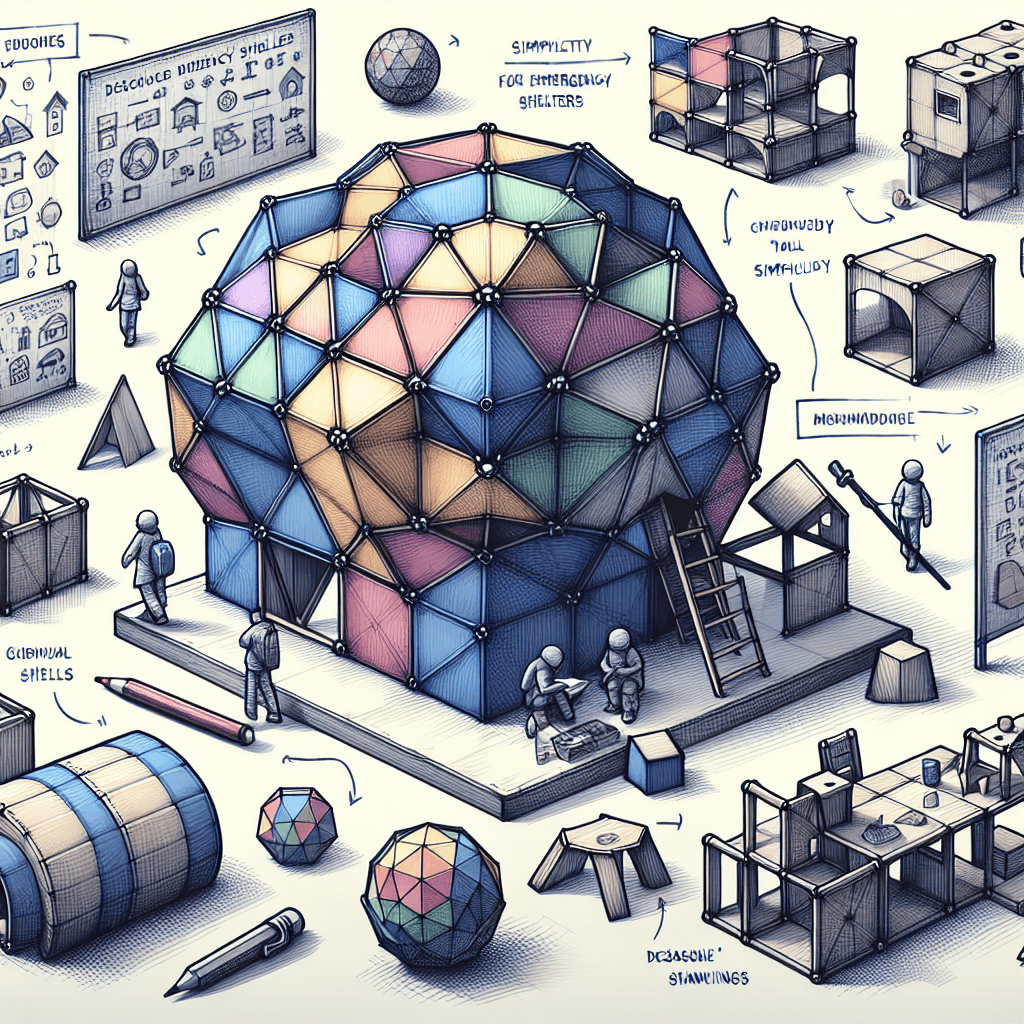
Survival Shells: Modular Geometry for Emergency Shelter Design
Inquiry Framework
Question Framework
Driving Question
The overarching question that guides the entire project.How can we, as solution seekers, design a modular emergency shelter system that optimizes volume for human safety while minimizing surface area for maximum thermal efficiency and portability?Essential Questions
Supporting questions that break down major concepts.- How can we, as solution seekers, use geometric modularity and volume constraints to design high-efficiency emergency shelters that maximize human safety and portability?
- What is the relationship between surface area and volume, and how does this ratio impact the cost and thermal efficiency of a shelter?
- How can modular geometric shapes be utilized to create structures that are both easy to transport and quick to assemble in a disaster zone?
- How do we mathematically determine the minimum spatial requirements for a human being while staying within the constraints of available materials?
- In what ways can geometric transformations (translations, rotations, and reflections) be used to optimize the layout of a multi-unit shelter camp?
- How does the choice of a specific 3D polyhedra (e.g., prisms vs. pyramids vs. geodesic domes) affect the structural integrity and interior functionality of a survival shell?
Standards & Learning Goals
Learning Goals
By the end of this project, students will be able to:- Students will calculate and analyze the surface area-to-volume ratios of various 3D polyhedra to optimize thermal efficiency and material usage in shelter design.
- Students will apply geometric transformations (translations, rotations, and reflections) to design modular components that can be efficiently packed, transported, and assembled.
- Students will use volume formulas and constraints to determine the minimum spatial requirements for human occupancy while maintaining structural integrity.
- Students will evaluate the trade-offs between different geometric shapes (prisms, pyramids, geodesic domes) based on structural stability, interior functionality, and portability.
- Students will demonstrate the 'Solution Seeker' mindset by iterating on designs to overcome physical and financial constraints in a disaster-relief scenario.
Common Core State Standards for Mathematics
Local School/District Competencies
Entry Events
Events that will be used to introduce the project to studentsThe 'Footprint' Challenge
Students enter a classroom where a 2-meter by 2-meter square is taped on the floor, containing only a 'survival kit' of 10 essential items. They are told they must design a structure that fits within this footprint but maximizes living volume and heat retention for a family of four. This immediately forces students to grapple with the tension between limited floor space and the geometric need for vertical or modular expansion.Portfolio Activities
Portfolio Activities
These activities progressively build towards your learning goals, with each submission contributing to the student's final portfolio.The Human Dimension Blueprint
Before designing the shelter, students must understand the 'client.' In this activity, students use geometric modeling to determine the minimum volume required to house a family of four. They will represent human bodies as cylinders or rectangular prisms to calculate the 'living volume' and the 'buffer volume' needed for movement and essential supplies.Steps
Here is some basic scaffolding to help students complete the activity.Final Product
What students will submit as the final product of the activityA dimensioned 'Human Spatial Analysis' blueprint that outlines the total required volume and the minimum floor area (the 2m x 2m footprint) for the shelter.Alignment
How this activity aligns with the learning objectives & standardsHSG-MG.A.1: Modeling human spatial needs as geometric shapes. HSG-GMD.A.3: Calculating volumes of cylinders and prisms to determine capacity.The Efficiency Audit: Surface vs. Volume
Thermal efficiency in a survival scenario is often a function of the Surface Area to Volume (SA:V) ratio. Students will compare three different geometric designs (e.g., a rectangular prism, a square pyramid, and a geodesic half-sphere/cylinder) that all share the same internal volume calculated in Activity 1. They will determine which shape requires the least material (surface area) to enclose the most space, thereby minimizing heat loss.Steps
Here is some basic scaffolding to help students complete the activity.Final Product
What students will submit as the final product of the activityAn 'Efficiency Audit Report' featuring a comparison table of volumes, surface areas, and SA:V ratios for three different polyhedra.Alignment
How this activity aligns with the learning objectives & standardsHSG-MG.A.3: Applying geometric methods to satisfy constraints and minimize cost (material usage). HSG-GMD.A.3: Using formulas for pyramids, prisms, and cylinders to solve optimization problems.Modular Mosaic: The Transformation Task
Survival shells must be portable. In this activity, students focus on the 'modularity' of their design. They will use geometric transformations—translations, rotations, and reflections—to show how their shelter design can be collapsed into a 'flat-pack' or how multiple units can be tessellated to form a camp. This ensures the design is not just a single unit, but a scalable system.Steps
Here is some basic scaffolding to help students complete the activity.Final Product
What students will submit as the final product of the activityA 'Transformation Map' or digital animation showing the shell folding from 3D to 2D, or a layout showing how 10 shells pack perfectly into a shipping container.Alignment
How this activity aligns with the learning objectives & standardsHSG-CO.A.2: Representing transformations in the plane and describing them as functions to optimize layout and packing.The Survival Shell Pitch & Prototype
Students bring all previous math together to build a final scale model of their Survival Shell. They must justify their design choices based on the SA:V ratio (efficiency), volume (human needs), and modularity (portability). As 'Solution Seekers,' they must identify one major design flaw discovered during the process and explain the mathematical iterative change they made to solve it.Steps
Here is some basic scaffolding to help students complete the activity.Final Product
What students will submit as the final product of the activityA 1:10 scale physical model of the Survival Shell accompanied by a 'Solution Seeker’s Pitch'—a presentation or technical brief justifying the design with math.Alignment
How this activity aligns with the learning objectives & standardsSS-01: Demonstrating the 'Solution Seeker' mindset through iterative design. HSG-MG.A.3: Final design synthesis to satisfy physical and safety constraints.Rubric & Reflection
Portfolio Rubric
Grading criteria for assessing the overall project portfolioThe Survival Shell: Geometry & Design Optimization Rubric
Human-Centric Geometric Modeling
Evaluation of the student's ability to model real-world constraints using 3D geometry and volume formulas.Geometric Spatial Analysis
Accuracy and sophistication in representing human dimensions and survival needs as 3D geometric solids (cylinders, prisms, etc.) within the 2m x 2m constraint.
Exemplary
4 PointsModeling is highly sophisticated; uses precise dimensions and complex geometric representations to maximize the 2m x 2m footprint while ensuring realistic human comfort and 'buffer' volume. All calculations are flawlessly executed and clearly documented.
Proficient
3 PointsModeling accurately represents humans and survival items using appropriate 3D shapes. The 2m x 2m footprint constraint is met, and volume calculations for living and buffer space are correct.
Developing
2 PointsModeling is attempted but may use oversimplified shapes or contain minor errors in volume calculations. The relationship between the human dimensions and the footprint is somewhat unclear or slightly exceeds constraints.
Beginning
1 PointsModeling is incomplete or inaccurate. Shapes used do not logically represent human dimensions, and volume calculations are missing or contain significant errors. Footprint constraints are ignored.
Efficiency & Optimization
Assessment of the student's application of geometric methods to satisfy physical constraints and maximize efficiency.SA:V Optimization Analysis
The ability to calculate surface area and volume for multiple polyhedra and use the SA:V ratio to justify the most thermally and materially efficient design.
Exemplary
4 PointsDemonstrates expert-level analysis by comparing three or more complex shapes; provides a deep mathematical justification for the chosen design based on minimizing material (SA) while maximizing volume (V) and explains the thermal implications in detail.
Proficient
3 PointsAccurately calculates SA, Volume, and SA:V ratios for three different shapes. Correctly identifies the most efficient shape and provides a clear mathematical explanation for the choice.
Developing
2 PointsCalculates SA and Volume for shapes but may have errors in the ratio calculation. Comparison is basic, and the choice of the 'most efficient' shape is only partially supported by the data.
Beginning
1 PointsFails to accurately calculate SA or Volume. Comparison table is missing or contains major mathematical flaws, showing little understanding of the SA:V relationship.
Modular Design & Transformations
Evaluation of how geometric transformations are used to optimize the transport and scalability of the shelter system.Transformation & Modularity Accuracy
Application of rigid motions (translations, rotations, reflections) to design a modular system that is portable and scalable.
Exemplary
4 PointsUses complex transformations and tessellations to create a highly efficient 'flat-pack' design or camp layout. Describes transformations as functions with precise notation (e.g., coordinates, degrees) and demonstrates innovative space-saving techniques.
Proficient
3 PointsClearly demonstrates how transformations (translations, rotations, reflections) allow the shelter to fold or be arranged into a multi-unit layout. Transformations are documented correctly and show a logical modular system.
Developing
2 PointsApplies basic transformations to the design, but the modularity or packing efficiency is limited. Documentation of the specific movements (rotations/translations) is vague or inconsistent.
Beginning
1 PointsMinimal use of transformations. The design is static and does not account for portability, folding, or modular layout. Transformations are not mathematically described.
Solution Seeker Synthesis
Assessment of the student's ability to refine their work and communicate their mathematical reasoning effectively.Iterative Problem Solving
Demonstration of the 'Solution Seeker' mindset by identifying design flaws through prototyping and using mathematical reasoning to iterate and improve the final product.
Exemplary
4 PointsIdentifies a complex design flaw during prototyping and executes a sophisticated mathematical correction. The final pitch is compelling, using precise data (SA:V, volume, transformations) to justify every design decision to the expert panel.
Proficient
3 PointsIdentifies a clear point of failure and uses math to iterate a solution. The final prototype and pitch logically integrate volume and efficiency data to support the design's viability.
Developing
2 PointsRecognizes a problem with the design but the iterative fix is not strongly supported by mathematical reasoning. The pitch includes basic project details but lacks a cohesive argument for efficiency.
Beginning
1 PointsShows little evidence of iteration; design flaws are either ignored or fixed without mathematical justification. The pitch is incomplete or fails to address the core design constraints.