
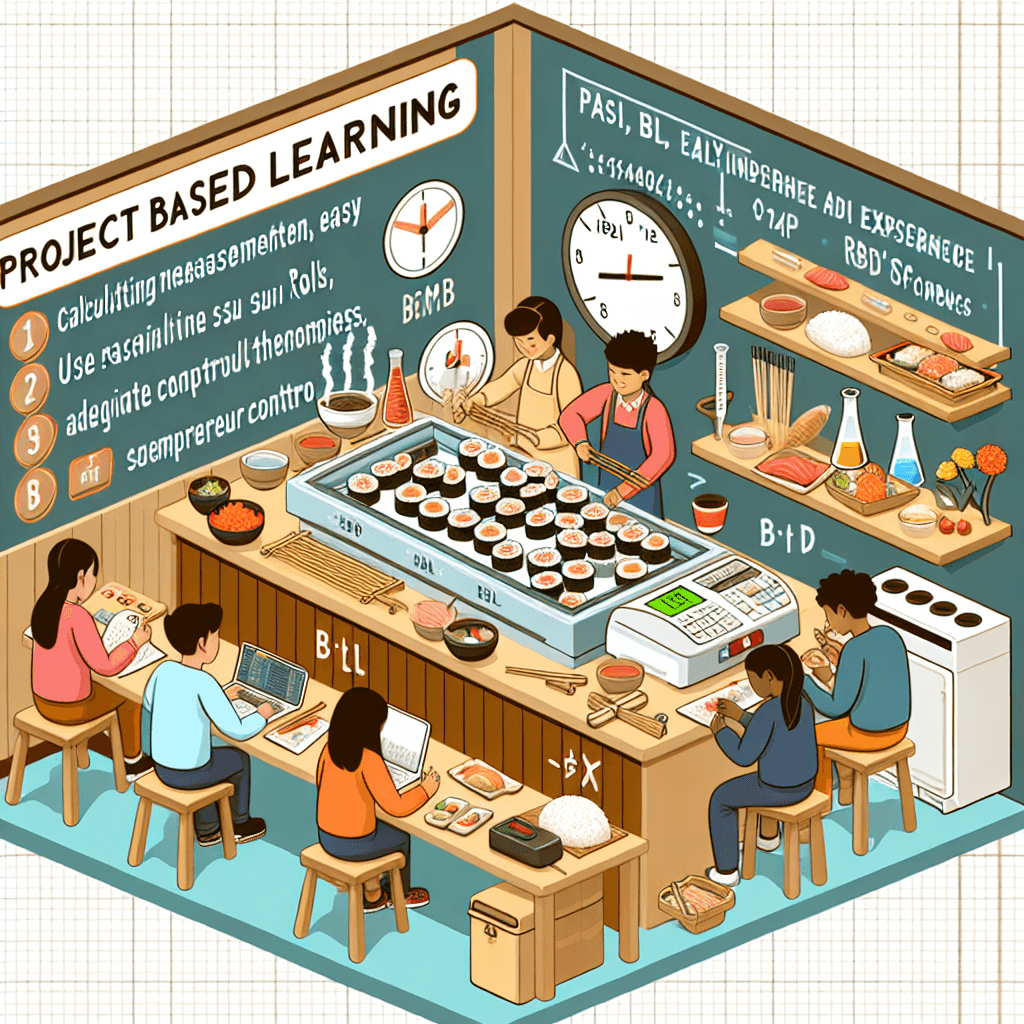
Sushi Bar Simulation with Math and Science
Inquiry Framework
Question Framework
Driving Question
The overarching question that guides the entire project.How can we design an inclusive and interactive sushi bar that captures the essence of Japanese culture, incorporates essential math and science concepts, and creatively expresses art and geographical influences?Essential Questions
Supporting questions that break down major concepts.- What are the core ingredients in sushi and why are they important?
- How can we use math to calculate the ingredients needed for making different sushi rolls?
- What scientific processes are involved in sushi preparation, such as fermentation?
- In what ways does sushi reflect Japanese culture and history?
- How can we create a sushi bar station that incorporates art and design?
- How does geography influence the ingredients available for sushi making in Japan?
- What are some ways we can make our sushi bar inclusive and accessible to everyone?
Standards & Learning Goals
Learning Goals
By the end of this project, students will be able to:- Students will understand and apply basic multiplication and division to solve real-world problems involving quantities and measurements.
- Students will comprehend the cultural significance of sushi in Japanese culture and its historical context.
- Learners will explore scientific concepts such as fermentation and how they apply to food preparation.
- Students will design and conceptualize a sushi bar, integrating elements of art, geography, and inclusivity.
- Participants will engage with fractions to measure ingredients accurately and create balanced sushi recipes.
- Students will develop their research skills by asking and answering questions about Japanese culture and the geographical origins of sushi.
- Learners will contribute to designing an inclusive sushi bar that addresses diverse needs and accessibility features.
Common Core Standards - Math
NGSS
Common Core Standards - English/Language Arts
Social Studies C3 Framework
Entry Events
Events that will be used to introduce the project to studentsSushi Bar Pop-up Experience
Transform the classroom into a bustling sushi bar for a day, with sensory stations featuring sushi ingredients, a Japanese chef's video demonstration, and traditional music. This immersive setup will ignite students' curiosity about sushi-making processes and allow them to explore the math and science involved in recipes and sushi rolling. The integration of Japanese culture spurs inquiry into geography and social studies, while art activities like creating sushi menus blend creativity with cultural learning.A Sushi Chef's Mysterious Message
Kick off the project with a cryptic letter from a fictional Sushi Chef, urging students to solve puzzles and conduct experiments to unlock his prized sushi recipes. The scenario encourages decoding activities, problem-solving, and scientific exploration of ingredients while tying in aspects of Japanese history and geography. The mysterious narrative structure hooks students immediately and keeps them engaged throughout the project.Create Your Sushi Roll Competition
Launch a sushi roll design contest ('Create Your Sushi Roll') where students submit their own sushi roll recipes and designs. Alongside creative expression and culinary exploration, students will calculate ingredient costs, analyze nutritional content, and draw connections to Japanese culinary customs. Offering a blend of art, math, and science within a real-world context, this entry event provides ample pathways for inquiry and exploration.Portfolio Activities
Portfolio Activities
These activities progressively build towards your learning goals, with each submission contributing to the student's final portfolio.Addition and Subtraction Sushi Challenges
This activity focuses on strengthening students' addition and subtraction skills using sushi-themed problems and scenarios. Engaging students in a culinary context helps them practice basic arithmetic, improving their problem-solving abilities in a fun, themed way.Steps
Here is some basic scaffolding to help students complete the activity.Final Product
What students will submit as the final product of the activityA sushi roll plan with detailed calculations of required ingredients, illustrating effective use of addition and subtraction.Alignment
How this activity aligns with the learning objectives & standardsSupports basic arithmetic operations focusing on addition and subtraction through real-life sushi scenarios.Rubric & Reflection
Portfolio Rubric
Grading criteria for assessing the overall project portfolioInteractive Sushi Bar Project Rubric
Mathematical Applications
Assess the ability to use multiplication and division with fractions in practical scenarios related to the sushi bar.Multiplication and Division Proficiency
Evaluates the effectiveness of using multiplication and division to calculate sushi ingredient quantities.
Exemplary
4 PointsAccurately and efficiently uses multiplication and division to solve complex ingredient calculations without errors.
Proficient
3 PointsCorrectly applies multiplication and division in the majority of ingredient calculations with minor errors.
Developing
2 PointsAttempts multiplication and division with some understanding but with frequent errors.
Beginning
1 PointsStruggles to apply multiplication and division, leading to inaccurate calculations.
Fractions Understanding
Measures understanding of fractions in the context of ingredient measurement for sushi recipes.
Exemplary
4 PointsDisplays a clear understanding of fractions by accurately measuring and using ingredients to create well-balanced sushi recipes.
Proficient
3 PointsUnderstands and applies fractions correctly in most ingredient measurements with few inaccuracies.
Developing
2 PointsShows basic understanding of fractions but makes inconsistent measurement errors.
Beginning
1 PointsHas difficulty understanding and applying fractions, resulting in significant measurement errors.
Cultural Comprehension
Evaluate the understanding of Japanese culture and history as demonstrated through the sushi bar project.Cultural Elements Integration
Assesses integration of Japanese cultural aspects in the sushi bar design.
Exemplary
4 PointsThoroughly integrates diverse cultural elements, showing a deep understanding of Japanese culture and sushi's historical context.
Proficient
3 PointsIntegrates cultural elements effectively, with a solid understanding of Japanese cultural influences.
Developing
2 PointsIncludes some cultural elements with basic understanding but lacks depth.
Beginning
1 PointsDisplays minimal integration of Japanese cultural elements with little understanding or relevance.
Scientific Inquiry and Processes
Assesses understanding of scientific processes like fermentation in sushi preparation.Scientific Concept Application
Evaluates application of scientific concepts such as reversible and irreversible changes in sushi making.
Exemplary
4 PointsDemonstrates a robust understanding of scientific processes in sushi preparation, accurately describing the roles of fermentation and other changes.
Proficient
3 PointsShows understanding of scientific processes and applies them correctly in the context of sushi making.
Developing
2 PointsShows basic awareness of scientific processes with partial understanding and application.
Beginning
1 PointsLacks understanding of scientific processes, failing to accurately describe or apply them.
Creativity and Design
Assess creative and artistic integration in the design of a sushi bar that also reflects inclusiveness and accessibility.Design Innovation
Assesses creativity and innovation in the design of the sushi bar.
Exemplary
4 PointsExhibits exceptional creativity and innovation, creating an inviting and culturally rich sushi bar design that is inclusive and accessible.
Proficient
3 PointsDemonstrates clear creativity and thoughtfulness in design, with some consideration of accessibility.
Developing
2 PointsShows basic creativity in design, with limited accessibility features.
Beginning
1 PointsDemonstrates minimal creativity, lacking innovation and accessibility.