
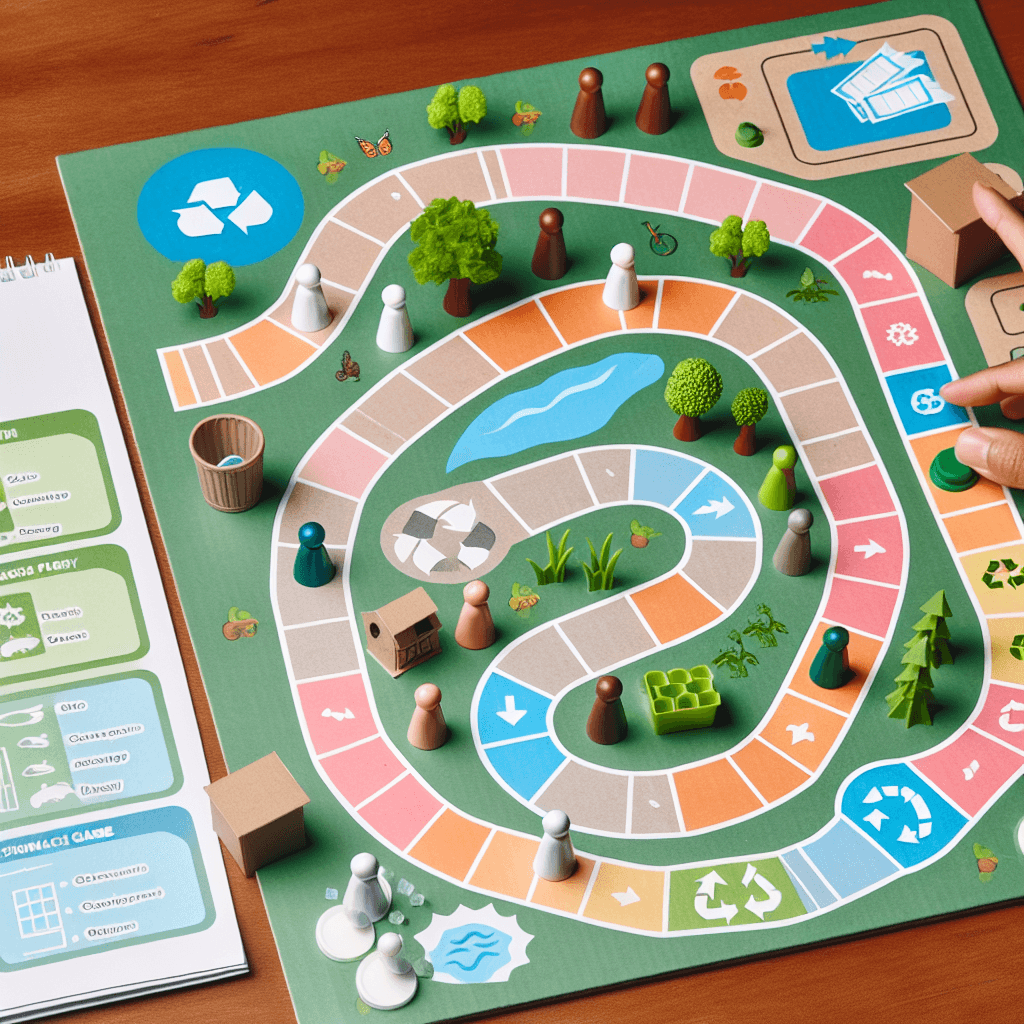
Sustainability Challenge: Design a Resource Management Board Game
Inquiry Framework
Question Framework
Driving Question
The overarching question that guides the entire project.How can we design a game that teaches players to make sustainable choices and understand global resource interdependence?Essential Questions
Supporting questions that break down major concepts.- How do our daily choices affect global resources?
- What are the key principles of sustainable resource management?
- How can we balance economic needs with environmental protection?
- In what ways are countries around the world interdependent in terms of resources?
- What are the consequences of unsustainable practices?
Standards & Learning Goals
Learning Goals
By the end of this project, students will be able to:- Students will be able to explain the concept of sustainable development.
- Students will be able to identify and analyze the impact of human activities on global resources.
- Students will be able to design a board game that effectively teaches sustainable resource management.
- Students will be able to evaluate the interdependence of countries in terms of resource management.
Entry Events
Events that will be used to introduce the project to studentsEchoes of Eco-City
A mysterious package arrives containing strange artifacts from a future 'Eco-City' that collapsed. Students must analyze these objects to determine what went wrong and how sustainable practices could have prevented the city's downfall, sparking their investigation into sustainable resource management.Global Crisis Simulation
Stage a mock 'Global Resources Summit' where each student represents a different country with unique resources and challenges. A sudden 'resource crisis' (e.g., water scarcity, deforestation) forces them to negotiate, collaborate, and make tough decisions about sustainability to avoid a global catastrophe, introducing the complexities of interdependence.Paradise Lost?
Present students with a seemingly idyllic island community facing a rapid influx of tourists. This boom threatens the island's delicate ecosystem and traditional way of life. Students must work as consultants to advise the community on how to balance economic growth with environmental protection, prompting them to explore sustainable development strategies.Sustainability Shark Tank
Challenge students to 'pitch' their own innovative solutions for a local sustainability problem (e.g., waste management, energy consumption) to a panel of 'investors' (teachers, community members). The catch? They can only use materials readily available to them, encouraging creative problem-solving and a deeper understanding of resource limitations.The Future is Now
Begin with a captivating video showcasing extreme examples of both environmental destruction and successful sustainable initiatives around the world. Ask students to vote on which location they think will be inhabitable first in 50 years. This exercise sparks debate and sets the stage for investigating the factors that contribute to or detract from long-term sustainability.Portfolio Activities
Portfolio Activities
These activities progressively build towards your learning goals, with each submission contributing to the student's final portfolio.Decoding Sustainability: Defining the Core
Students research and define sustainable development, exploring its core principles and goals.Steps
Here is some basic scaffolding to help students complete the activity.Final Product
What students will submit as the final product of the activityA detailed definition of sustainable development with examples and a visual representation (e.g., infographic, mind map).Alignment
How this activity aligns with the learning objectives & standardsAddresses the learning goal: Students will be able to explain the concept of sustainable development.Ripple Effects: Mapping Human Impact
Students investigate the impact of specific human activities (e.g., deforestation, overfishing, industrial pollution) on global resources, analyzing their consequences.Steps
Here is some basic scaffolding to help students complete the activity.Final Product
What students will submit as the final product of the activityA cause-and-effect diagram or chart illustrating the relationship between human activities and their impact on global resources, including specific examples.Alignment
How this activity aligns with the learning objectives & standardsAddresses the learning goal: Students will be able to identify and analyze the impact of human activities on global resources.Global Connections: Resource Interdependence
Students explore case studies of countries that are interdependent in terms of resource management, focusing on how resource policies in one country affect others.Steps
Here is some basic scaffolding to help students complete the activity.Final Product
What students will submit as the final product of the activityA comparative analysis of two or more countries, highlighting their interdependence in terms of resource management, presented as a short report or presentation.Alignment
How this activity aligns with the learning objectives & standardsAddresses the learning goal: Students will be able to evaluate the interdependence of countries in terms of resource management.Game On: Designing for Sustainability
Students design a board game incorporating the principles of sustainable resource management and global interdependence, including rules, game pieces, and a game board.Steps
Here is some basic scaffolding to help students complete the activity.Final Product
What students will submit as the final product of the activityA fully designed board game, including a game board, rules, game pieces, and instructions, that teaches players about sustainable resource management and global interdependence.Alignment
How this activity aligns with the learning objectives & standardsAddresses the learning goal: Students will be able to design a board game that effectively teaches sustainable resource management. Also covers: Students will be able to explain the concept of sustainable development; Students will be able to identify and analyze the impact of human activities on global resources; Students will be able to evaluate the interdependence of countries in terms of resource management.Rubric & Reflection
Portfolio Rubric
Grading criteria for assessing the overall project portfolioSustainability Board Game Rubric
Understanding Sustainability
This category assesses the student's understanding and articulation of sustainable development.Definition of Sustainability
Accuracy and clarity of the definition of sustainable development, demonstrating a thorough understanding of its core principles.
Exemplary
4 PointsDefinition is exceptionally clear, comprehensive, and nuanced, reflecting deep understanding and insightful synthesis of multiple reputable sources; visual aid is highly effective and enhances understanding.
Proficient
3 PointsDefinition is clear, accurate, and reflects a good understanding of core principles; visual aid is effective and supports understanding.
Developing
2 PointsDefinition is somewhat vague or incomplete, showing a basic understanding of sustainable development; visual aid is present but may not fully support understanding.
Beginning
1 PointsDefinition is unclear, inaccurate, or missing key elements; visual aid is absent or ineffective.
Examples and Evidence
Use of examples and evidence to support the definition and illustrate its real-world applications.
Exemplary
4 PointsProvides compelling and relevant examples that showcase a sophisticated understanding of real-world applications and implications.
Proficient
3 PointsProvides relevant examples that clearly illustrate real-world applications.
Developing
2 PointsProvides few or unclear examples; connection to real-world applications is weak.
Beginning
1 PointsExamples are missing, irrelevant, or demonstrate misunderstanding.
Visual Representation
Quality and effectiveness of the visual representation (infographic, mind map, etc.) in communicating the key elements of sustainable development.
Exemplary
4 PointsVisual representation is exceptionally creative, well-organized, and highly effective in communicating complex information; demonstrates a clear understanding of design principles.
Proficient
3 PointsVisual representation is well-organized and effectively communicates key information.
Developing
2 PointsVisual representation is somewhat disorganized or unclear, with limited effectiveness in communicating key information.
Beginning
1 PointsVisual representation is poorly designed, confusing, or missing.
Analyzing Human Impact
This category evaluates the student's ability to analyze the impact of human activities on global resources.Activity Identification
Identification of a relevant human activity with a significant impact on global resources.
Exemplary
4 PointsActivity is highly relevant and demonstrates a nuanced understanding of complex environmental issues.
Proficient
3 PointsActivity is relevant and clearly linked to impacts on global resources.
Developing
2 PointsActivity is somewhat relevant, but the connection to global resource impacts is not clearly established.
Beginning
1 PointsActivity is irrelevant or does not demonstrate understanding of its impact on global resources.
Consequence Analysis
Comprehensive analysis of the direct and indirect consequences of the chosen activity on various resources.
Exemplary
4 PointsAnalysis is exceptionally thorough and insightful, demonstrating a sophisticated understanding of complex cause-and-effect relationships and long-term consequences.
Proficient
3 PointsAnalysis is thorough and clearly explains the direct and indirect consequences of the activity.
Developing
2 PointsAnalysis is somewhat incomplete or superficial, with limited exploration of indirect consequences.
Beginning
1 PointsAnalysis is minimal or missing key consequences.
Visual Representation of Impacts
Clarity and accuracy of the cause-and-effect diagram or chart in visually representing the relationships between the activity and its impacts.
Exemplary
4 PointsDiagram/chart is exceptionally clear, well-organized, and visually compelling, effectively communicating complex relationships; includes supporting data.
Proficient
3 PointsDiagram/chart is clear, well-organized, and accurately represents the relationships between the activity and its impacts; includes supporting data.
Developing
2 PointsDiagram/chart is somewhat disorganized or unclear, with limited connection between cause and effect; supporting data may be missing.
Beginning
1 PointsDiagram/chart is poorly designed, confusing, or missing.
Understanding Interdependence
This category assesses the student's understanding of global resource interdependence and the impact of national policies.Country Selection
Selection of two or more countries with a clear and relevant relationship in terms of resource management.
Exemplary
4 PointsCountries selected demonstrate a highly relevant and complex relationship, showcasing a nuanced understanding of global interdependence.
Proficient
3 PointsCountries selected have a clear and relevant relationship in terms of resource management.
Developing
2 PointsCountries selected have a somewhat tenuous or unclear relationship.
Beginning
1 PointsCountries selected are irrelevant or demonstrate misunderstanding of resource interdependence.
Research Quality
Depth and accuracy of the research on the resource policies and practices of each country.
Exemplary
4 PointsResearch is exceptionally thorough, insightful, and based on reputable sources; demonstrates a comprehensive understanding of each country's policies and practices.
Proficient
3 PointsResearch is thorough and accurately describes the resource policies and practices of each country.
Developing
2 PointsResearch is somewhat incomplete or superficial.
Beginning
1 PointsResearch is minimal or inaccurate.
Interdependence Analysis
Analysis of how the resource policies of one country affect the other(s), including potential consequences of unsustainable practices.
Exemplary
4 PointsAnalysis is exceptionally insightful and nuanced, demonstrating a sophisticated understanding of the complex interplay between countries and the long-term consequences of unsustainable practices.
Proficient
3 PointsAnalysis clearly explains how the resource policies of one country affect the other(s), including potential consequences.
Developing
2 PointsAnalysis is somewhat superficial or incomplete, with limited exploration of consequences.
Beginning
1 PointsAnalysis is minimal or missing key connections between countries and consequences.
Game Design & Mechanics
This category evaluates the overall design and effectiveness of the sustainability board game.Rule Clarity
Clarity and completeness of the game rules, ensuring they are easy to understand and follow.
Exemplary
4 PointsRules are exceptionally clear, concise, and comprehensive, leaving no room for ambiguity; includes detailed examples and anticipates potential player questions.
Proficient
3 PointsRules are clear, concise, and easy to understand.
Developing
2 PointsRules are somewhat confusing or incomplete, with some room for ambiguity.
Beginning
1 PointsRules are unclear, difficult to understand, or missing key elements.
Educational Effectiveness
Effectiveness of the game mechanics in teaching sustainable resource management and global interdependence.
Exemplary
4 PointsGame mechanics are highly innovative and effectively teach complex concepts related to sustainability and interdependence in an engaging and memorable way.
Proficient
3 PointsGame mechanics effectively teach sustainable resource management and global interdependence.
Developing
2 PointsGame mechanics address sustainability and interdependence but may not be fully effective or engaging.
Beginning
1 PointsGame mechanics do not effectively teach sustainability or interdependence.
Game Design
Creativity and design of the game board and pieces, including their relevance to the game's theme and learning objectives.
Exemplary
4 PointsGame board and pieces are exceptionally creative, visually appealing, and perfectly aligned with the game's theme and learning objectives; demonstrates a high level of design skill.
Proficient
3 PointsGame board and pieces are creative, visually appealing, and relevant to the game's theme and learning objectives.
Developing
2 PointsGame board and pieces are adequate but lack creativity or relevance.
Beginning
1 PointsGame board and pieces are poorly designed or irrelevant.
Sustainability Incentives
Extent to which the game incentivizes sustainable choices and penalizes unsustainable ones.
Exemplary
4 PointsThe game mechanics expertly incentivize sustainable choices while also applying appropriate penalties for decisions that degrade ecological systems or promote injustice.
Proficient
3 PointsThe game incentivizes sustainable choices and penalizes unsustainable ones.
Developing
2 PointsThe game attempts to incentivize sustainability, but the mechanisms are weak or inconsistent.
Beginning
1 PointsThe game does not effectively incentivize sustainable choices.