
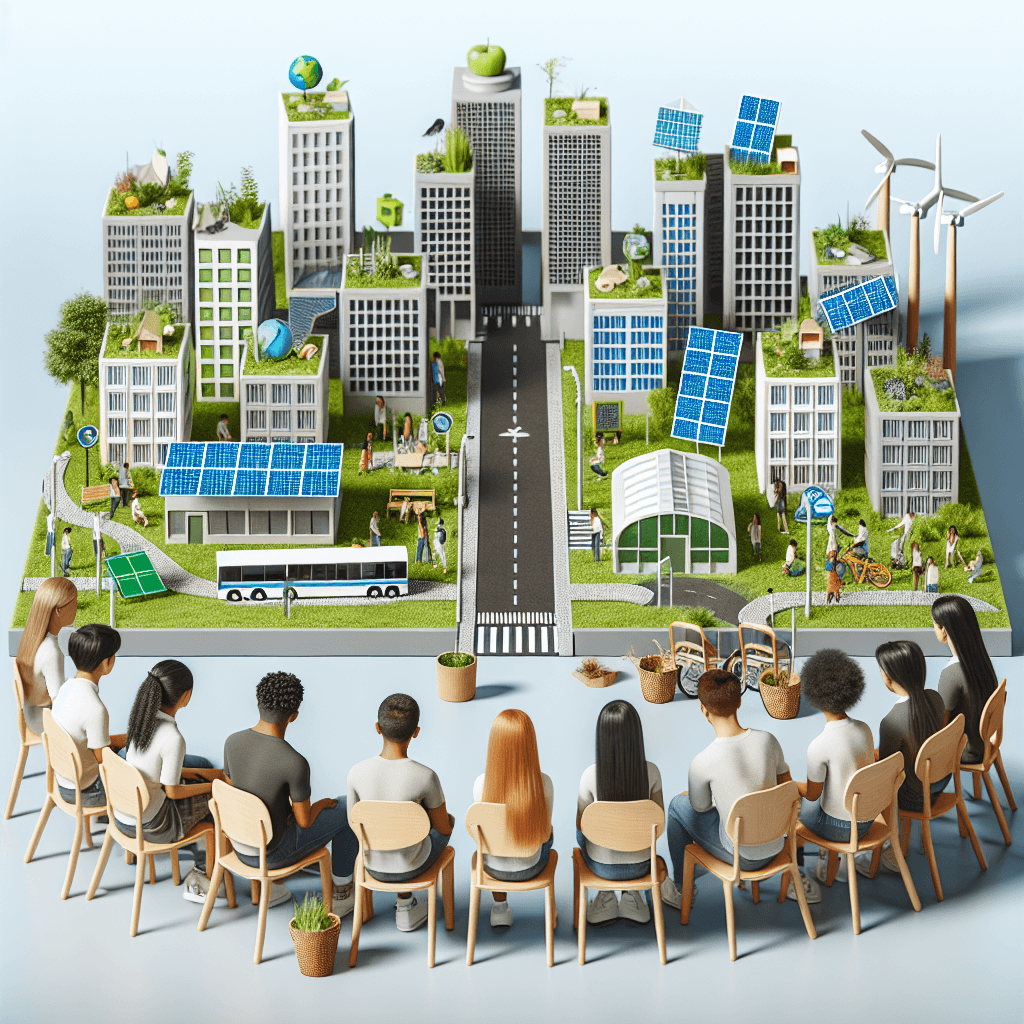
Sustainable City Design Challenge
Inquiry Framework
Question Framework
Driving Question
The overarching question that guides the entire project.How can we incorporate sustainable and eco-friendly features into urban planning to minimize environmental impact and promote decarbonization?Essential Questions
Supporting questions that break down major concepts.- What features make a city sustainable and eco-friendly?
- How can we design urban spaces to reduce environmental impact?
- What are the environmental problems associated with fossil fuels?
- How can decarbonization contribute to sustainable urban design?
Standards & Learning Goals
Learning Goals
By the end of this project, students will be able to:- Students will understand key features of sustainable and eco-friendly urban designs.
- Students will be able to design urban spaces that minimize environmental impact and promote decarbonization.
- Students will evaluate the environmental problems associated with fossil fuels.
- Students will explore the role of decarbonization in creating sustainable urban designs.
NGSS
ISTE
Entry Events
Events that will be used to introduce the project to studentsThe Great Debate: Cars vs. Bikes
Kick off the project by setting the scene of a bustling city where pollution levels have reached critical levels. Students participate in a debate on whether the city should prioritize bike lanes over new roads, putting their research on environmental impacts and sustainable solutions to the test.Portfolio Activities
Portfolio Activities
These activities progressively build towards your learning goals, with each submission contributing to the student's final portfolio.Eco-City Vision Board
In this initial activity, students brainstorm and collaborate to create a vision board that conceptualizes what a sustainable city looks like. Through imagery, words, and design elements, students explore the foundational features of eco-friendly urban spaces.Steps
Here is some basic scaffolding to help students complete the activity.Final Product
What students will submit as the final product of the activityA collaborative vision board showcasing various elements of a sustainable and eco-friendly urban space.Alignment
How this activity aligns with the learning objectives & standardsAligns with SCI.8.ESS3.3 as it introduces students to designing methods that minimize human environmental impacts.Decarbonization Design Workshop
Students dive deeper into the subject of decarbonization by attending a workshop aimed at understanding how to apply scientific principles in urban design. They will design a small-scale city model using low-carbon practices.Steps
Here is some basic scaffolding to help students complete the activity.Final Product
What students will submit as the final product of the activityA small-scale model or detailed sketch of a city that uses sustainable, low-carbon technologies and practices.Alignment
How this activity aligns with the learning objectives & standardsAligns with SCI.8.ETS1.2 by having students evaluate and implement design solutions focusing on sustainability criteria.Fossil Fuel Impact Investigation
This activity centers on researching and presenting the environmental problems caused by fossil fuels. Students act as environmental scientists, gathering evidence and explaining findings to their peers.Steps
Here is some basic scaffolding to help students complete the activity.Final Product
What students will submit as the final product of the activityA group report or presentation on the environmental effects of fossil fuels, complete with data and visual aids.Alignment
How this activity aligns with the learning objectives & standardsAligns with SCI.8.ESS3.1 by having students construct explanations based on evidence of fossil fuel impacts linked to geoscience processes.Sustainable Solutions Critique
In this activity, students critically analyze various sustainable urban design proposals to assess their effectiveness in reducing environmental impact and promoting decarbonization.Steps
Here is some basic scaffolding to help students complete the activity.Final Product
What students will submit as the final product of the activityA comprehensive critique presentation with assessments and recommendations for sustainable urban design solutions.Alignment
How this activity aligns with the learning objectives & standardsAligns with TECH.8.3-5-ETS1-3 as it involves evaluating the effectiveness of urban planning models and identifying areas for improvement.Rubric & Reflection
Portfolio Rubric
Grading criteria for assessing the overall project portfolioSustainable City Design Rubric
Understanding of Sustainable Urban Design
Assesses the depth of understanding of key features of sustainable and eco-friendly urban designs.Conceptual Understanding
Measures students' grasp of sustainable urban features such as renewable energy, green spaces, and efficient public transport.
Exemplary
4 PointsDemonstrates sophisticated understanding of sustainable features, articulated clearly in all aspects of the project.
Proficient
3 PointsShows thorough understanding of sustainable features, accurately incorporated into the project.
Developing
2 PointsShows emerging understanding with basic ideas incorporated but lacks depth in execution.
Beginning
1 PointsMinimal understanding demonstrated with major concepts missing or misunderstood.
Application of Scientific Principles
Evaluates the application of scientific principles to minimize environmental impacts, including decarbonization strategies.
Exemplary
4 PointsEffectively applies scientific principles with innovative strategies evident in all project elements.
Proficient
3 PointsApplies scientific principles appropriately with clear evidence in project design.
Developing
2 PointsBasic application of principles with partial implementation across project elements.
Beginning
1 PointsStruggles to apply scientific principles, resulting in incomplete or inaccurate application.
Collaboration and Communication
Evaluates students' ability to work collaboratively and communicate their ideas effectively to peers and others.Collaboration
Assesses the effectiveness of working within a team to achieve project goals.
Exemplary
4 PointsExhibits leadership and initiative in collaborative settings, enhancing group dynamics and outcomes.
Proficient
3 PointsContributes effectively to the team, supporting goal achievement and decision-making processes.
Developing
2 PointsParticipates in group work but with inconsistent engagement and support for team objectives.
Beginning
1 PointsLimited participation and reliance on others; struggles to contribute meaningfully.
Communication Skills
Measures the clarity and organization of presentation and explanation of project ideas and outcomes.
Exemplary
4 PointsPresents ideas clearly and persuasively with strong organization, engaging and insightful content.
Proficient
3 PointsCommunicates ideas clearly with well-structured presentations that cover key topics.
Developing
2 PointsCommunicates ideas but with some disorganization or lacking depth in explanation.
Beginning
1 PointsStruggles to communicate ideas clearly, with significant gaps in presentation structure and content.
Critical Thinking and Problem Solving
Assesses the ability to analyze, evaluate, and improve urban design solutions based on sustainability criteria.Analytical Skills
Measures students' ability to critique sustainable urban design solutions and identify improvements or alternatives.
Exemplary
4 PointsDemonstrates exceptional analytical skills with insightful evaluations and innovative improvement suggestions.
Proficient
3 PointsConducts thorough analysis with clear understanding of strengths and weaknesses of design solutions.
Developing
2 PointsEngages in basic analysis lacking depth and detailed evaluation.
Beginning
1 PointsStruggles to conduct analysis with limited recognition of design aspects and improvements.