
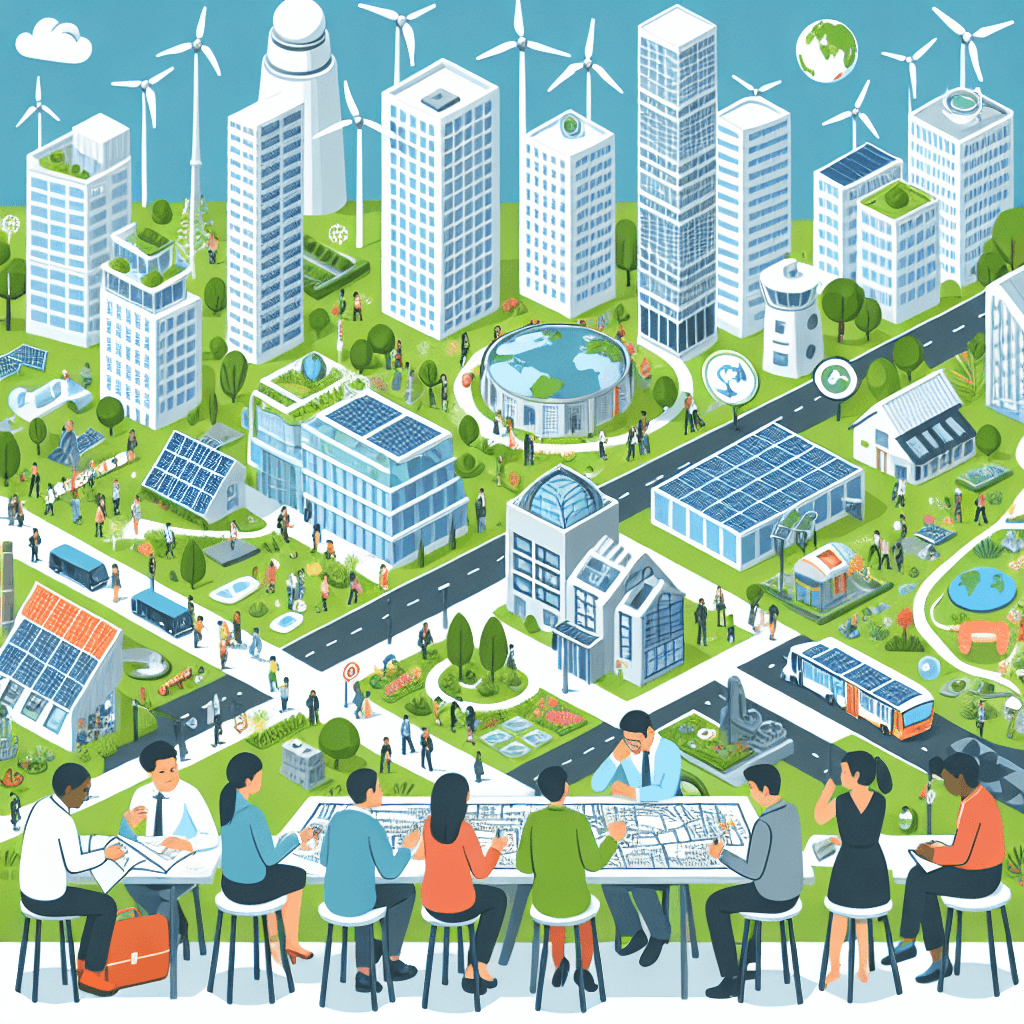
Sustainable City Planning for Urban Growth
Inquiry Framework
Question Framework
Driving Question
The overarching question that guides the entire project.How can we design a sustainable city that effectively adapts to population growth and transportation changes while aligning with government policies and communication methods?Essential Questions
Supporting questions that break down major concepts.- What are the key factors that influence urbanization and how do they interrelate?
- How can sustainable city planning address issues arising from population growth and changes in transportation?
- What role does government policy play in shaping urban development and sustainability?
- In what ways do migration patterns affect the social and economic fabric of urban areas?
- How can various communication methods aid in the planning and development of a sustainable city?
Standards & Learning Goals
Learning Goals
By the end of this project, students will be able to:- Students will evaluate how changes in transportation and communication influence urbanization.
- Students will analyze the effects of population growth, migration, and economic development on urban areas.
- Students will develop a city plan that incorporates sustainable practices to manage population growth and transportation changes.
- Students will assess the role of government policies in shaping urban environments and sustainability initiatives.
- Students will critically engage with multiple sources and data to inform their city planning project.
- Students will use simulations to visualize and modify their city plans to meet sustainability criteria.
Common Core Standards
C3 Framework for Social Studies
NGSS
Entry Events
Events that will be used to introduce the project to studentsCity Hackathon Kick-Off
Initiate the project with a hackathon challenge where students brainstorm innovative solutions to common urban problems like traffic congestion and pollution. Teams present their ideas, spurring competitive engagement and collaborative problem-solving from the onset.Portfolio Activities
Portfolio Activities
These activities progressively build towards your learning goals, with each submission contributing to the student's final portfolio.Urban Inspirations Gallery
Students gather visual, audio, and textual resources that exemplify innovative urban concepts and sustainable city models. This gallery will serve as their reference and inspiration for later design phases.Steps
Here is some basic scaffolding to help students complete the activity.Final Product
What students will submit as the final product of the activityA digital gallery showcasing examples of sustainability in urban planning.Alignment
How this activity aligns with the learning objectives & standardsThis activity supports CCSS.ELA-LITERACY.RH.11-12.7 as students integrate and evaluate information from diverse media.Population Dynamics Workshop
Learners explore case studies on urban population growth and migration patterns to understand their implications on city planning.Steps
Here is some basic scaffolding to help students complete the activity.Final Product
What students will submit as the final product of the activityA detailed report comparing different cities' responses to population growth and migration.Alignment
How this activity aligns with the learning objectives & standardsAligns with D2.Geo.12.9-12 by evaluating urbanization's impact.Civic Influence Analyzer
Students investigate how government policies affect urban development through policy analysis.Steps
Here is some basic scaffolding to help students complete the activity.Final Product
What students will submit as the final product of the activityAn analytical essay discussing the role of government policy in urban development.Alignment
How this activity aligns with the learning objectives & standardsSupports D2.Civ.10.9-12 by analyzing civic influence on governmental policy.GIS-Based Green Space Utilization
Students will use GIS technology to analyze green spaces in a designated city, identifying potential areas that could be utilized for community sustainability initiatives. This activity will enhance understanding of spatial analysis and its application in urban planning.Steps
Here is some basic scaffolding to help students complete the activity.Final Product
What students will submit as the final product of the activityA comprehensive GIS map with proposals for utilizing green spaces in urban sustainability efforts.Alignment
How this activity aligns with the learning objectives & standardsIntegrates technology and geography standards by applying GIS tools to real-world urban planning challenges.Rubric & Reflection
Portfolio Rubric
Grading criteria for assessing the overall project portfolioSustainable City Planning Project Rubric
Research and Integration
Assessment of students' ability to research, gather, and integrate information from diverse sources to support the city planning project.Information Gathering
Evaluate the comprehensiveness and relevance of research gathered from various sources, including multimedia, articles, and case studies.
Exemplary
4 PointsResearch includes a wide range of highly relevant and credible sources, providing comprehensive insights into sustainable urban planning concepts.
Proficient
3 PointsResearch includes a good range of relevant and credible sources, offering a clear understanding of sustainable urban planning concepts.
Developing
2 PointsResearch includes some relevant sources, but lacks depth and variety needed for a full understanding of sustainable urban planning concepts.
Beginning
1 PointsResearch lacks relevance or credible sources, providing insufficient insights into sustainable urban planning concepts.
Integration of Information
Assess ability to effectively integrate multiple sources of information into the planning process, supported by evidence-based conclusions.
Exemplary
4 PointsInformation is seamlessly integrated into the planning process, with strong, evidence-based conclusions drawn from the data.
Proficient
3 PointsInformation is well integrated, with clear evidence-based conclusions drawn from the collected data.
Developing
2 PointsSome integration of information, but conclusions are less clear or not fully supported by the presented data.
Beginning
1 PointsMinimal integration of information with few clear conclusions drawn from the data.
Analysis and Critical Thinking
Evaluation of students' ability to analyze urban planning challenges and apply critical thinking to develop sustainable city plans.Urban Planning Analysis
Assess the depth of analysis regarding urban issues such as population growth, migration, and transportation changes.
Exemplary
4 PointsDemonstrates thorough analysis of urban challenges with insightful connections to sustainable practices.
Proficient
3 PointsProvides strong analysis of urban challenges with clear connections to sustainable practices.
Developing
2 PointsSome analysis of urban challenges, but connections to sustainable practices are weak or unclear.
Beginning
1 PointsLimited analysis of urban challenges with few connections to sustainable practices.
Critical Application of Concepts
Evaluate how well students apply theoretical concepts in proposing practical urban planning solutions.
Exemplary
4 PointsEffectively applies theoretical concepts to create innovative, practical, and sustainable urban planning solutions.
Proficient
3 PointsApplies theoretical concepts to formulate clear and practical urban planning solutions.
Developing
2 PointsAttempts to apply theoretical concepts in solutions, but lacks practicality or clarity.
Beginning
1 PointsStruggles to apply theoretical concepts in practical solutions for urban planning.
Presentation and Communication
Focus on students' ability to effectively communicate their city planning project and ideas to an audience.Clarity and Organization
Assess how clearly and logically information is presented in both written and oral forms.
Exemplary
4 PointsPresentation is highly clear, well-organized, and engages the audience through logical flow and structure.
Proficient
3 PointsPresentation is clear and organized with a logical flow of information.
Developing
2 PointsPresentation has some clarity, but lacks organization or a logical flow in parts.
Beginning
1 PointsPresentation lacks clarity and organization, making it difficult to follow.
Use of Multimedia Tools
Evaluate the effective use of digital tools and multimedia in supporting the presentation and enhancing understanding.
Exemplary
4 PointsInnovative and effective use of multimedia tools significantly enhances the presentation and audience understanding.
Proficient
3 PointsGood use of multimedia tools to support and enhance the presentation.
Developing
2 PointsLimited use of multimedia tools with some contribution to the presentation.
Beginning
1 PointsMinimal or ineffective use of multimedia tools, adding little to the presentation.
Collaboration and Teamwork
Assessment of students' ability to work collaboratively on the city planning project.Team Contribution
Evaluate individual contributions to team goals and collaborative processes.
Exemplary
4 PointsConsistently makes meaningful contributions to team goals and supports group dynamics effectively.
Proficient
3 PointsMakes valuable contributions to team goals and works well with others.
Developing
2 PointsOccasionally contributes to team goals, but participation is inconsistent.
Beginning
1 PointsMinimal contribution to team efforts and group dynamics.
Leadership and Initiative
Assessment of students' ability to take initiative and demonstrate leadership within the group setting.
Exemplary
4 PointsDemonstrates leadership and initiative, often guiding group activities and decision-making.
Proficient
3 PointsShows initiative and leadership skills in supporting team activities.
Developing
2 PointsSome initiative shown, but leadership is limited.
Beginning
1 PointsRarely shows initiative or leadership ability.