
Inquiry Framework
Question Framework
Driving Question
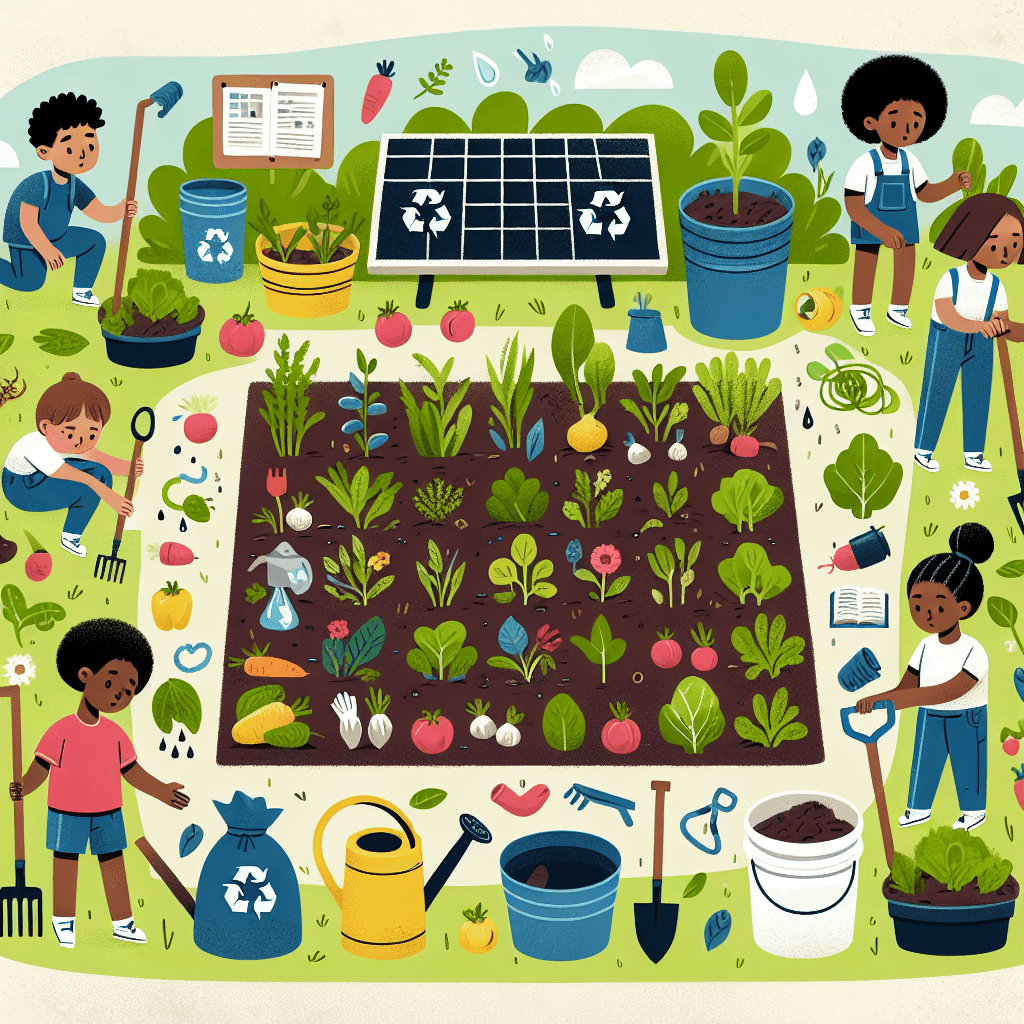
The overarching question that guides the entire project.How can we design and maintain a sustainable garden that minimizes its environmental impact by optimizing resource use, promoting biodiversity, and reducing waste, while monitoring its effectiveness over time?Essential Questions
Supporting questions that break down major concepts.- How can we design a garden that minimizes its impact on the environment?
- What resources are essential for plant growth, and how can we ensure their sustainable use?
- How do different gardening practices affect resource consumption and waste generation?
- What methods can we use to conserve water and improve soil health in our garden?
- How can we create a balanced ecosystem within our garden to support plant growth and minimize pest problems?
- How can we monitor and measure the environmental impact of our garden over time?
- What are the potential benefits of sustainable gardening for our community and the wider environment?
Standards & Learning Goals
Learning Goals
By the end of this project, students will be able to:- Students will design and implement a sustainable garden that minimizes environmental impact through resource optimization, biodiversity promotion, and waste reduction strategies.
NGSS
Entry Events
Events that will be used to introduce the project to studentsTaste the Difference
Students participate in a 'blind taste test' comparing produce grown using conventional methods versus sustainable practices. The stark difference in flavor and quality sparks a discussion about the environmental impact of different farming techniques and the importance of sustainable agriculture.Portfolio Activities
Portfolio Activities
These activities progressively build towards your learning goals, with each submission contributing to the student's final portfolio.Sunflower Sprouts: Exploring Water's Impact
Students will conduct a seed germination experiment to investigate the impact of different resource levels (water) on sunflower plant growth. This activity introduces the concept of limiting factors and their effects on organisms.Steps
Here is some basic scaffolding to help students complete the activity.Final Product
What students will submit as the final product of the activityA lab report documenting the experiment, including data tables, graphs illustrating plant growth over time, analysis of the results, and conclusions about the impact of water availability on sunflower plant growth.Alignment
How this activity aligns with the learning objectives & standardsMS-LS2-1. Analyzing and Interpreting Data, LS2.A: Interdependent Relationships in Ecosystems, Cause and EffectResource Investigators: Unearthing the Secrets of Plant Growth
Building on the seed experiment, students will design and conduct an investigation to explore the effects of another resource (e.g., sunlight or nutrient levels) on plant growth in their sustainable garden plots.Steps
Here is some basic scaffolding to help students complete the activity.Final Product
What students will submit as the final product of the activityA detailed research report, including background research on the chosen resource, experimental design, data collection and analysis, discussion of findings, and connections to sustainable gardening practices.Alignment
How this activity aligns with the learning objectives & standardsMS-LS2-1. Analyzing and Interpreting Data, LS2.A: Interdependent Relationships in Ecosystems, Cause and EffectComposting Champions: Turning Waste into Garden Gold
Students will create compost bins and monitor the decomposition process, observing how organic matter is broken down and transformed into nutrient-rich soil. This activity reinforces the importance of recycling and resource utilization in a sustainable garden.Steps
Here is some basic scaffolding to help students complete the activity.Final Product
What students will submit as the final product of the activityA composting journal documenting observations, temperature readings, analysis of decomposition rates, and reflections on the role of composting in sustainable gardening.Alignment
How this activity aligns with the learning objectives & standardsMS-LS2-3. Develop a model to describe the cycling of matter and flow of energy, LS2.A: Interdependent Relationships in EcosystemsPest Control Pioneers: Protecting Our Garden Naturally
Students will research and debate the pros and cons of different pest control methods, including natural predators, companion planting, and pesticides. They will then choose and implement a pest control strategy for their garden.Steps
Here is some basic scaffolding to help students complete the activity.Final Product
What students will submit as the final product of the activityA persuasive presentation arguing for the chosen pest control method, supported by research, data from their garden, and consideration of environmental impacts.Alignment
How this activity aligns with the learning objectives & standardsMS-LS2-4. Construct an argument supported by empirical evidence, LS2.A: Interdependent Relationships in EcosystemsSustainable Garden Stewards: Reflecting and Refining Our Approach
Students will analyze data collected throughout the project (plant growth, resource use, pest control, waste reduction) to evaluate the overall effectiveness of their sustainable garden. They will then propose modifications and improvements for future iterations.Steps
Here is some basic scaffolding to help students complete the activity.Final Product
What students will submit as the final product of the activityA comprehensive project report summarizing the entire gardening project, including data analysis, evaluation of successes and challenges, reflections on learning, and proposals for future improvements.Alignment
How this activity aligns with the learning objectives & standardsMS-LS2-1. Analyzing and Interpreting Data, LS2.A: Interdependent Relationships in Ecosystems, Cause and EffectRubric & Reflection
Portfolio Rubric
Grading criteria for assessing the overall project portfolioSustainable Gardening Portfolio Activities Rubric
Data Analysis and Interpretation
Evaluates students' ability to analyze and interpret experimental data related to resource management in gardening activities.Accuracy and Completeness of Data
Assesses the accuracy and thoroughness of data collected and recorded in the experiments.
Exemplary
4 PointsData is accurately recorded, comprehensive, and reflects a high attention to detail. Measurements are precise and complete without errors.
Proficient
3 PointsData is mostly accurate and complete, minor inconsistencies present. Displays appropriate data recording techniques.
Developing
2 PointsData is incomplete and has noticeable inconsistencies or errors. Some important measurements are missing.
Beginning
1 PointsData lacks accuracy and completeness with numerous errors. Measurements are often missing or incorrect.
Data Visualization
Evaluates the effectiveness in using tables, charts, and graphs to present data findings.
Exemplary
4 PointsVisualizations are clear, innovative, and effectively enhance understanding of data. The choice of charts/graphs is highly appropriate.
Proficient
3 PointsVisualizations are clear and appropriate, with relevant use of charts/graphs to display data findings.
Developing
2 PointsVisualizations are used but may not clearly present all essential data. Some choice of charts/graphs may be inappropriate.
Beginning
1 PointsVisualizations are unclear, inappropriate, or absent. Little connection to underlying data.
Data Interpretation and Analysis
Measures the ability to interpret and draw conclusions from experimental data.
Exemplary
4 PointsAnalysis demonstrates a deep understanding of the data. Conclusions are insightful, well-supported, and reflect strong cause-effect reasoning.
Proficient
3 PointsAnalysis is clear, demonstrating solid understanding. Conclusions are supported by data and show understanding of cause-effect relationships.
Developing
2 PointsBasic analysis with limited conclusions. Some support from data is evident.
Beginning
1 PointsMinimal analysis with vague or unsupported conclusions. Limited ability to demonstrate cause-effect understanding.
Scientific Understanding
Assesses students' understanding of scientific concepts pertaining to ecosystem interdependencies and resource impact.Understanding of Scientific Concepts
Evaluates the comprehension of science principles related to ecosystems, resources, and sustainability in gardening.
Exemplary
4 PointsDemonstrates extensive knowledge and integration of scientific concepts. Explains interrelated ecosystem processes insightfully.
Proficient
3 PointsConveys clear understanding of key scientific concepts, with solid explanations of ecosystem interrelations.
Developing
2 PointsPartial understanding of the key scientific concepts. Explanations may be incomplete or lack depth.
Beginning
1 PointsLimited understanding of scientific concepts with minimal explanation of ecosystem processes.
Application of Concepts to Problem Solving
Assesses how well students apply their scientific understanding to solve problems related to sustainable gardening.
Exemplary
4 PointsConsistently applies scientific concepts innovatively to solve complex problems. Solutions are well-reasoned and sustainable.
Proficient
3 PointsApplies scientific understanding effectively to create feasible solutions for problems presented in activities.
Developing
2 PointsApplies scientific principles with some relevance. Solutions may be plausible but lack sophistication.
Beginning
1 PointsStruggles to apply scientific understanding to solve problems. Solutions are vague or unsupported.
Collaboration and Communication
Evaluates teamwork, communication, and presentation skills within group and individual activities.Effective Collaboration
Assesses students' ability to work collaboratively in teams during gardening activities.
Exemplary
4 PointsExhibits leadership within group dynamics. Consistently contributes ideas and facilitates collaboration effectively.
Proficient
3 PointsEngages actively in group work, sharing ideas and supporting peers within collaborative tasks.
Developing
2 PointsParticipates inconsistently in group activities. Contributions are minimal or sporadic.
Beginning
1 PointsLimited participation in group tasks. Requires assistance to contribute effectively.
Communication of Ideas
Evaluates clarity and effectiveness in presenting research findings and proposals.
Exemplary
4 PointsCommunicates ideas compellingly using concise language and engaging presentations. Supports points with detailed evidence.
Proficient
3 PointsPresents ideas clearly, using appropriate language and structure. Provides evidence for key points.
Developing
2 PointsPresentation clarity varies. Some key points supported by evidence but inconsistently.
Beginning
1 PointsStruggles to convey ideas clearly. Limited structure and evidence.
Reflection and Self-Assessment
Assesses ability to reflect on learning experiences and evaluate project outcomes.Depth of Reflection
Measures the depth and insightfulness of student reflections concerning their learning and project experiences.
Exemplary
4 PointsReflections are profound and insightful, demonstrating high self-awareness and learning from experiences.
Proficient
3 PointsReflections show clear understanding and evaluation of learning experience. Demonstrates thoughtful consideration.
Developing
2 PointsReflection shows emerging critical thinking. Some insights into learning experiences are evident.
Beginning
1 PointsReflections are superficial with limited understanding or learning insights.