
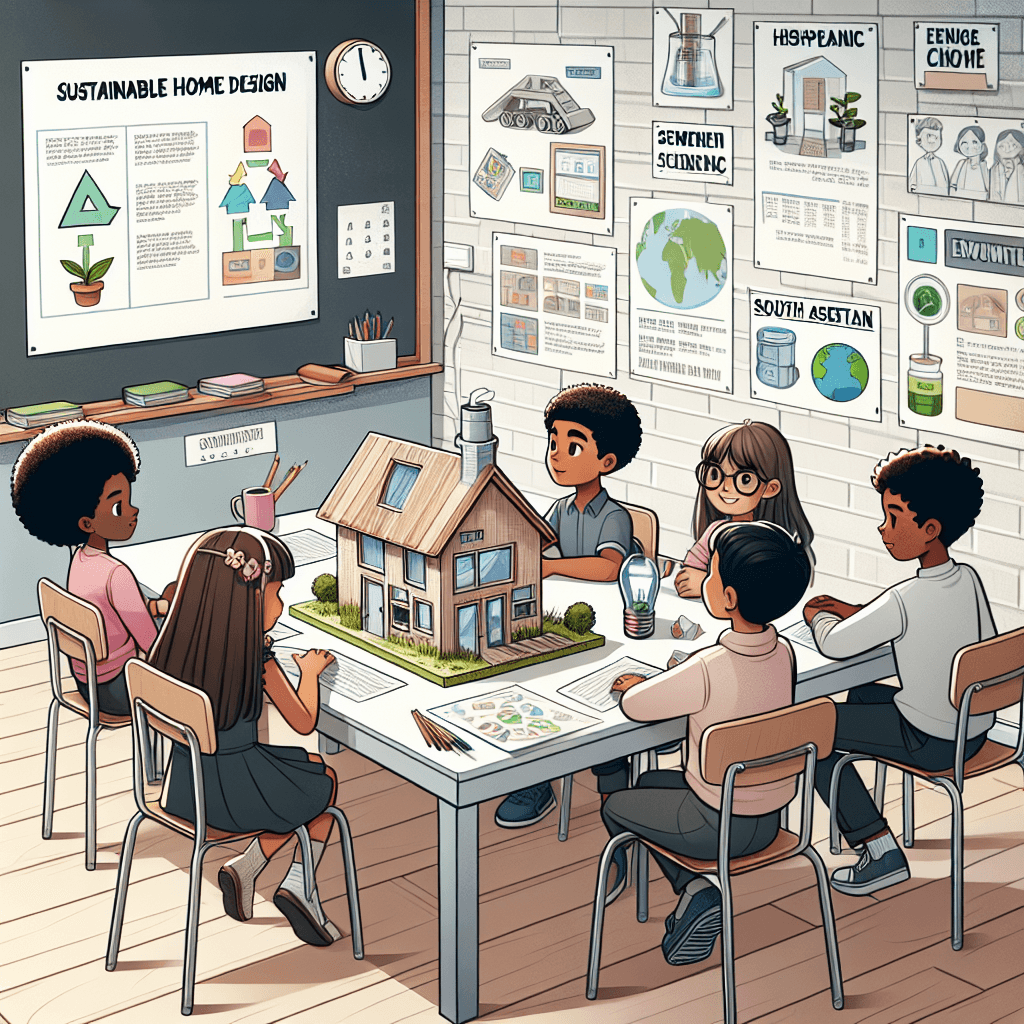
Sustainable Home Design: A 5th Grade Science Project
Inquiry Framework
Question Framework
Driving Question
The overarching question that guides the entire project.How can we design and build a sustainable home that minimizes environmental impact and maximizes resource conservation?Essential Questions
Supporting questions that break down major concepts.- How do our daily activities at home impact the environment?
- What are the different sources of energy we use in our homes?
- How can we design a home to minimize energy consumption and waste?
- What materials are eco-friendly and suitable for building a sustainable home?
- How can we conserve water in our homes?
- How can solar energy be used to power a home?
- What are the advantages and disadvantages of using renewable energy sources?
- How does insulation help in making a home more energy-efficient?
- How can we reduce waste and recycle materials in our homes?
- What are the long-term benefits of living in a sustainable home?
Standards & Learning Goals
Learning Goals
By the end of this project, students will be able to:- Students will be able to identify and assess the environmental impacts of daily home activities.
- Students will be able to design a sustainable home model that minimizes energy consumption, conserves water, and reduces waste.
- Students will be able to evaluate the advantages and disadvantages of renewable energy sources for home use.
- Students will be able to explain how insulation and eco-friendly materials contribute to energy efficiency in a sustainable home.
- Students will be able to propose strategies for waste reduction and recycling in homes.
Entry Events
Events that will be used to introduce the project to students"The Mysterious Energy Bill"
Students receive an unusually high energy bill for a fictional 'Eco-Home' and must investigate the potential causes, sparking curiosity about energy consumption and sustainable solutions. This sets the stage for designing their own energy-efficient homes."A Day in the Life of a Sustainable Home"
Students experience a day through the eyes of a family living in a sustainable home via an immersive simulation or interactive story. This activity will reveal both the benefits and challenges of eco-friendly living, inspiring them to consider practical design elements for their own projects."The Great Home Design Challenge"
Divide the class into teams and task each with transforming a basic home blueprint into a sustainable design, focusing on energy efficiency, water conservation, and waste reduction. The activity will foster collaborative problem-solving and creative thinking about eco-friendly home design."Sustainable Home Escape Room"
Design an escape room scenario where students solve puzzles related to sustainable home practices to 'escape' a carbon-emitting house and unlock the secrets to eco-friendly living. This gamified approach makes learning about sustainability engaging and memorable, promoting deeper understanding through interactive challenges."Build a Tiny Sustainable Home Model"
Engage students in constructing miniature sustainable home models using recyclable materials, challenging them to apply principles of energy efficiency, water conservation, and waste reduction in a tangible way. This hands-on activity will bring abstract concepts to life and enable them to visualize the practical applications of sustainable design.Portfolio Activities
Portfolio Activities
These activities progressively build towards your learning goals, with each submission contributing to the student's final portfolio.Home Energy Footprint Tracker
Students begin by tracking their own home's energy usage to understand the environmental impact of daily activities. They will collect data on electricity, water, and gas consumption.Steps
Here is some basic scaffolding to help students complete the activity.Final Product
What students will submit as the final product of the activityA detailed report on their home's energy footprint, including data tables and analysis of energy consumption patterns.Alignment
How this activity aligns with the learning objectives & standardsAddresses the learning goal: 'Students will be able to identify and assess the environmental impacts of daily home activities.'Sustainable Home Design Brainstorm
Students brainstorm and sketch initial designs for a sustainable home, focusing on energy efficiency, water conservation, and waste reduction strategies.Steps
Here is some basic scaffolding to help students complete the activity.Final Product
What students will submit as the final product of the activityA set of initial design sketches with detailed explanations of sustainable features.Alignment
How this activity aligns with the learning objectives & standardsAddresses the learning goal: 'Students will be able to design a sustainable home model that minimizes energy consumption, conserves water, and reduces waste.'Renewable Energy Feasibility Study
Students investigate the feasibility of using renewable energy sources (solar, wind, geothermal) to power their sustainable home design.Steps
Here is some basic scaffolding to help students complete the activity.Final Product
What students will submit as the final product of the activityA feasibility report outlining the selected renewable energy source, its benefits, and estimated energy output and cost savings.Alignment
How this activity aligns with the learning objectives & standardsAddresses the learning goal: 'Students will be able to evaluate the advantages and disadvantages of renewable energy sources for home use.'Eco-Materials and Insulation Analysis
Students research and select eco-friendly building materials and insulation techniques to enhance the energy efficiency of their sustainable home.Steps
Here is some basic scaffolding to help students complete the activity.Final Product
What students will submit as the final product of the activityA detailed material and insulation plan, including material selection, insulation techniques, and energy savings calculations.Alignment
How this activity aligns with the learning objectives & standardsAddresses the learning goal: 'Students will be able to explain how insulation and eco-friendly materials contribute to energy efficiency in a sustainable home.'Waste Reduction and Recycling Plan
Students develop a comprehensive waste reduction and recycling plan for their sustainable home, promoting responsible waste management.Steps
Here is some basic scaffolding to help students complete the activity.Final Product
What students will submit as the final product of the activityA detailed waste reduction and recycling plan, including strategies for reducing, reusing, and recycling waste.Alignment
How this activity aligns with the learning objectives & standardsAddresses the learning goal: 'Students will be able to propose strategies for waste reduction and recycling in homes.'Rubric & Reflection
Portfolio Rubric
Grading criteria for assessing the overall project portfolioSustainable Home Design Project Rubric
Energy Footprint Analysis
Evaluates the student's ability to collect, analyze, and interpret data related to home energy consumption.Data Collection
Assesses the accuracy and thoroughness of energy data collected by the student.
Exemplary
4 PointsThorough and accurate data collected for all specified energy types, with no errors and clear organization described.
Proficient
3 PointsAccurate data collected for most specified energy types with minimal errors and adequate organization.
Developing
2 PointsPartial data collected with noticeable errors or omissions in at least one specified energy type.
Beginning
1 PointsSignificant gaps or inaccuracies in data collection, with disorganized presentation.
Data Analysis
Assesses the ability to analyze energy data to identify and report on consumption patterns.
Exemplary
4 PointsInsightful analysis provided, clearly identifying consumption patterns with strong supporting evidence.
Proficient
3 PointsClear analysis with sound identification of consumption patterns, mostly supported by evidence.
Developing
2 PointsBasic analysis with partial identification of consumption patterns and limited supporting evidence.
Beginning
1 PointsLimited or unclear analysis of energy data, with few patterns identified and weak evidence.
Sustainable Design Innovation
Assesses the creativity and effectiveness of the student's sustainable home design features.Design Creativity
Measures the originality and inventiveness of sustainable design features included in the project.
Exemplary
4 PointsExtremely creative and original designs with unique sustainable features, clearly inspired by research.
Proficient
3 PointsCreative designs with some original sustainable features that are well-researched.
Developing
2 PointsDesigns show basic creativity and include standard sustainable features, lacking uniqueness.
Beginning
1 PointsBasic and common designs, with minimal evidence of sustainable features or originality.
Design Explanation
Evaluates the student's ability to explain how their design features contribute to sustainability.
Exemplary
4 PointsComprehensive and insightful explanations provided, detailing how each feature enhances sustainability.
Proficient
3 PointsClear and accurate explanations for most features, demonstrating solid understanding of sustainability.
Developing
2 PointsBasic explanations provided, with partial accuracy and some areas of misunderstanding.
Beginning
1 PointsLimited explanations lacking clarity or accuracy in relating features to sustainability.
Renewable Energy Evaluation
Assesses the student's ability to evaluate and justify the use of renewable energy sources in their design.Renewable Energy Research
Measures the depth and accuracy of research conducted on renewable energy sources.
Exemplary
4 PointsThorough and accurate research conducted, showing in-depth understanding of various renewable sources.
Proficient
3 PointsAccurate and relevant research with minor gaps in understanding of renewable sources.
Developing
2 PointsBasic research conducted with noticeable gaps or narrow focus on renewable sources.
Beginning
1 PointsLimited research with significant inaccuracies in understanding renewable energy.
Justification of Choice
Evaluates how well the student justifies their choice of renewable energy source for the design.
Exemplary
4 PointsClear, logical, and well-supported justification for the chosen energy source, addressing all relevant factors.
Proficient
3 PointsLogical and mostly well-supported justification for chosen energy source, addressing most factors.
Developing
2 PointsBasic justification with partial support and some relevant factors addressed.
Beginning
1 PointsWeak justification and incomplete consideration of relevant factors for energy source choice.
Materials and Insulation Selection
Evaluates the student's choice and justification of eco-friendly materials and insulation techniques.Materials Research and Selection
Measures the student's ability to research and select suitable and eco-friendly materials for the home design.
Exemplary
4 PointsComprehensive research and informed selection of innovative materials, well-justified by sustainability principles.
Proficient
3 PointsThorough research and logical selection of materials, mostly aligned with sustainability principles.
Developing
2 PointsBasic research and selection with partial alignment to sustainable principles.
Beginning
1 PointsLimited research and uninformed material selection, lacking justifiable sustainability focus.
Insulation Technique Explanation
Assesses the student's ability to explain the energy efficiency benefits of selected insulation techniques.
Exemplary
4 PointsDetailed and insightful explanations of insulation techniques, clearly linking to energy efficiency benefits.
Proficient
3 PointsClear explanations showing a good grasp of insulation techniques and their efficiency benefits.
Developing
2 PointsBasic explanations with limited detail on insulation benefits.
Beginning
1 PointsMinimal explanations with unclear linkage between insulation and energy benefits.
Waste Management and Recycling Strategy
Assesses the student's understanding and application of waste reduction and recycling strategies.Recycling System Design
Evaluates the student's ability to design an effective recycling system for home sustainability.
Exemplary
4 PointsInnovative and comprehensive recycling system design with detailed planning and creative approaches.
Proficient
3 PointsEffective recycling system design with clear planning and practical applications.
Developing
2 PointsBasic recycling system design with some planning and practical insights.
Beginning
1 PointsLimited recycling system design with unclear or impractical strategies.
Waste Reduction Strategy
Assesses the student’s ability to propose effective waste reduction strategies for their sustainable home.
Exemplary
4 PointsComprehensive and innovative waste reduction strategies proposed with clear benefits articulated.
Proficient
3 PointsSolid waste reduction strategies proposed with clear and practical benefits.
Developing
2 PointsBasic waste reduction strategies with limited detail or practical implementation.
Beginning
1 PointsMinimal or vague waste reduction strategies lacking practical detail.