
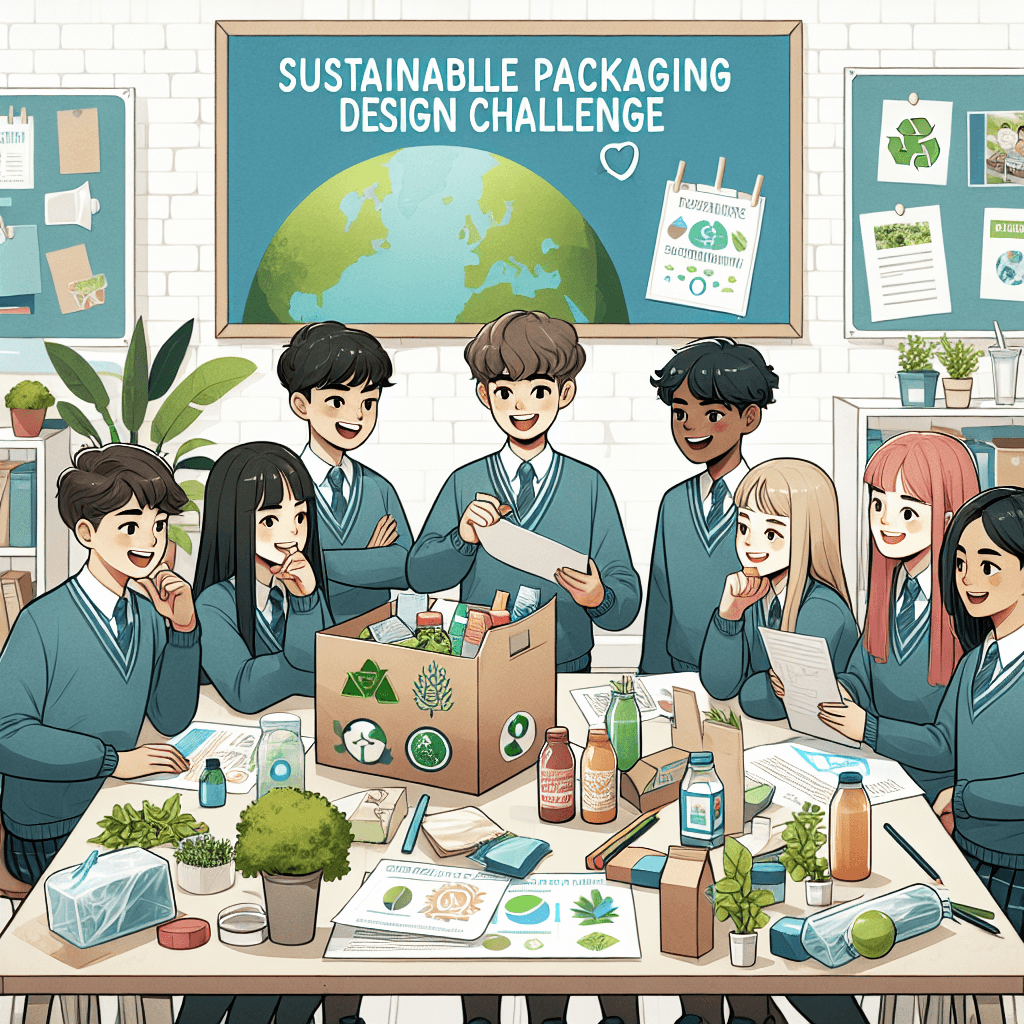
Inquiry Framework
Question Framework
Driving Question
The overarching question that guides the entire project.How can we design and create sustainable packaging solutions for local products that consider environmental impact, consumer behavior, cultural influences, and the redesign of existing materials?Essential Questions
Supporting questions that break down major concepts.- What makes packaging sustainable and what impact does it have on the environment?
- How can we redesign existing packaging solutions to make them more environmentally friendly?
- In what ways does the design of packaging affect consumer behavior and decision making?
- How do cultural and regional contexts influence packaging design and materials?
Standards & Learning Goals
Learning Goals
By the end of this project, students will be able to:- Students will be able to design and propose sustainable packaging solutions that take into account environmental and cultural factors.
- Students will demonstrate their ability to assess and critique the environmental impact of current packaging solutions.
- Students will effectively communicate complex ideas related to packaging and sustainability through presentations and written reports.
- Students will utilize problem-solving skills to innovate and redesign packaging solutions to be more sustainable.
CEFR Can do B1 level
Entry Events
Events that will be used to introduce the project to studentsMystery Box Challenge
Students receive a sealed package without knowing its contents. The task is to study and debate on the potential ecological footprint the packaging materials might have, exploring sustainable alternatives in collaboration with classmates. A hands-on activity that taps into curiosity and critical thinking about packaging impacts.Eco-Audit Field Walk
Taking students on a walk through local shops, they'll observe and document the various packaging types used. This activity sets the stage for brainstorming innovative design ideas that can reduce waste, directly connecting observations to real-world applications of sustainable packaging.Virtual Reality Packaging Tour
Through VR headsets, students explore different environments affected by waste, highlighting how packaging contributes to pollution. They can document their experience and engage in discussions about how they can creatively design better solutions.Packaging Design Hackathon
Organize a day-long event where students, in teams, tackle problems with current packaging solutions, using only locally available recyclable materials. This competitive setting infuses energy and pushes for creative problem-solving aligned with real-world challenges.Portfolio Activities
Portfolio Activities
These activities progressively build towards your learning goals, with each submission contributing to the student's final portfolio.Curiosity Sparks: Unveiling the Mystery Box
In this activity, students will engage in a hands-on exploration of packaging materials and their ecological footprint by analyzing a mystery box's packaging. This will foster curiosity and critical thinking, setting a foundation for understanding the environmental impact of packaging.Steps
Here is some basic scaffolding to help students complete the activity.Final Product
What students will submit as the final product of the activityDetailed journal entries analyzing packaging materials' environmental impact and sustainability.Alignment
How this activity aligns with the learning objectives & standardsCEFR_B1_LK1: Facilitates connection of new information with prior knowledge through focused questioning.Eco-Investigators: Field Walk & Analysis
Students take an investigative walk through local shops to observe and document various packaging types. The task involves noting down observations and analyzing how these relate to sustainability principles, consumer behaviors, and cultural influences.Steps
Here is some basic scaffolding to help students complete the activity.Final Product
What students will submit as the final product of the activityCollective presentation showcasing observations and potential redesign ideas for more sustainable solutions.Alignment
How this activity aligns with the learning objectives & standardsCEFR_B1_LK2: Involves explaining packaging design's impact using everyday examples from the field.Rephrase Relay: Communicating Sustainability
This activity focuses on enhancing students' communication skills by having them explain their observations and ideas about sustainable packaging to different audiences. They must adapt their language to suit various comprehension levels.Steps
Here is some basic scaffolding to help students complete the activity.Final Product
What students will submit as the final product of the activityAdapted presentation scripts demonstrating the ability to communicate packaging sustainability research to diverse audiences.Alignment
How this activity aligns with the learning objectives & standardsCEFR_B1_AL1: Develops skills to rephrase complex ideas for better understanding by different audiences.Blueprint Breaker: The Packaging Solution Workshop
Students will participate in a collaborative workshop focused on breaking down the packaging design process into manageable tasks. They will utilize creativity and problem-solving skills to propose new sustainable packaging solutions.Steps
Here is some basic scaffolding to help students complete the activity.Final Product
What students will submit as the final product of the activityPrototypes of sustainable packaging designs accompanied by a structured action plan.Alignment
How this activity aligns with the learning objectives & standardsCEFR_B1_BC1: Supports breaking down tasks into clear stages and instructing peers on steps.Rubric & Reflection
Portfolio Rubric
Grading criteria for assessing the overall project portfolioSustainable Packaging Design Rubric
Connection to Prior Knowledge
Evaluates how well students relate new information about sustainable packaging to what they and their peers already know.Focused Questioning
Measures the ability to ask relevant questions that link new information to existing knowledge.
Exemplary
4 PointsAsks insightful, focused questions that consistently connect new information to prior knowledge, enhancing group understanding.
Proficient
3 PointsAsks relevant questions that usually connect new information to prior knowledge, aiding group discussion.
Developing
2 PointsAsks some questions that occasionally link new information to prior knowledge.
Beginning
1 PointsStruggles to ask questions that link new information to prior knowledge and requires prompting.
Sustainability Understanding
Assesses students' understanding of sustainability concepts and their application to packaging design.Ecological Impact Analysis
Evaluates the ability to analyze the environmental impact of packaging materials.
Exemplary
4 PointsProvides comprehensive analysis of environmental impacts, supported by detailed examples and innovative insights.
Proficient
3 PointsProvides clear analysis of environmental impacts with supporting examples.
Developing
2 PointsOffers basic analysis with limited examples of environmental impacts.
Beginning
1 PointsStruggles to analyze environmental impacts and lacks supporting examples.
Redesign Proposal
Measures the ability to propose innovative redesigns for existing packaging solutions.
Exemplary
4 PointsProposes highly innovative redesigns well-supported by sustainability principles and consumer insights.
Proficient
3 PointsProposes innovative redesigns generally supported by sustainability principles.
Developing
2 PointsProposes basic redesigns with some alignment to sustainability principles.
Beginning
1 PointsStruggles to propose redesigns aligned with sustainability principles and lacks creativity.
Communication and Adaptation
Evaluates students' ability to communicate complex ideas about sustainable packaging effectively to various audiences.Clarity and Rephrasing
Measures effective adaptation of language for clarity among diverse audiences.
Exemplary
4 PointsConsistently uses clear, adapted language that ensures understanding by multiple audiences, demonstrating creativity and insight.
Proficient
3 PointsUsually uses clear, adapted language suitable for several audiences, showing understanding and flexibility.
Developing
2 PointsAttempts to adapt language for different audiences with varying success and clarity.
Beginning
1 PointsStruggles to adapt language, resulting in unclear communication.
Collaborative Problem Solving
Assesses the ability to work effectively in teams to design and implement sustainable packaging solutions.Team Contribution and Leadership
Measures participation, collaboration, and leadership in group settings.
Exemplary
4 PointsLeads team effectively, consistently contributing innovative ideas and facilitating others’ contributions.
Proficient
3 PointsContributes cooperatively to the team, offering useful ideas and supporting group dynamics.
Developing
2 PointsParticipates in team with limited contribution of ideas and occasional support for peers.
Beginning
1 PointsStruggles to engage with the team, requiring encouragement to contribute.