
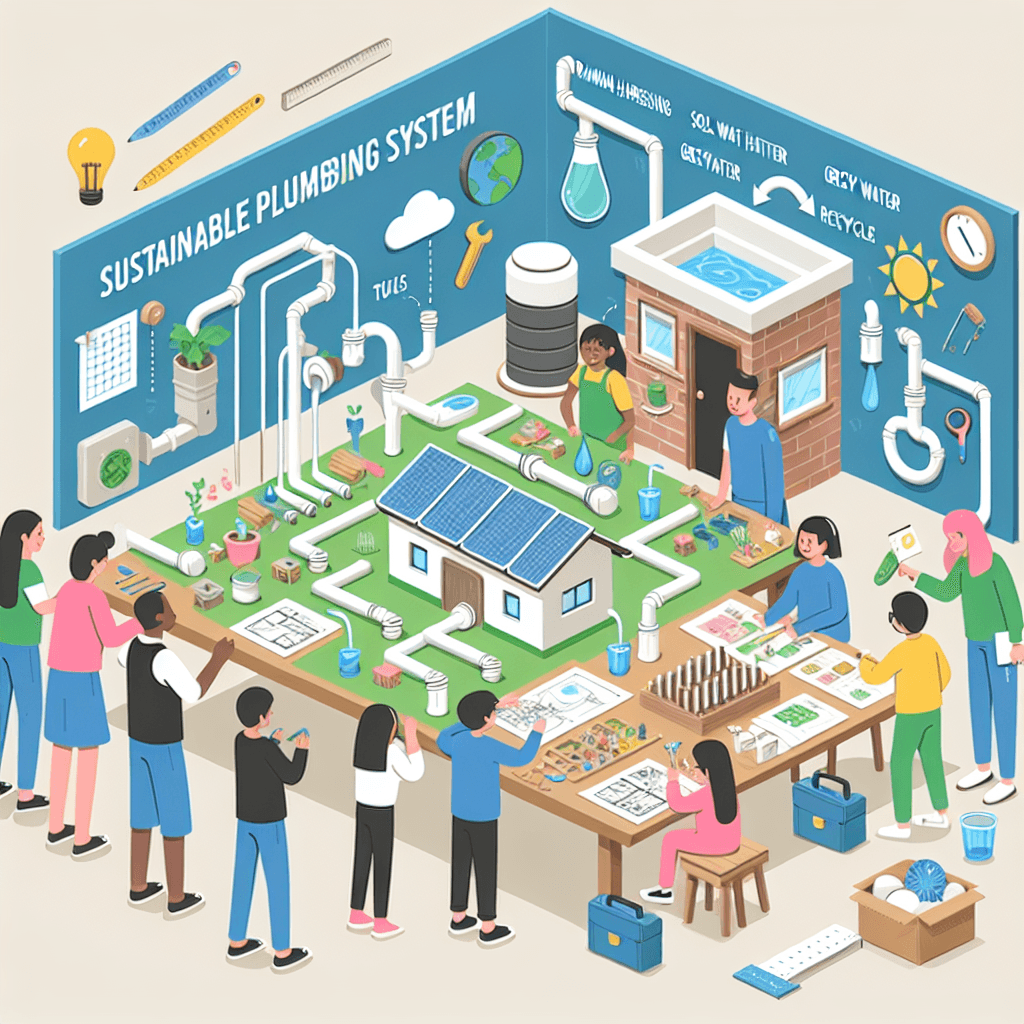
Sustainable Plumbing Design Project
Inquiry Framework
Question Framework
Driving Question
The overarching question that guides the entire project.How can we design and implement a cost-effective and environmentally responsible plumbing system that integrates innovative technologies to minimize water waste and maximize long-term savings for homeowners and businesses?Essential Questions
Supporting questions that break down major concepts.- How can we optimize water usage in plumbing systems to minimize waste?
- What are the environmental impacts of traditional plumbing materials, and how can we mitigate them?
- How can sustainable plumbing practices contribute to cost savings for homeowners and businesses?
- In what ways can we integrate technology into plumbing systems to enhance sustainability?
- What are the trade-offs between different sustainable plumbing solutions in terms of cost, performance, and environmental impact?
Standards & Learning Goals
Learning Goals
By the end of this project, students will be able to:- Students will be able to design a sustainable plumbing system that minimizes water waste.
- Students will be able to evaluate the environmental impact of traditional plumbing materials and practices.
- Students will be able to calculate and compare the cost-effectiveness of different plumbing solutions.
- Students will be able to integrate innovative water-saving technologies into plumbing system designs.
Massachusetts CTE Plumbing Standards
Entry Events
Events that will be used to introduce the project to studentsDesign a Plumbing System for Mars
Challenge students to design a closed-loop, sustainable plumbing system for a Martian colony, considering resource scarcity and extreme environmental conditions. This encourages creative problem-solving and pushes them to explore innovative water recycling and conservation technologies applicable to Earth.Portfolio Activities
Portfolio Activities
These activities progressively build towards your learning goals, with each submission contributing to the student's final portfolio.Water Footprint Analysis
Students will begin by assessing their own water usage and that of a typical household to understand where water is wasted. They will identify areas with the highest potential for water conservation and calculate potential savings.Steps
Here is some basic scaffolding to help students complete the activity.Final Product
What students will submit as the final product of the activityA detailed report on personal and household water usage, highlighting areas of waste and potential savings.Alignment
How this activity aligns with the learning objectives & standardsLearning Goal 1: Students will be able to design a sustainable plumbing system that minimizes water waste. Standard 1: Understand the principles of water conservation. Standard 7: Understand the environmental impact of plumbing systems.Eco-Material Database
Students will research and compile a database of eco-friendly plumbing materials, comparing their environmental impact, cost, and performance characteristics. This database will serve as a reference for selecting sustainable materials for their plumbing system design.Steps
Here is some basic scaffolding to help students complete the activity.Final Product
What students will submit as the final product of the activityA comprehensive database of eco-friendly plumbing materials with detailed information on environmental impact, cost, and performance.Alignment
How this activity aligns with the learning objectives & standardsLearning Goal 2: Students will be able to evaluate the environmental impact of traditional plumbing materials and practices. Standard 2: Identify and select eco-friendly plumbing materials. Standard 7: Understand the environmental impact of plumbing systems.Tech Integration Blueprint
Students will investigate various water-saving technologies (e.g., low-flow fixtures, greywater recycling systems, rainwater harvesting) and create a blueprint for integrating these technologies into a residential plumbing system.Steps
Here is some basic scaffolding to help students complete the activity.Final Product
What students will submit as the final product of the activityA detailed blueprint showcasing the integration of water-saving technologies into a residential plumbing system, including calculations of potential water savings and cost analysis.Alignment
How this activity aligns with the learning objectives & standardsLearning Goal 4: Students will be able to integrate innovative water-saving technologies into plumbing system designs. Standard 4: Install water-saving fixtures and appliances. Standard 5: Design plumbing systems that optimize water usage.Cost-Effectiveness Calculator
Students will develop a cost-effectiveness calculator to compare different plumbing system designs, considering both initial costs and long-term savings from reduced water consumption.Steps
Here is some basic scaffolding to help students complete the activity.Final Product
What students will submit as the final product of the activityA functional cost-effectiveness calculator that allows users to compare different plumbing system designs based on initial costs and long-term savings.Alignment
How this activity aligns with the learning objectives & standardsLearning Goal 3: Students will be able to calculate and compare the cost-effectiveness of different plumbing solutions. Standard 3: Apply mathematical concepts to calculate water flow rates and system efficiency. Standard 6: Evaluate the cost-effectiveness of different plumbing systems.Sustainable Plumbing System Design
Students will apply their research and calculations to design a sustainable plumbing system for a specific building (e.g., a school, a house, or a small business). The design will incorporate eco-friendly materials, water-saving technologies, and cost-effective solutions.Steps
Here is some basic scaffolding to help students complete the activity.Final Product
What students will submit as the final product of the activityA complete design for a sustainable plumbing system, including a schematic diagram, a list of materials, a description of the water-saving technologies used, and a cost-effectiveness analysis.Alignment
How this activity aligns with the learning objectives & standardsLearning Goal 1: Students will be able to design a sustainable plumbing system that minimizes water waste. Learning Goal 2: Students will be able to evaluate the environmental impact of traditional plumbing materials and practices. Learning Goal 3: Students will be able to calculate and compare the cost-effectiveness of different plumbing solutions. Learning Goal 4: Students will be able to integrate innovative water-saving technologies into plumbing system designs. Standard 5: Design plumbing systems that optimize water usage.Rubric & Reflection
Portfolio Rubric
Grading criteria for assessing the overall project portfolioSustainable Plumbing System Design Rubric
Water Conservation Design
Effectiveness of the design in minimizing water waste and optimizing water usage.Water Usage Minimization
Extent to which the design reduces water consumption compared to traditional systems.
Beginning
1 PointsDesign shows minimal consideration for water conservation; limited reduction in water usage.
Developing
2 PointsDesign incorporates some water-saving features; moderate reduction in water usage.
Proficient
3 PointsDesign effectively minimizes water waste; significant reduction in water usage.
Exemplary
4 PointsDesign innovatively minimizes water waste with exceptional water-saving features; outstanding reduction in water usage.
System Optimization
How well the design optimizes water flow and reduces potential leaks.
Beginning
1 PointsDesign shows little effort to optimize water flow or prevent leaks; basic layout.
Developing
2 PointsDesign attempts to optimize water flow and reduce leaks; some improvements over basic systems.
Proficient
3 PointsDesign optimizes water flow and effectively minimizes potential leaks; well-planned layout.
Exemplary
4 PointsDesign demonstrates exceptional optimization of water flow and leak prevention with innovative solutions; highly efficient layout.
Eco-Friendly Materials
Selection and integration of environmentally friendly plumbing materials.Material Selection
Appropriateness and justification of eco-friendly materials chosen.
Beginning
1 PointsMaterials used are not eco-friendly, or selection is unjustified.
Developing
2 PointsSome eco-friendly materials are used, but justification is limited.
Proficient
3 PointsEco-friendly materials are appropriately selected and justified based on environmental impact.
Exemplary
4 PointsEco-friendly materials are innovatively selected with comprehensive justification, demonstrating deep understanding of their environmental benefits.
Material Integration
How well the chosen materials are integrated into the plumbing system design.
Beginning
1 PointsMaterials are poorly integrated, and their use is impractical.
Developing
2 PointsMaterials are integrated with some consideration for practicality, but improvements are needed.
Proficient
3 PointsMaterials are well-integrated into the design, enhancing the system's sustainability.
Exemplary
4 PointsMaterials are seamlessly integrated into the design, demonstrating a sophisticated understanding of their application and maximizing the system's sustainability.
Technology Integration
Effective use of water-saving technologies in the plumbing system design.Technology Selection
Appropriateness and diversity of water-saving technologies chosen.
Beginning
1 PointsFew or no water-saving technologies are included; choices are inappropriate.
Developing
2 PointsSome water-saving technologies are included, but choices could be more appropriate or diverse.
Proficient
3 PointsAppropriate and diverse water-saving technologies are effectively selected and integrated.
Exemplary
4 PointsInnovative and highly effective water-saving technologies are chosen, demonstrating a deep understanding of their potential and maximizing water conservation.
Technology Implementation
How well the selected technologies are implemented and integrated into the system.
Beginning
1 PointsTechnologies are poorly implemented, with no clear understanding of their function.
Developing
2 PointsTechnologies are implemented with limited effectiveness; integration is basic.
Proficient
3 PointsTechnologies are effectively implemented and well-integrated into the system.
Exemplary
4 PointsTechnologies are seamlessly integrated into the system, demonstrating a sophisticated understanding of their application and maximizing their benefits.
Cost-Effectiveness Analysis
Thoroughness and accuracy of the cost-effectiveness analysis.Lifecycle Costing
Consideration of all relevant costs and savings over the system's lifespan.
Beginning
1 PointsAnalysis is superficial with minimal consideration of lifecycle costs.
Developing
2 PointsAnalysis considers some lifecycle costs, but lacks depth and accuracy.
Proficient
3 PointsAnalysis thoroughly considers all relevant costs and savings over the system's lifespan.
Exemplary
4 PointsAnalysis is comprehensive and insightful, providing a sophisticated understanding of the system's long-term cost-effectiveness.
Comparative Analysis
Comparison of different design options and justification of the chosen design.
Beginning
1 PointsNo comparison of different design options is provided.
Developing
2 PointsSome comparison of design options is attempted, but justification is weak.
Proficient
3 PointsClear comparison of different design options with sound justification for the chosen design.
Exemplary
4 PointsComprehensive comparison of multiple design options with compelling justification, demonstrating a deep understanding of the trade-offs and benefits of each option.