
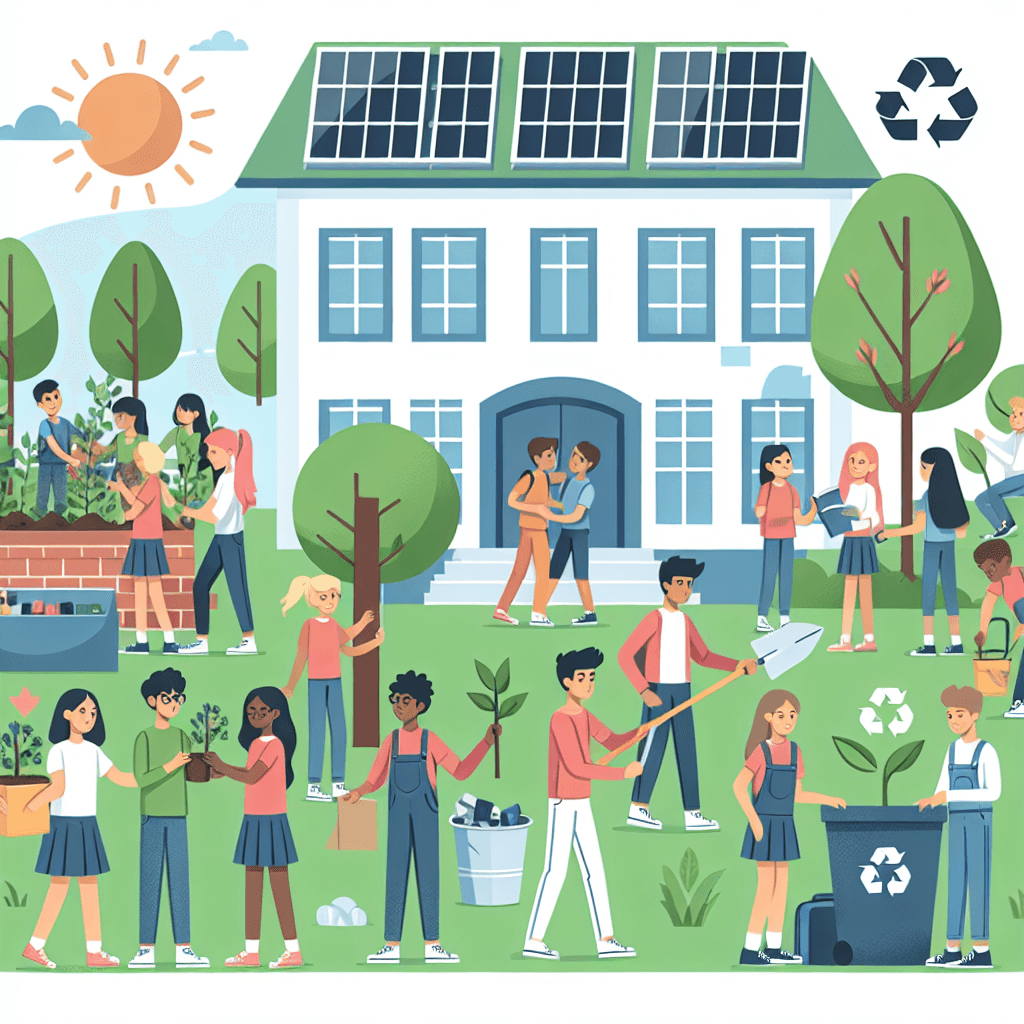
Sustainable Schools: Action for a Better World
Inquiry Framework
Question Framework
Driving Question
The overarching question that guides the entire project.How can we take informed action to address local environmental challenges and contribute to a more sustainable future, in alignment with the UN Sustainable Development Goals?Essential Questions
Supporting questions that break down major concepts.- Why is sustainability important for both people and the planet?
- How are local environmental issues connected to global challenges?
- What responsibilities do we have as individuals and as a community?
- How can informed action lead to meaningful change?
Standards & Learning Goals
Learning Goals
By the end of this project, students will be able to:- Identify and explain the purpose of the UN Sustainable Development Goals.
- Analyze local and global environmental challenges and their causes and effects.
- Develop research, collaboration, communication, and critical thinking skills through inquiry.
- Take informed and responsible action to contribute positively to sustainability in their school or local community, and clearly explain the reasoning and evidence behind their decisions.
Entry Events
Events that will be used to introduce the project to studentsThe Case of the Missing Resources
Learners investigate a real-world puzzle using baseline data from the school: a recent increase in water use, electricity consumption, and waste output. In groups, students examine simple data cards, photos, and short anecdotes from different areas of the campus to identify patterns and possible causes for the “missing resources.” They generate questions, propose initial hypotheses, and decide what further evidence they need to collect. Each group records its thinking on a Cause–Evidence–Next steps chart and posts it on the Wonder Wall. This provocation launches inquiry into Sustainable Development Goals by connecting local resource use to global sustainability.Community Time Capsule
Students explore sustainability within their school and local community by examining current practices related to waste, water, energy, and greenery. Learners document observations through photos, sketches, or notes and record initial reflections on how these practices support or challenge sustainability. These reflections are placed into a “Time Capsule” that will be opened again at the end of the unit to compare how their understanding and perspectives have grown.Materials
Data cards showing monthly water, electricity, and waste figures; photos of taps, switchboards, bins; short written scenarios from classrooms, cafeteria, and playground; Cause–Evidence–Next steps chart paper; sticky notes; markers.Expected Student Evidence
Group chart with at least two plausible causes linked to specific evidence, a list of data they still need, and two inquiry questions to pursue during Week 1 and Week 2.Portfolio Activities
Portfolio Activities
These activities progressively build towards your learning goals, with each submission contributing to the student's final portfolio.Understanding Sustainability & the SDGs
Learners are introduced to the United Nations Sustainable Development Goals and begin exploring why sustainability is important for both people and the planet. This activity builds foundational vocabulary and activates prior knowledge to launch inquiry.Steps
Here is some basic scaffolding to help students complete the activity.Final Product
What students will submit as the final product of the activityGroup-sorted SDG posters and a shared Wonder Wall of inquiry questions.Alignment
How this activity aligns with the learning objectives & standardsIdentify and explain the purpose of the UN Sustainable Development Goals.Investigating Local Sustainability Practices
Learners inquire into sustainability within their school environment by observing current practices related to water, waste, energy, and green spaces. They connect local observations to global sustainability challenges.Steps
Here is some basic scaffolding to help students complete the activity.Final Product
What students will submit as the final product of the activityResearch poster showing causes, effects, stakeholders, and connections between the local issue and relevant SDGs.Alignment
How this activity aligns with the learning objectives & standardsAnalyze local and global environmental challenges and their causes and effects.Designing and Presenting Sustainable Action Plans
Learners synthesize their understanding by designing a realistic sustainability action plan to improve practices in the school or community. They justify their decisions with evidence and connect their proposal to relevant SDGs.Steps
Here is some basic scaffolding to help students complete the activity.Final Product
What students will submit as the final product of the activitySustainability Action Plan presentation with supporting visual prototype or communication tool.Alignment
How this activity aligns with the learning objectives & standardsTake informed and responsible action to contribute positively to sustainability in the school or local community, explaining reasoning with evidence.Taking Action: Implementing Sustainable Change
Learners implement their sustainability action plan within the school or local community. They document the process, monitor progress, and evaluate the impact of their choices to determine what worked, what needs adjustment, and what can continue beyond the project.Steps
Here is some basic scaffolding to help students complete the activity.Final Product
What students will submit as the final product of the activityA reflection portfolio that includes: • Description of the action taken • Evidence of implementation (photos, data, or documentation) • Analysis of the impact • Reflections on successes, challenges, and next stepsAlignment
How this activity aligns with the learning objectives & standardsTake informed and responsible action to contribute positively to sustainability in their school or local community, and explain the reasoning and evidence behind their decisions.Rubric & Reflection
Portfolio Rubric
Grading criteria for assessing the overall project portfolioSustainability Action Project Rubric
Understanding of Sustainability Concepts
Demonstrates understanding of key sustainability concepts, including the UN Sustainable Development Goals and their relevance to local and global issues.Knowledge of SDGs
Demonstrates knowledge of the UN Sustainable Development Goals and their interconnections.
Exemplary
4 PointsDemonstrates a deep and nuanced understanding of multiple SDGs and their interconnectedness, explaining how they relate to various aspects of sustainability.
Proficient
3 PointsDemonstrates a solid understanding of several SDGs, explaining their purpose and relevance to sustainability.
Developing
2 PointsDemonstrates a basic understanding of a few SDGs, but struggles to explain their purpose or relevance.
Beginning
1 PointsShows limited understanding of the SDGs and their connection to sustainability.
Connection to Local and Global Issues
Connects sustainability concepts to local and global environmental challenges.
Exemplary
4 PointsArticulates insightful connections between local actions, global challenges, and the SDGs, demonstrating a systems-thinking perspective.
Proficient
3 PointsClearly connects local environmental issues to broader global challenges and relevant SDGs.
Developing
2 PointsIdentifies some connections between local issues and global challenges, but explanations are superficial.
Beginning
1 PointsStruggles to connect local issues to global challenges or the SDGs.
Analysis of Environmental Challenges
Analyzes local environmental challenges, identifying causes, effects, and stakeholders.Identification of Causes and Effects
Identifies the causes and effects of the chosen environmental challenge.
Exemplary
4 PointsThoroughly analyzes the root causes and cascading effects of the environmental challenge, providing detailed and well-supported explanations.
Proficient
3 PointsClearly identifies the main causes and effects of the environmental challenge, providing logical explanations.
Developing
2 PointsIdentifies some causes and effects of the environmental challenge, but explanations are incomplete or lack detail.
Beginning
1 PointsStruggles to identify the causes and effects of the environmental challenge.
Stakeholder Identification
Identifies the stakeholders involved in the environmental challenge.
Exemplary
4 PointsIdentifies a comprehensive range of stakeholders (individuals, groups, organizations) and analyzes their diverse perspectives and roles in the challenge.
Proficient
3 PointsIdentifies the key stakeholders involved in the environmental challenge and describes their roles.
Developing
2 PointsIdentifies some stakeholders, but struggles to explain their roles or perspectives.
Beginning
1 PointsStruggles to identify relevant stakeholders.
Action Plan Design and Implementation
Designs and implements a realistic action plan to address the chosen environmental challenge.Action Plan Feasibility and Innovation
Designs a feasible and innovative action plan that addresses the environmental challenge.
Exemplary
4 PointsDevelops a highly innovative and practical action plan with clearly defined steps, resources, and timelines, demonstrating a deep understanding of the challenge and potential solutions.
Proficient
3 PointsDevelops a realistic and well-defined action plan with clear steps and resource considerations.
Developing
2 PointsDevelops an action plan with some steps, but lacks detail or feasibility considerations.
Beginning
1 PointsStruggles to develop a coherent action plan.
Implementation and Documentation
Implements the action plan effectively and documents the process with evidence.
Exemplary
4 PointsImplements the action plan with dedication and documents the process thoroughly using diverse evidence (photos, data, testimonials) to showcase impact and challenges.
Proficient
3 PointsImplements the action plan and provides clear documentation of the process with relevant evidence.
Developing
2 PointsAttempts to implement the action plan, but documentation is incomplete or lacks detail.
Beginning
1 PointsStruggles to implement the action plan or provide documentation.
Reflection and Evaluation
Reflects on the outcomes of the action plan, evaluating successes, challenges, and next steps.Analysis of Impact
Analyzes the impact of the action plan, using data or observations to support claims.
Exemplary
4 PointsProvides a sophisticated analysis of the action plan's impact, using quantitative and qualitative data to demonstrate measurable outcomes and insights.
Proficient
3 PointsAnalyzes the impact of the action plan, providing clear evidence and logical reasoning to support claims.
Developing
2 PointsDescribes the impact of the action plan, but lacks specific evidence or detailed analysis.
Beginning
1 PointsStruggles to assess the impact of the action plan.
Reflection on Learning
Reflects on personal learning and growth throughout the project.
Exemplary
4 PointsOffers insightful reflections on personal growth, challenges overcome, and lessons learned, demonstrating a deep understanding of the project's impact on their own learning and perspective.
Proficient
3 PointsReflects on personal learning and growth, identifying key takeaways and challenges encountered during the project.
Developing
2 PointsProvides some reflections on the project experience, but lacks depth or personal insight.
Beginning
1 PointsStruggles to reflect on personal learning or growth.
IB PYP Framework Alignment
This category records the unit’s IB PYP alignment so the project is clearly conceptual, inquiry-driven, and skills-focused.PYP Core Elements
Central Idea: Sustainable development is influenced by the choices we make about how we use and share resources. Key Concepts: Responsibility, Connection, Causation Lines of Inquiry: 1. The causes of environmental challenges (Causation) 2. How human choices impact sustainability in local and global contexts (Responsibility) 3. Positive actions that support sustainable development (Connection) Related Concepts: Systems, Interdependence, Conservation, Equity Learner Profile Attributes: Caring, Thinker, Principled, Communicator Approaches to Learning Skills: • Research Skills – gathering data, evaluating sources, interpreting information • Communication Skills – presenting ideas clearly through multiple forms of expression • Social Skills – collaboration, shared decision-making, respectful dialogue • Thinking Skills – analyzing information, making connections, reasoning with evidence Summative Assessment: Students design and present a sustainability action plan for their school or local community. The presentation must explain the issue and why it matters, show evidence of research, propose a realistic and responsible action, justify the action with reasoning and evidence, and reflect on expected and or observed impact. Reflection Prompts: • How did my understanding of sustainability change during the project? • What skills did I use and strengthen during this inquiry? • What actions can I continue beyond this unit to support sustainability?
Not Assessed
0 PointsThis criterion is for documenting the IB PYP framework only and is not graded.
Met / Recorded
0 PointsThis criterion is for documenting the IB PYP framework only and is not graded.