
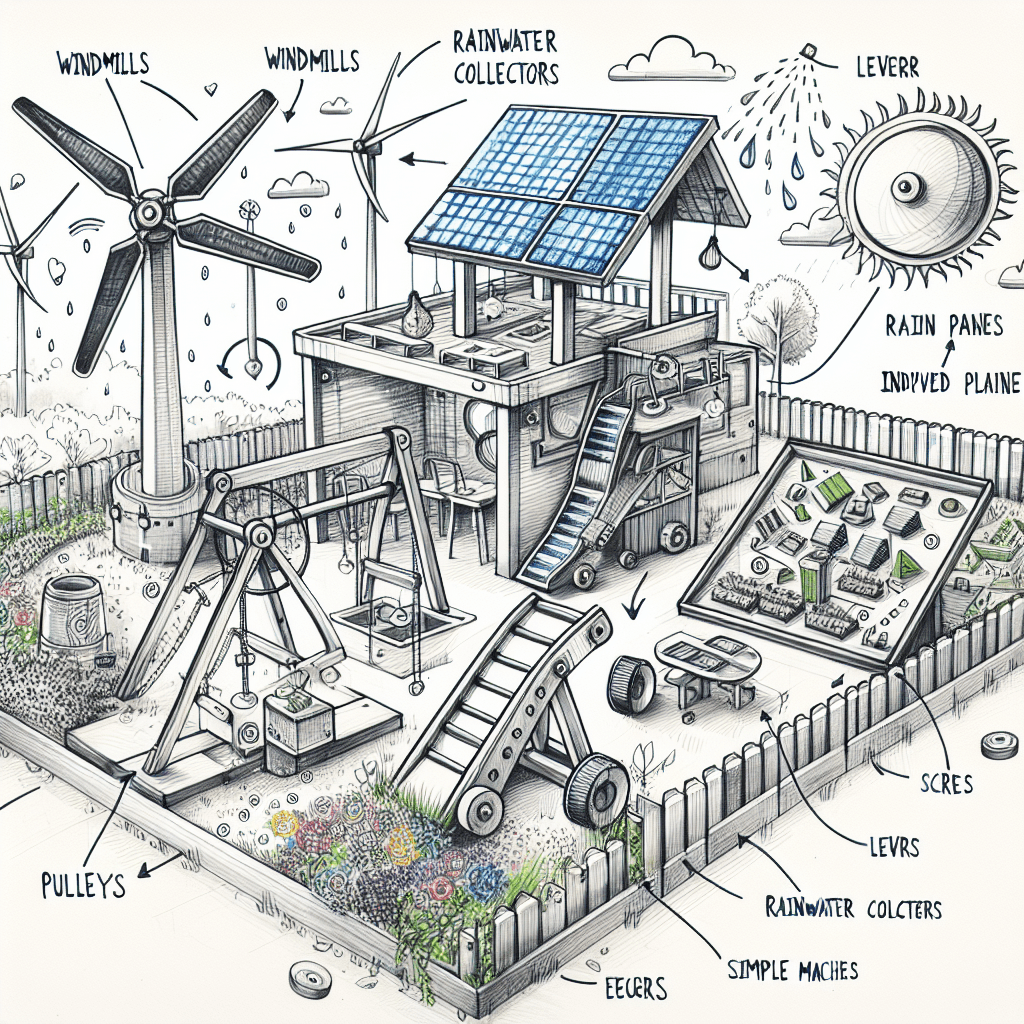
Sustainable Simple Machines Playground
Inquiry Framework
Question Framework
Driving Question
The overarching question that guides the entire project.How can we design and build a safe and enjoyable playground using simple machines like pulleys and levers while minimizing environmental impacts?Essential Questions
Supporting questions that break down major concepts.- What are simple machines and what are their key properties?
- How do pulleys and levers make work easier?
- How can the principles of simple machines be used to construct a sustainable playground?
- What are the environmental impacts of building a playground and how can we minimize them?
- How can we ensure that the playground is safe and enjoyable for everyone?
Standards & Learning Goals
Learning Goals
By the end of this project, students will be able to:- Students will be able to identify and describe the properties of simple machines including levers, pulleys, wedges, inclined planes, wheel and axles, and screws.
- Students will design a playground that integrates simple machines and considers environmental impacts.
- Students will understand and apply the principles of energy transfer through simple machines like pulleys and levers.
- Students will develop solutions to minimize environmental impacts in playground construction.
Next Generation Science Standards
Entry Events
Events that will be used to introduce the project to studentsPlayground in a Box
Present students with a mysterious box containing various items such as pulleys, levers, ropes, and wheels. Challenge them to figure out how these items can come together to create a sustainable, imaginative playground structure. This hands-on discovery will ignite curiosity about the playground's design and function.Portfolio Activities
Portfolio Activities
These activities progressively build towards your learning goals, with each submission contributing to the student's final portfolio.Design Challenge: Playground Prototype
Students apply their understanding of simple machines to design a model of a playground using pulleys and levers.Steps
Here is some basic scaffolding to help students complete the activity.Final Product
What students will submit as the final product of the activityA model of a playground featuring pulleys and levers, designed to be both fun and sustainable.Alignment
How this activity aligns with the learning objectives & standardsAligns with 4-PS3-4 of NGSS by applying scientific ideas to design and test a device for energy conversion.Eco-friendly Playground Assessment
Students evaluate their playground designs to identify the environmental impacts and propose solutions to minimize them.Steps
Here is some basic scaffolding to help students complete the activity.Final Product
What students will submit as the final product of the activityA revised playground model with a report detailing the environmental assessments and proposed solutions for sustainability.Alignment
How this activity aligns with the learning objectives & standardsSupports 4-ESS3-2 NGSS by focusing on evaluating and minimizing environmental impacts.Safety and Durability Inspection
Students focus on the safety and durability aspects of their playground designs, assessing how they withstand environmental factors like weather.Steps
Here is some basic scaffolding to help students complete the activity.Final Product
What students will submit as the final product of the activityA safety and durability inspection report highlighting changes made to enhance the design's resilience and safety.Alignment
How this activity aligns with the learning objectives & standardsAligns with 3-ESS3-1 of NGSS concerning the reduction of impacts from weather-related hazards.Rubric & Reflection
Portfolio Rubric
Grading criteria for assessing the overall project portfolioSustainable Playground Design Rubric
Understanding of Simple Machines
Evaluates the student's understanding of simple machines and their properties as applied in the playground design.Demonstrates Knowledge of Simple Machines
Ability to accurately identify and describe the properties and functions of levers and pulleys used in the playground design.
Extending
4 PointsDemonstrates a sophisticated understanding of the functions and properties of levers and pulleys, accurately integrating them into the playground design.
Proficient
3 PointsDemonstrates thorough understanding of the functions and properties of levers and pulleys with appropriate integration into the playground design.
Developing
2 PointsShows emerging understanding of the functions and properties of levers and pulleys with inconsistent application in the playground design.
Emerging
1 PointsShows initial understanding of the functions and properties of levers and pulleys with limited or incorrect application in the playground design.
Design and Innovation Skills
Assesses creativity and innovation in designing a playground model that integrates simple machines for energy efficient and safe play.Creativity and Innovation
The originality and thoughtfulness in the playground design using simple machines to achieve energy efficiency and safety.
Extending
4 PointsExhibits exceptional creativity and innovation, integrating simple machines ingeniously to enhance energy efficiency and safety.
Proficient
3 PointsShows creativity and practical use of simple machines in the playground design with effective consideration of energy efficiency and safety.
Developing
2 PointsDisplays some creativity in the playground design, with basic application of simple machines to achieve energy efficiency and safety.
Emerging
1 PointsShows limited creativity with minimal or inappropriate use of simple machines in the playground design.
Environmental Impact Assessment
Evaluates the student's ability to assess and minimize environmental impacts in their playground design.Environmental Consideration
Assessment of environmental impacts and strategies to minimize ecological footprints in the playground design.
Extending
4 PointsProvides a comprehensive analysis and innovative solutions to effectively minimize the playground's ecological footprint.
Proficient
3 PointsProvides clear analysis and practical solutions to reduce the playground's ecological footprint.
Developing
2 PointsOffers basic analysis with limited solutions for minimizing the playground's environmental impacts.
Emerging
1 PointsDisplays minimal analysis and lacks effective strategies to mitigate environmental impacts.
Safety and Resilience Evaluation
Measures the effectiveness of safety and durability assessments, ensuring the playground design withstands various environmental conditions.Safety and Durability
Effectiveness in identifying potential hazards and making modifications to enhance the safety and resilience of the playground design.
Extending
4 PointsDemonstrates exceptional skill in identifying and mitigating safety hazards, ensuring the playground's resilience against environmental conditions.
Proficient
3 PointsEffectively identifies safety hazards and implements modifications to enhance the playground’s resilience and safety.
Developing
2 PointsIdentifies some safety hazards, with basic modifications made to enhance resilience and safety.
Emerging
1 PointsShows limited ability to identify safety hazards and make necessary modifications.