
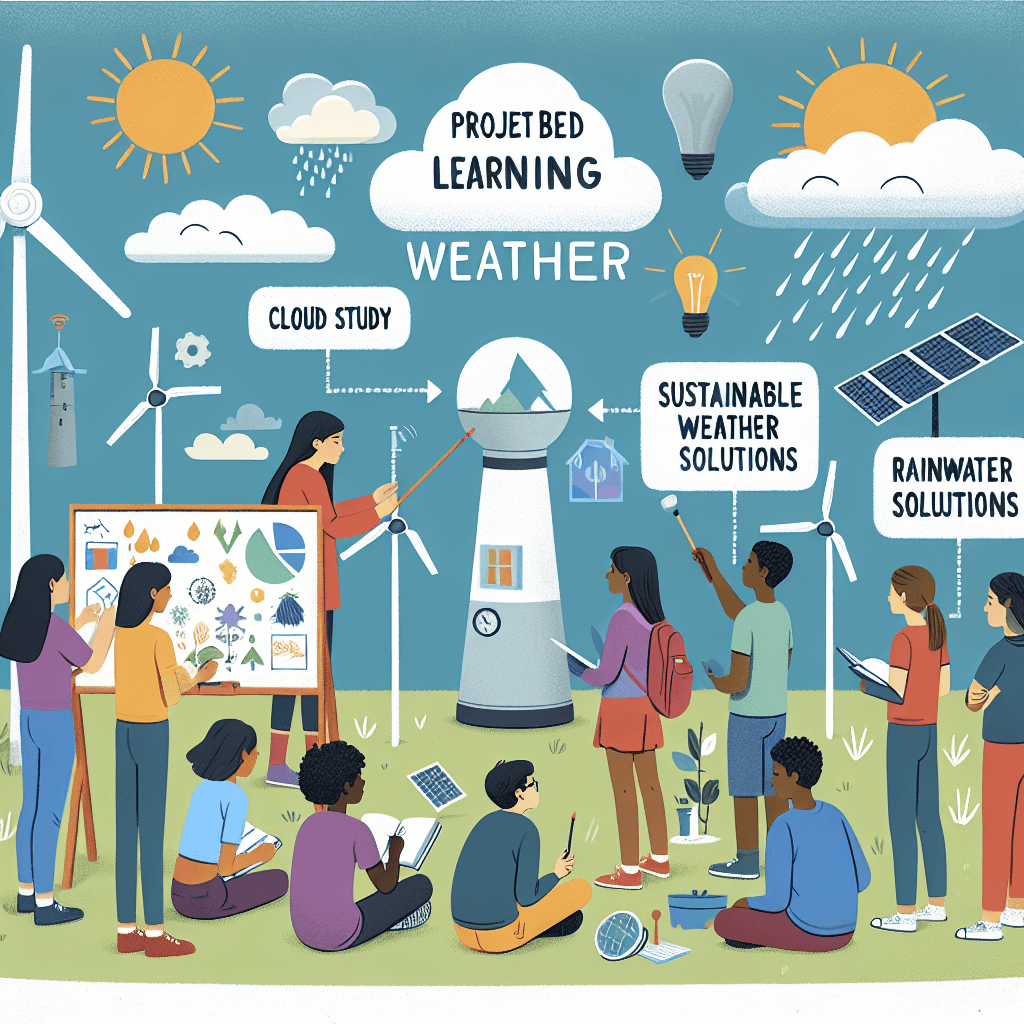
Sustainable Weather Solution: Mitigating Weather's Impact
Inquiry Framework
Question Framework
Driving Question
The overarching question that guides the entire project.How can we design a sustainable solution to a weather-related challenge in our community, using our understanding of weather patterns, technology, and resource management?Essential Questions
Supporting questions that break down major concepts.- How do different weather conditions impact our community and the environment?
- What technologies can help us address specific weather-related challenges?
- What does 'sustainable' mean, and how can we apply it to weather solutions?
- How do air movement and solar energy transfer affect weather patterns locally and globally?
- How can we measure and represent local weather conditions accurately?
- What materials and resources can we use to create a sustainable weather solution?
- How can we design a solution that minimizes negative impacts on the environment and society?
- How can we test and improve our weather solution to make it more effective and sustainable?
Standards & Learning Goals
Learning Goals
By the end of this project, students will be able to:- Students will be able to measure and represent local weather conditions, including temperature, wind speed and direction, amount of sunlight, precipitation, relative humidity, and cloud cover.
- Students will be able to investigate local, national, and global weather conditions, including the role of air movement and solar energy transfer.
- Students will be able to analyze the impact of weather on society and the environment, including technologies that help humans address weather conditions.
- Students will be able to design a sustainable solution to a weather-related challenge in their community.
- Students will be able to apply their understanding of weather patterns, technology, and resource management to develop their solution.
- Students will be able to evaluate the sustainability of their solution and identify areas for improvement.
- Students will be able to test and refine their solution based on data and feedback.
- Students will understand the meaning of 'sustainable' and apply it to weather solutions
Weather Standards
Entry Events
Events that will be used to introduce the project to studentsEmergency Broadcast Interruption
**"Emergency Broadcast Interruption":** The class views a realistic, simulated emergency broadcast detailing an imminent weather-related crisis in their local area. Working in teams, they must quickly brainstorm and prototype sustainable solutions to protect their community, using limited resources and real-time weather data.The Case of the Vanishing Bees
**"The Case of the Vanishing Bees (or other local species)":** A local beekeeper (or environmental expert) presents a real-world problem of declining bee populations due to changing weather patterns. Students become 'environmental engineers,' researching the impact of weather on bees and designing a sustainable habitat solution to help them thrive.Weather Diaries from Around the World
**"Weather Diaries from Around the World":** Students receive personal video diaries from kids in different countries describing how weather impacts their daily lives (floods, droughts, extreme heat/cold). They compare experiences, identify common challenges, and propose sustainable solutions that could be adapted across different regions.Portfolio Activities
Portfolio Activities
These activities progressively build towards your learning goals, with each submission contributing to the student's final portfolio.Weather Watchers: Measuring Our Environment
Students will learn how to accurately measure weather elements using various instruments. They will record their findings in a weather journal.Steps
Here is some basic scaffolding to help students complete the activity.Final Product
What students will submit as the final product of the activityA detailed weather journal with daily measurements and observations over two weeks.Alignment
How this activity aligns with the learning objectives & standardsAligns with WE5.1 by focusing on measuring and representing weather conditions.Air & Sun Explorers: Understanding Weather Dynamics
Students investigate how air movement and solar energy transfer affect local weather patterns. They will create a model to demonstrate these concepts.Steps
Here is some basic scaffolding to help students complete the activity.Final Product
What students will submit as the final product of the activityA working model and a presentation explaining the impact of air movement and solar energy on local weather.Alignment
How this activity aligns with the learning objectives & standardsAddresses WE5.2 by investigating weather conditions and the role of air movement and solar energy.Tech Titans: Weather-Busting Technologies
Students research and present on existing technologies that help humans address weather conditions (e.g., flood defenses, drought-resistant crops, early warning systems).Steps
Here is some basic scaffolding to help students complete the activity.Final Product
What students will submit as the final product of the activityA presentation detailing a specific weather-related technology and its impact on society.Alignment
How this activity aligns with the learning objectives & standardsRelates to WE5.3 by analyzing the impact of weather and exploring technologies that help humans.Solution Architects: Building a Sustainable Future
Students design a sustainable solution to a weather-related challenge in their community, incorporating their knowledge of weather patterns, technology, and resource management.Steps
Here is some basic scaffolding to help students complete the activity.Final Product
What students will submit as the final product of the activityA detailed design proposal for a sustainable weather solution, including diagrams, materials list, and explanation of its benefits.Alignment
How this activity aligns with the learning objectives & standardsIntegrates WE5.1, WE5.2, and WE5.3 by designing a sustainable solution to a weather challenge.Rubric & Reflection
Portfolio Rubric
Grading criteria for assessing the overall project portfolioWeather & Sustainability Portfolio Rubric
Data Collection & Analysis
Assesses the student's ability to accurately measure, record, and interpret weather data.Measurement Accuracy
Accuracy and consistency of weather measurements.
Exemplary
4 PointsMeasurements are consistently accurate and precise, demonstrating a deep understanding of weather instruments.
Proficient
3 PointsMeasurements are generally accurate and consistent, with minor errors that do not significantly impact overall data.
Developing
2 PointsMeasurements show some inaccuracies and inconsistencies, impacting the reliability of the data.
Beginning
1 PointsMeasurements are frequently inaccurate and inconsistent, indicating a lack of understanding of weather instruments.
Journal Completeness
Completeness and organization of the weather journal.
Exemplary
4 PointsJournal is exceptionally detailed, well-organized, and includes thoughtful reflections and analysis.
Proficient
3 PointsJournal is complete, well-organized, and includes clear descriptions and observations.
Developing
2 PointsJournal is mostly complete but lacks detail and organization in some areas.
Beginning
1 PointsJournal is incomplete, poorly organized, and lacks essential information.
Pattern Interpretation
Identification and interpretation of weather patterns from collected data.
Exemplary
4 PointsDemonstrates sophisticated analysis of weather patterns, drawing insightful conclusions supported by data.
Proficient
3 PointsIdentifies and interprets weather patterns accurately, using data to support conclusions.
Developing
2 PointsIdentifies some weather patterns but struggles to interpret them accurately or support conclusions with data.
Beginning
1 PointsStruggles to identify weather patterns or interpret data effectively.
Weather Dynamics
Evaluates the student's understanding of weather dynamics and their ability to demonstrate these concepts through a model and presentation.Conceptual Understanding
Understanding of air movement, solar energy transfer, and their impact on weather.
Exemplary
4 PointsDemonstrates a comprehensive and nuanced understanding of air movement and solar energy transfer, explaining their impact on weather patterns with clarity and insight.
Proficient
3 PointsDemonstrates a thorough understanding of air movement and solar energy transfer, explaining their impact on weather patterns effectively.
Developing
2 PointsShows a basic understanding of air movement and solar energy transfer, but struggles to explain their impact on weather patterns clearly.
Beginning
1 PointsShows a limited understanding of air movement and solar energy transfer, and is unable to explain their impact on weather patterns.
Model Quality
Quality and functionality of the air movement and solar energy model.
Exemplary
4 PointsModel is exceptionally well-designed, constructed with attention to detail, and effectively demonstrates the concepts of air movement and solar energy transfer.
Proficient
3 PointsModel is well-designed, functional, and clearly demonstrates the concepts of air movement and solar energy transfer.
Developing
2 PointsModel is partially functional but may lack detail or clarity in demonstrating the concepts of air movement and solar energy transfer.
Beginning
1 PointsModel is poorly constructed, lacks functionality, and does not effectively demonstrate the concepts of air movement and solar energy transfer.
Presentation Clarity
Clarity and accuracy of the presentation explaining air movement and solar energy.
Exemplary
4 PointsPresentation is exceptionally clear, engaging, and accurately explains the concepts of air movement and solar energy transfer with compelling visuals and examples.
Proficient
3 PointsPresentation is clear, well-organized, and accurately explains the concepts of air movement and solar energy transfer.
Developing
2 PointsPresentation is somewhat unclear, disorganized, or contains minor inaccuracies in explaining the concepts of air movement and solar energy transfer.
Beginning
1 PointsPresentation is unclear, disorganized, and contains significant inaccuracies in explaining the concepts of air movement and solar energy transfer.
Weather Technologies
Assesses the student's ability to research, analyze, and present information about weather-related technologies.Research Depth
Depth of research on the chosen weather-related technology.
Exemplary
4 PointsDemonstrates extensive and insightful research on the chosen technology, exploring its history, development, and future potential.
Proficient
3 PointsDemonstrates thorough research on the chosen technology, covering its key features, functionality, and applications.
Developing
2 PointsShows basic research on the chosen technology but lacks depth and detail in some areas.
Beginning
1 PointsShows limited research on the chosen technology and lacks essential information.
Impact Analysis
Analysis of the technology's impact on society and the environment.
Exemplary
4 PointsProvides a comprehensive and nuanced analysis of the technology's impact, considering both positive and negative consequences on society and the environment.
Proficient
3 PointsProvides a clear and balanced analysis of the technology's impact on society and the environment.
Developing
2 PointsAnalyzes the technology's impact on society and the environment but lacks depth or balance.
Beginning
1 PointsFails to adequately analyze the technology's impact on society and the environment.
Presentation Effectiveness
Effectiveness of the presentation in conveying information about the technology.
Exemplary
4 PointsPresentation is exceptionally engaging, informative, and effectively conveys complex information about the technology in a clear and accessible manner.
Proficient
3 PointsPresentation is clear, well-organized, and effectively conveys information about the technology.
Developing
2 PointsPresentation is somewhat unclear, disorganized, or lacks key information about the technology.
Beginning
1 PointsPresentation is unclear, disorganized, and fails to convey essential information about the technology.
Sustainable Solutions
Evaluates the student's ability to design a sustainable solution to a weather-related challenge.Challenge Identification
Identification of a relevant weather-related challenge in the community.
Exemplary
4 PointsIdentifies a highly relevant and impactful weather-related challenge in the community, demonstrating a deep understanding of local issues.
Proficient
3 PointsIdentifies a relevant weather-related challenge in the community.
Developing
2 PointsIdentifies a weather-related challenge but its relevance to the community is not clearly established.
Beginning
1 PointsFails to identify a relevant weather-related challenge in the community.
Solution Innovation
Innovation and sustainability of the proposed solution.
Exemplary
4 PointsProposes a highly innovative and sustainable solution that demonstrates a deep understanding of environmental and social impacts.
Proficient
3 PointsProposes a sustainable solution that addresses the identified weather-related challenge effectively.
Developing
2 PointsProposes a solution with some elements of sustainability but lacks innovation or a comprehensive understanding of environmental and social impacts.
Beginning
1 PointsProposes a solution that is not sustainable or does not adequately address the identified weather-related challenge.
Proposal Clarity
Clarity and detail of the design proposal.
Exemplary
4 PointsDesign proposal is exceptionally clear, detailed, and includes comprehensive diagrams, materials list, and a well-reasoned explanation of its benefits.
Proficient
3 PointsDesign proposal is clear, detailed, and includes diagrams, materials list, and an explanation of its benefits.
Developing
2 PointsDesign proposal is somewhat unclear, lacks detail, or is missing key elements such as diagrams or a materials list.
Beginning
1 PointsDesign proposal is unclear, incomplete, and lacks essential information.
Presentation Effectiveness
Effectiveness of the presentation in explaining the solution's sustainability and benefits.
Exemplary
4 PointsPresentation is exceptionally persuasive, clearly articulating the solution's sustainability and benefits with compelling evidence and visuals.
Proficient
3 PointsPresentation is clear and effectively explains the solution's sustainability and benefits.
Developing
2 PointsPresentation is somewhat unclear or lacks key information about the solution's sustainability and benefits.
Beginning
1 PointsPresentation is unclear and fails to adequately explain the solution's sustainability and benefits.