
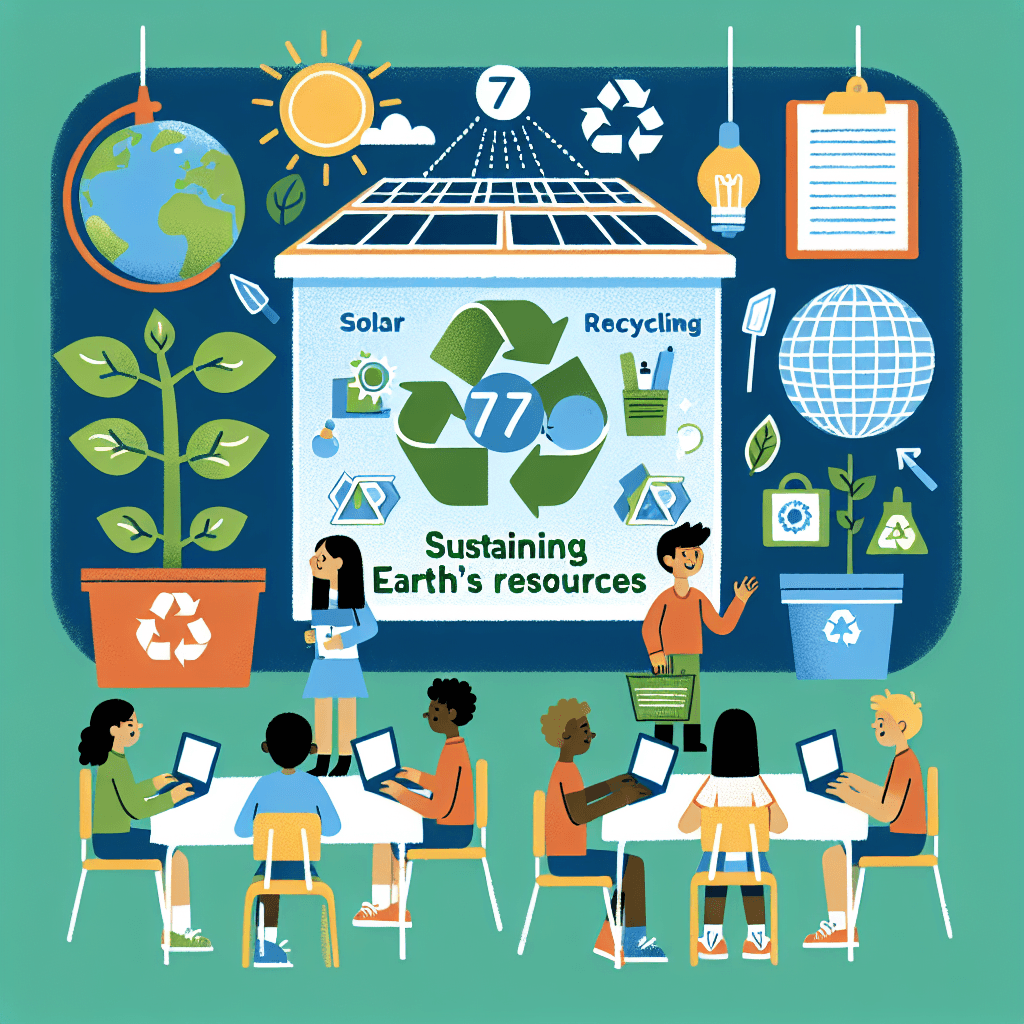
Sustaining Earth's Resources: A 7th Grade Exploration
Inquiry Framework
Question Framework
Driving Question
The overarching question that guides the entire project.How can we collaborate to develop and implement innovative strategies that ensure the sustainable use of Earth's natural resources while balancing ecological, economic, and cultural needs?Essential Questions
Supporting questions that break down major concepts.- What are Earth's natural resources, and why are they important?
- How do human activities impact the availability and quality of Earth's natural resources?
- What sustainable practices can be adopted to preserve natural resources for future generations?
- How does the use of natural resources differ across various regions and cultures worldwide?
- In what ways can individuals contribute to the sustainability of Earth's natural resources?
- How do scientific principles guide the sustainable use of natural resources?
- What role do governments and organizations play in managing natural resources sustainably?
- How can we assess the impact of a community or country's consumption of natural resources?
- What are the potential consequences of not adopting sustainable practices for natural resources?
- How can persuasive language and communication effectively promote sustainability awareness?
Standards & Learning Goals
Learning Goals
By the end of this project, students will be able to:- Investigate and understand the significance of Earth's natural resources and their uses.
- Evaluate the impact of human activities on the availability and quality of natural resources.
- Develop innovative strategies for the sustainable use of natural resources balancing ecological, economic, and cultural needs.
- Collaborate effectively to design and implement solutions for sustainability challenges.
- Communicate persuasively about the importance of sustainable practices through various media.
- Analyze regional differences in resource use and cultural perspectives on sustainability.
- Examine the roles of governments and organizations in managing natural resources.
- Assess the consequences of unsustainable practices on natural resources and propose solutions.
- Apply scientific principles to guide the sustainable management of resources.
NGSS
Common Core Standards
Entry Events
Events that will be used to introduce the project to studentsVR Journey to a Future Earth
Students will be introduced to a virtual reality experience that projects them into a future where Earth's natural resources are severely depleted. The goal is to evoke strong emotional responses and curiosity about how the future depends on sustainable practices.Schoolyard Challenge: Waste Audit
Students are tasked with conducting a waste audit in their schoolyard, challenging them to investigate how waste is managed and explore ways to reduce and recycle effectively. This hands-on experience is linked directly to real-world actions in sustainability.Sustainability Scavenger Hunt
Students engage in a scavenger hunt to find items or ideas representing sustainable and non-sustainable practices within their community, sparking discussions and inquiries about local impacts on global issues.Portfolio Activities
Portfolio Activities
These activities progressively build towards your learning goals, with each submission contributing to the student's final portfolio.Schoolyard Waste Audit Report
Students will compile data from the Schoolyard Waste Audit, analyzing waste management and proposing actionable strategies for reduction and recycling.Steps
Here is some basic scaffolding to help students complete the activity.Final Product
What students will submit as the final product of the activityA comprehensive report with data analysis and sustainability recommendations.Alignment
How this activity aligns with the learning objectives & standardsAligns with NGSS MS-ESS3-3 (Apply scientific principles to design a method for monitoring and minimizing human impact on the environment) and CCSS.ELA-LITERACY.W.7.1 (Write arguments to support claims).Community Scavenger Inquiry
Students will take part in a scavenger hunt within their community to identify examples of sustainable and non-sustainable practices, sparking inquiry into local impacts and practices.Steps
Here is some basic scaffolding to help students complete the activity.Final Product
What students will submit as the final product of the activityA visual and verbal presentation analyzing local sustainability practices and their global implications.Alignment
How this activity aligns with the learning objectives & standardsAligns with CCSS.ELA-LITERACY.SL.7.1 (Engage effectively in a range of collaborative discussions) and NGSS MS-ESS3-1 (Constructing scientific explanations based on evidence).Innovative Sustainability Design Challenge
Students will collaborate to design an innovative solution for sustainable resource use, taking into account scientific principles and potential impacts.Steps
Here is some basic scaffolding to help students complete the activity.Final Product
What students will submit as the final product of the activityA prototype or model for a sustainable resource-use solution, accompanied by a presentation.Alignment
How this activity aligns with the learning objectives & standardsAligns with NGSS MS-ETS1-1 (Define the criteria and constraints of a design problem), MS-ESS3-4 (Construct an argument supported by evidence) and CCSS.ELA-LITERACY.W.7.1 (Write arguments to support claims).Sustainability Awareness Campaign
Students will use persuasive techniques to create a campaign that promotes sustainability awareness within the school or community.Steps
Here is some basic scaffolding to help students complete the activity.Final Product
What students will submit as the final product of the activityA school or community-centered campaign raising awareness on sustainability issues.Alignment
How this activity aligns with the learning objectives & standardsAligns with CCSS.ELA-LITERACY.W.7.1 (Write arguments to support claims) and CCSS.ELA-LITERACY.W.7.7 (Conduct short research projects).Rubric & Reflection
Portfolio Rubric
Grading criteria for assessing the overall project portfolioSustainability Project Portfolio Rubric
Scientific Understanding & Application
Assesses students' ability to understand and apply scientific principles to sustainability issues.Data Analysis & Interpretation
Evaluate the student's skill in analyzing and interpreting environmental data to identify patterns or problems.
Exemplary
4 PointsDemonstrates comprehensive data analysis with insightful connections to sustainability issues, supported by robust evidence and clear reasoning.
Proficient
3 PointsCompletes thorough data analysis with clear, logical connections to identified sustainability issues.
Developing
2 PointsShows basic data analysis with some logical connections to sustainability issues, though with limited depth.
Beginning
1 PointsPresents minimal data analysis with unclear connections to sustainability issues, lacking depth and clarity.
Application of Scientific Principles
Measure the extent to which students apply scientific principles to develop sustainable strategies.
Exemplary
4 PointsExpertly applies scientific principles to innovative and sustainable solutions, demonstrating deep understanding and creativity.
Proficient
3 PointsEffectively applies appropriate scientific principles to sustainable solutions, showing good understanding.
Developing
2 PointsApplies basic scientific principles, though the solutions may lack depth or creativity.
Beginning
1 PointsStruggles to apply scientific principles to solutions, with solutions underdeveloped or impractical.
Communication & Argumentation
Evaluates students' ability to effectively communicate and support their ideas and solutions.Persuasive Writing
Assesses the student's ability to construct persuasive arguments with supporting evidence.
Exemplary
4 PointsCrafts compelling arguments with substantial evidence and sophisticated use of language, engaging the audience effectively.
Proficient
3 PointsConstructs clear arguments supported by relevant evidence, language effectively used to engage audience.
Developing
2 PointsForms basic arguments with some evidence, though engagement and clarity are inconsistent.
Beginning
1 PointsAttempts arguments with little evidence, lacking clarity and engagement for the audience.
Presentation Delivery
Assesses the effectiveness of student presentations in engaging and informing their audience.
Exemplary
4 PointsDelivers presentations with confidence, clarity, and engagement, addressing audience questions insightfully.
Proficient
3 PointsPresents clearly and effectively, partially addressing audience questions.
Developing
2 PointsPresents with basic clarity, though may lack engagement and full responsiveness to questions.
Beginning
1 PointsStruggles with clear presentation, with limited engagement and difficulty responding to questions.
Collaboration & Initiative
Measures the ability to work collaboratively and take initiative in project execution.Team Collaboration
Evaluates the effectiveness in which students contribute to and lead collaborative efforts.
Exemplary
4 PointsActs as a proactive leader, promoting a positive team environment, consistently integrates team input.
Proficient
3 PointsContributes effectively to the team, supporting a positive team dynamic.
Developing
2 PointsParticipates in team efforts, though contributions may be inconsistent.
Beginning
1 PointsLimited participation in team efforts, struggles to integrate into team tasks.
Problem-Solving Initiative
Assesses the student's initiative in identifying problems and proposing solutions.
Exemplary
4 PointsProactively identifies innovative solutions with a strategic approach to problem-solving.
Proficient
3 PointsIdentifies effective solutions with a structured approach to problem-solving.
Developing
2 PointsIdentifies basic solutions, though approach may lack structure or innovation.
Beginning
1 PointsStruggles to identify effective solutions, lacking strategy and insight.