
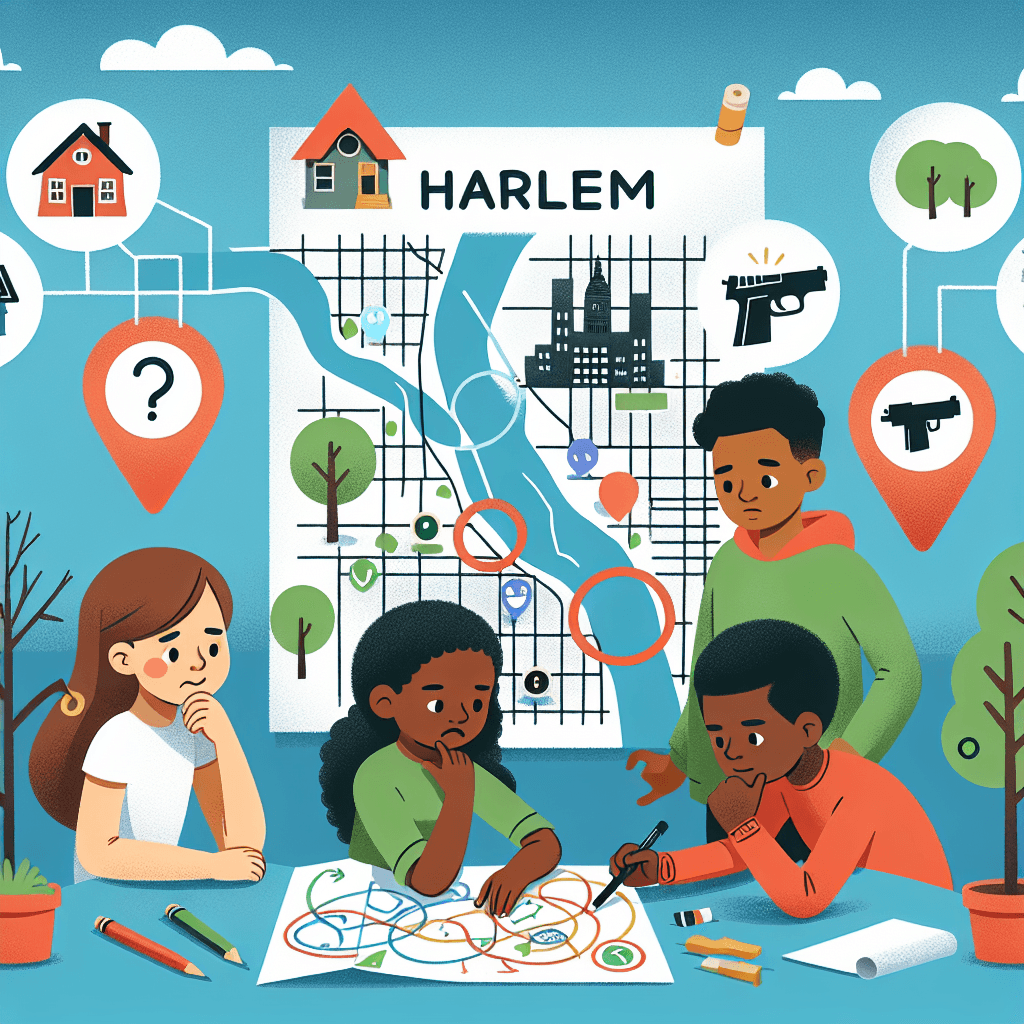
Tackling Harlem's Community Challenges: Gun Violence, Housing, Green Space
Inquiry Framework
Question Framework
Driving Question
The overarching question that guides the entire project.How can we, as young advocates and community members, propose and implement effective, sustainable, and culturally-sensitive solutions to address gun violence, housing insecurity, and limited green space in Harlem?Essential Questions
Supporting questions that break down major concepts.- How do social, economic, and environmental factors contribute to community issues such as gun violence, housing insecurity, and limited green space in Harlem?
- What historical and contemporary solutions have been proposed to address these issues, and how have they impacted the community?
- How can we evaluate the effectiveness of existing policies and initiatives aimed at reducing gun violence, improving housing security, and expanding green spaces in urban areas like Harlem?
- What role do community organizations, government agencies, and individuals play in developing and implementing solutions to these issues?
- How can we propose actionable, sustainable, and culturally-sensitive solutions to address these community challenges?
Standards & Learning Goals
Learning Goals
By the end of this project, students will be able to:- Students will understand the impact of social, economic, and environmental factors on community issues in Harlem.
- Students will analyze historical and contemporary solutions to community challenges and their effectiveness.
- Students will evaluate existing policies and initiatives on gun violence, housing insecurity, and urban green spaces.
- Students will develop skills to propose and communicate effective, sustainable, and culturally-sensitive solutions to community issues.
- Students will engage in research and presentation, honing their ability to articulate findings and arguments effectively.
Common Core Standards
Entry Events
Events that will be used to introduce the project to studentsCommunity Walking Tour
Kick off the project with a guided walking tour of Harlem, highlighting areas impacted by gun violence, housing insecurity, and lack of green spaces. Invite local community leaders to share their insights and challenge students to identify real-world issues as they consider solutions.Guest Speaker Panel
Host a panel of diverse guest speakers, including activists, city planners, and residents who have firsthand experience with these issues. Encourage students to develop and ask questions, sparking an authentic inquiry into potential solutions for their community.Project Pitch Day
Organize a 'Shark Tank' style event where community members present current challenges and ask students to pitch improvement solutions. This will inspire students to connect directly with community needs, prompting innovative thinking and creative problem-solving.Community Challenge Scavenger Hunt
Design a scavenger hunt that leads students to various spots around Harlem, each representing a challenge related to gun violence, housing insecurity, or green space scarcity. At each location, students receive clues and information prompting them to brainstorm potential solutions.Portfolio Activities
Portfolio Activities
These activities progressively build towards your learning goals, with each submission contributing to the student's final portfolio.Neighborhood Exploration Notebooks
Students begin their project by creating 'Neighborhood Exploration Notebooks' documenting their observations from the Community Walking Tour. They will note down areas impacted by community issues and record insights shared by local leaders.Steps
Here is some basic scaffolding to help students complete the activity.Final Product
What students will submit as the final product of the activityA compiled set of notes and observations about community issues in Harlem.Alignment
How this activity aligns with the learning objectives & standardsThis activity helps develop research skills and introduces students to issues, aligning with CCSS.ELA-LITERACY.RI.7.3.Community Issue Research Folders
Students dive deeper into one specific community issue – gun violence, housing insecurity, or limited green space. They will collect and organize information using various sources to enhance their understanding of their chosen topic.Steps
Here is some basic scaffolding to help students complete the activity.Final Product
What students will submit as the final product of the activityAn organized research folder with summaries and potential questions for further inquiry.Alignment
How this activity aligns with the learning objectives & standardsAligns with CCSS.ELA-LITERACY.W.7.7 by teaching students to conduct research and delve into issues deeply.Solution Proposal Drafting
Utilizing their research, students begin drafting proposals that outline their suggested solutions to the chosen community issue, ensuring to include clear arguments supported with evidence.Steps
Here is some basic scaffolding to help students complete the activity.Final Product
What students will submit as the final product of the activityA drafted proposal that presents solutions to the community issue with supporting evidence.Alignment
How this activity aligns with the learning objectives & standardsThis activity supports CCSS.ELA-LITERACY.W.7.1 by focusing on writing arguments with clear reasons and evidence.Peer Review Workshop
Students exchange solution proposals for peer review. They will provide constructive feedback based on clarity, evidence, and feasibility.Steps
Here is some basic scaffolding to help students complete the activity.Final Product
What students will submit as the final product of the activityRevised solution proposals based on peer feedback.Alignment
How this activity aligns with the learning objectives & standardsThis aligns with CCSS.ELA-LITERACY.W.7.1 by refining writing through peer evaluation and revision.Community Solutions Presentation
Students present their final proposals in a community forum, incorporating multimedia elements to engage the audience and emphasize key points.Steps
Here is some basic scaffolding to help students complete the activity.Final Product
What students will submit as the final product of the activityA multimedia presentation of the students' proposed community solutions.Alignment
How this activity aligns with the learning objectives & standardsSupports CCSS.ELA-LITERACY.SL.7.4 by emphasizing strong presentation skills and coherent communication of ideas.Rubric & Reflection
Portfolio Rubric
Grading criteria for assessing the overall project portfolioCommunity Solutions Proposal Rubric
Research and Analysis
Evaluates the students' ability to research, organize, and analyze information related to community issues, as well as their reflection on social, economic, and environmental factors.Research Depth
The extent to which students conduct comprehensive research and gather information from diverse sources related to their chosen community issue.
Exemplary
4 PointsDemonstrates extensive research using a wide variety of sources; all necessary data is meticulously collected and clearly related to community issues.
Proficient
3 PointsConducts thorough research using a variety of sources; most information is relevant and adequately supports the understanding of the community issue.
Developing
2 PointsConducts limited research from a few sources; some information supports the understanding of the community issue, but lacks depth.
Beginning
1 PointsMinimal research conducted; lacks sufficient and relevant information to understand the community issue.
Analysis of Factors
Assessment of the students' ability to analyze and understand the interactions and impacts of social, economic, and environmental factors on the community issue.
Exemplary
4 PointsProvides insightful analysis of how various factors interact and impact the community issue, demonstrating sophisticated understanding.
Proficient
3 PointsAnalyzes the interactions of multiple factors related to the community issue, showing a clear understanding.
Developing
2 PointsIdentifies some interactions between factors, but analysis may be superficial or lack depth.
Beginning
1 PointsLimited or no analysis of factors; lacks understanding of how they impact the community issue.
Proposal Development
Assesses the students' ability to develop well-structured proposals with clear, supported arguments and actionable, innovative solutions.Argumentation and Support
Measure of students’ capability to develop structured arguments supporting their proposal with clear reasons and evidence.
Exemplary
4 PointsCrafts highly convincing arguments with robust evidence supporting the proposed solutions; all points are logically and clearly presented.
Proficient
3 PointsForms clear arguments with relevant evidence supporting the solutions proposed; the overall structure is coherent.
Developing
2 PointsPresents arguments with some supporting evidence; however, inconsistencies or gaps may be present in the reasoning.
Beginning
1 PointsLimited arguments presented with insufficient evidence; reasoning is unclear or unstructured.
Innovation and Actionability
Evaluates the creativity and feasibility of the proposed solutions in addressing community challenges.
Exemplary
4 PointsProposes innovative, creative solutions that are highly actionable and consider cultural sensitivities and sustainability.
Proficient
3 PointsOffers solutions that are actionable with some level of innovation; considers cultural sensitivity and sustainability.
Developing
2 PointsSuggestions show some creativity but may lack feasibility or depth; limited consideration for cultural or sustainable aspects.
Beginning
1 PointsProposed solutions lack creativity or feasibility; little to no consideration for cultural or sustainability aspects.
Communication and Presentation
Examines students’ ability to effectively communicate their proposals using clear language, appropriate presentation techniques, and engaging multimedia elements.Presentation Skills
Assessment of the students' presentation clarity, engagement, and use of multimedia to convey their proposal effectively.
Exemplary
4 PointsDelivers an engaging, well-organized presentation with effective use of multimedia; communicates ideas with clarity and confidence.
Proficient
3 PointsPresents organized with clarity; appropriate use of multimedia enhances understanding.
Developing
2 PointsConveys basic ideas; presentation lacks clarity or coherence, with limited multimedia use.
Beginning
1 PointsPresentation is unclear, poorly organized with minimal or ineffective use of multimedia.