
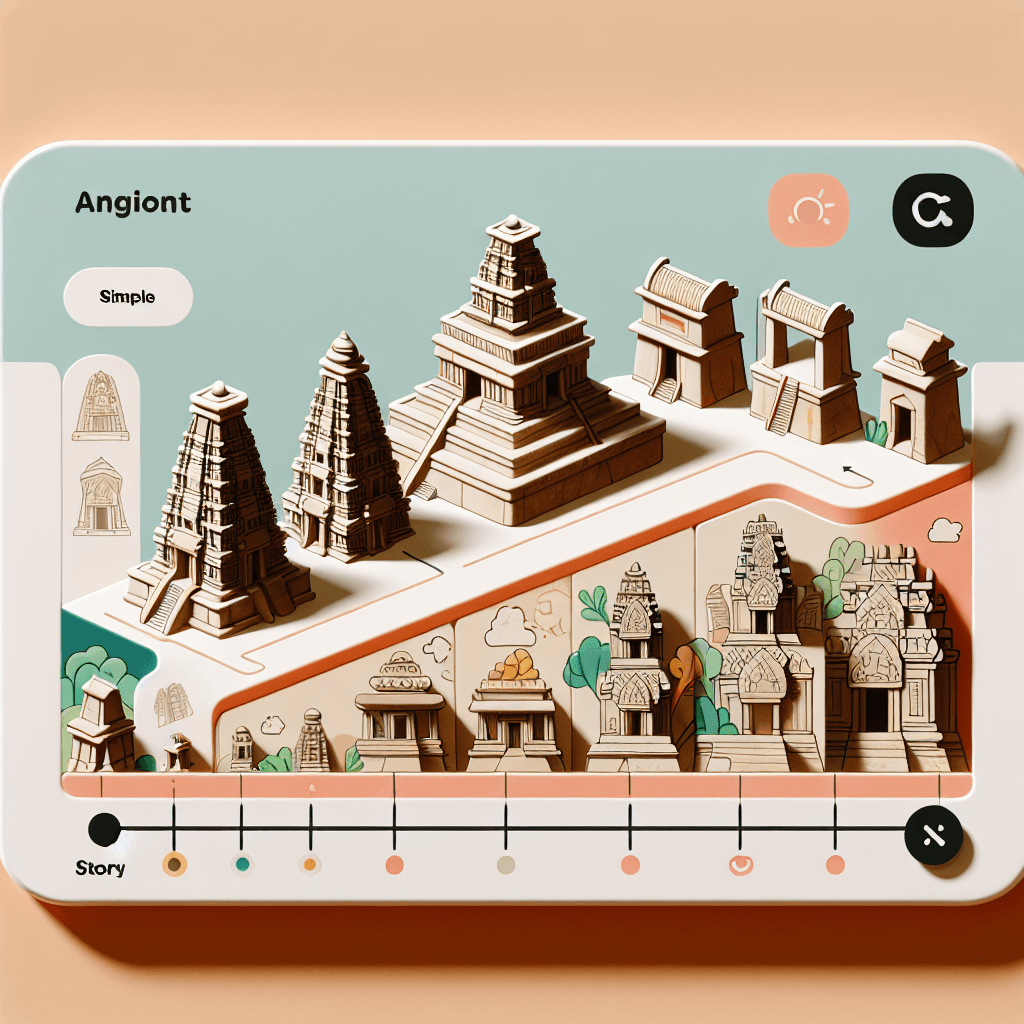
Temples Through Time: An AR Exhibition
Inquiry Framework
Question Framework
Driving Question
The overarching question that guides the entire project.How can we, as historians and technologists, create an augmented reality exhibition that showcases the evolution, significance, and sustainable preservation of South Indian temples?Essential Questions
Supporting questions that break down major concepts.- How did the architecture of South Indian temples evolve over time, and what factors influenced these changes?
- In what ways did South Indian temples serve as centers of social, economic, and cultural life?
- How can augmented reality (AR) technology enhance our understanding and appreciation of South Indian temples?
- What are the key architectural elements and symbolism found in South Indian temples?
- How did different dynasties and rulers contribute to the construction and development of South Indian temples?
- What are the environmental impacts of temple tourism, and how can we promote sustainable tourism practices?
- How can we use AR to create engaging and educational experiences that promote cultural heritage preservation?
Standards & Learning Goals
Learning Goals
By the end of this project, students will be able to:- Understand the historical evolution of South Indian temple architecture.
- Analyze the social, economic, and cultural roles of South Indian temples.
- Utilize augmented reality (AR) technology to create an engaging educational exhibition.
- Evaluate the environmental impacts of temple tourism and promote sustainable practices.
- Develop research, collaboration, and presentation skills.
Florida Standards
Common Core Standards
Entry Events
Events that will be used to introduce the project to studentsSacred Soundscape Immersion
The class experiences a curated soundscape featuring traditional music, chants, and ambient sounds recorded in and around South Indian temples. Students analyze the soundscape's elements, research their historical and cultural significance, and discuss how sound enhances the temple experience.Deconstructing a Temple Blueprint
Students receive a fragmented, incomplete blueprint of a famous South Indian temple. Working in teams, they must research and collaborate to reconstruct the blueprint, learning about architectural elements, spatial relationships, and the temple's overall design.Mystery Artefact Unveiling
A mysterious, unlabelled artefact (replica of a temple carving or architectural element) is delivered to the class. Students must use observation, research, and questioning to determine its origin, purpose, and significance, sparking interest in South Indian temple architecture.Portfolio Activities
Portfolio Activities
These activities progressively build towards your learning goals, with each submission contributing to the student's final portfolio.Socio-Economic Temple Web
Students investigate the social and economic roles temples played in South Indian society. They will map out the relationships between the temple and various aspects of community life.Steps
Here is some basic scaffolding to help students complete the activity.Final Product
What students will submit as the final product of the activityA web diagram illustrating the socio-economic role of South Indian temples with accompanying explanations.Alignment
How this activity aligns with the learning objectives & standardsSS.7.G.2.2 (Describe the cultural characteristics of various regions) Addresses the learning goal: Analyze the social, economic, and cultural roles of South Indian temples.AR Feature Focus Group
Students brainstorm and propose specific augmented reality features to enhance the AR exhibition, focusing on educational and engaging elements. This activity encourages creative thinking and technological application.Steps
Here is some basic scaffolding to help students complete the activity.Final Product
What students will submit as the final product of the activityA collection of well-defined AR feature proposals with mockups and justifications.Alignment
How this activity aligns with the learning objectives & standardsLAFS.7.SL.1.1 (Engage effectively in a range of collaborative discussions) Addresses the learning goal: Utilize augmented reality (AR) technology to create an engaging educational exhibition.Sustainable Temple Tourism Campaign
Students develop a campaign to promote sustainable tourism practices at South Indian temples, addressing environmental impacts and cultural preservation. This activity fosters critical thinking and responsible citizenship.Steps
Here is some basic scaffolding to help students complete the activity.Final Product
What students will submit as the final product of the activityA comprehensive campaign promoting sustainable tourism at South Indian temples.Alignment
How this activity aligns with the learning objectives & standardsLAFS.7.W.2.4 (Produce clear and coherent writing in which the development, organization, and style are appropriate to task, purpose, and audience.) Addresses the learning goal: Evaluate the environmental impacts of temple tourism and promote sustainable practices.Architectural Analysis Sketchbook
Students create a sketchbook documenting the structural and aesthetic elements of South Indian temple architecture through sketches, diagrams, and written analysis. This activity enhances visual literacy and analytical skills.Steps
Here is some basic scaffolding to help students complete the activity.Final Product
What students will submit as the final product of the activityA sketchbook documenting the structural and aesthetic elements of South Indian temple architecture.Alignment
How this activity aligns with the learning objectives & standardsVA.7.C.1.2 (Analyze the structural and aesthetic characteristics of a variety of art forms.) Addresses the learning goal: Understand the historical evolution of South Indian temple architecture. and Analyze the social, economic, and cultural roles of South Indian temples. and Develop research, collaboration, and presentation skills.Temple Timeline Builders
Students research and create a timeline showcasing the evolution of South Indian temple architecture across different dynasties. This activity helps students understand the historical context and architectural changes over time.Steps
Here is some basic scaffolding to help students complete the activity.Final Product
What students will submit as the final product of the activityA detailed timeline illustrating the evolution of South Indian temple architecture.Alignment
How this activity aligns with the learning objectives & standardsSS.7.H.1.1 (Analyze historical sources to develop a claim, support the claim with evidence, and draw conclusions.) Addresses the learning goal: Understand the historical evolution of South Indian temple architecture.Rubric & Reflection
Portfolio Rubric
Grading criteria for assessing the overall project portfolioSouth Indian Temples AR Exhibition Evaluation
Research and Historical Understanding
Evaluates the depth and accuracy of research conducted on South Indian temples and their historical context.Accuracy of Historical Research
Assesses the extent to which students accurately research and understand the historical context of South Indian temples.
Exemplary
4 PointsProvides detailed, accurate research with exceptional insight into the historical context of South Indian temples, supported by comprehensive sources.
Proficient
3 PointsProvides accurate historical research with clear understanding and appropriate use of sources related to South Indian temples.
Developing
2 PointsProvides basic historical research with some inaccuracies or incomplete understanding regarding South Indian temples.
Beginning
1 PointsProvides minimal historical research with significant inaccuracies or misunderstandings about South Indian temples.
Understanding Cultural Significance
Assesses students' understanding of the socio-economic and cultural roles South Indian temples played.
Exemplary
4 PointsDemonstrates profound understanding of the cultural and socio-economic roles of South Indian temples, with insightful connections made to current practices.
Proficient
3 PointsShows comprehensive understanding of cultural and socio-economic roles of South Indian temples, drawing relevant connections.
Developing
2 PointsShows partial understanding of cultural and socio-economic roles of South Indian temples with limited connections.
Beginning
1 PointsShows little to no understanding of cultural and socio-economic roles of South Indian temples.
Creativity and AR Technology Integration
Evaluates the creativity and effectiveness of integrating augmented reality technology in the exhibition.Innovation in AR Features
Assesses the originality and educational value of the AR features designed for the exhibition.
Exemplary
4 PointsDesigns highly innovative, engaging AR features that provide profound educational experiences and exceptional creativity.
Proficient
3 PointsDesigns creative and engaging AR features that clearly contribute to the educational goals of the exhibition.
Developing
2 PointsDesigns AR features with some creative elements; however, educational impact is limited.
Beginning
1 PointsDesigns AR features with little creativity or educational value.
Integration and Functionality of AR
Assesses how well AR technology is integrated into the exhibition to enhance learning.
Exemplary
4 PointsIntegrates AR technology seamlessly into the exhibition with outstanding functionality and enhances the learning experience.
Proficient
3 PointsIntegrates AR technology effectively into the exhibition, enhancing learning outcomes.
Developing
2 PointsIntegrates AR technology with some effectiveness; functionality may be limited.
Beginning
1 PointsStruggles to integrate AR technology effectively; functionality is poor or missing.
Presentation and Collaboration
Evaluates the students' ability to present information clearly and effectively collaborate with peers.Clarity of Presentation
Assesses the clarity, organization, and delivery of the final presentation or product.
Exemplary
4 PointsPresents work with exceptional clarity, organization, and engagement, facilitating deep understanding among the audience.
Proficient
3 PointsPresents work clearly and effectively, with good organization and audience engagement.
Developing
2 PointsPresents work with some organization issues; clarity and engagement are inconsistent.
Beginning
1 PointsStruggles to present work clearly; lacks organization and engagement.
Effectiveness in Collaboration
Assesses students' ability to work collaboratively with peers to achieve project goals.
Exemplary
4 PointsDemonstrates outstanding collaboration, leadership, and active participation with peers to achieve project goals.
Proficient
3 PointsWorks well with peers, contributing effectively to the collaborative process and project goals.
Developing
2 PointsParticipates in collaboration with peers but contribution and effectiveness are inconsistent.
Beginning
1 PointsStruggles with effective collaboration; minimal contribution to group efforts.