
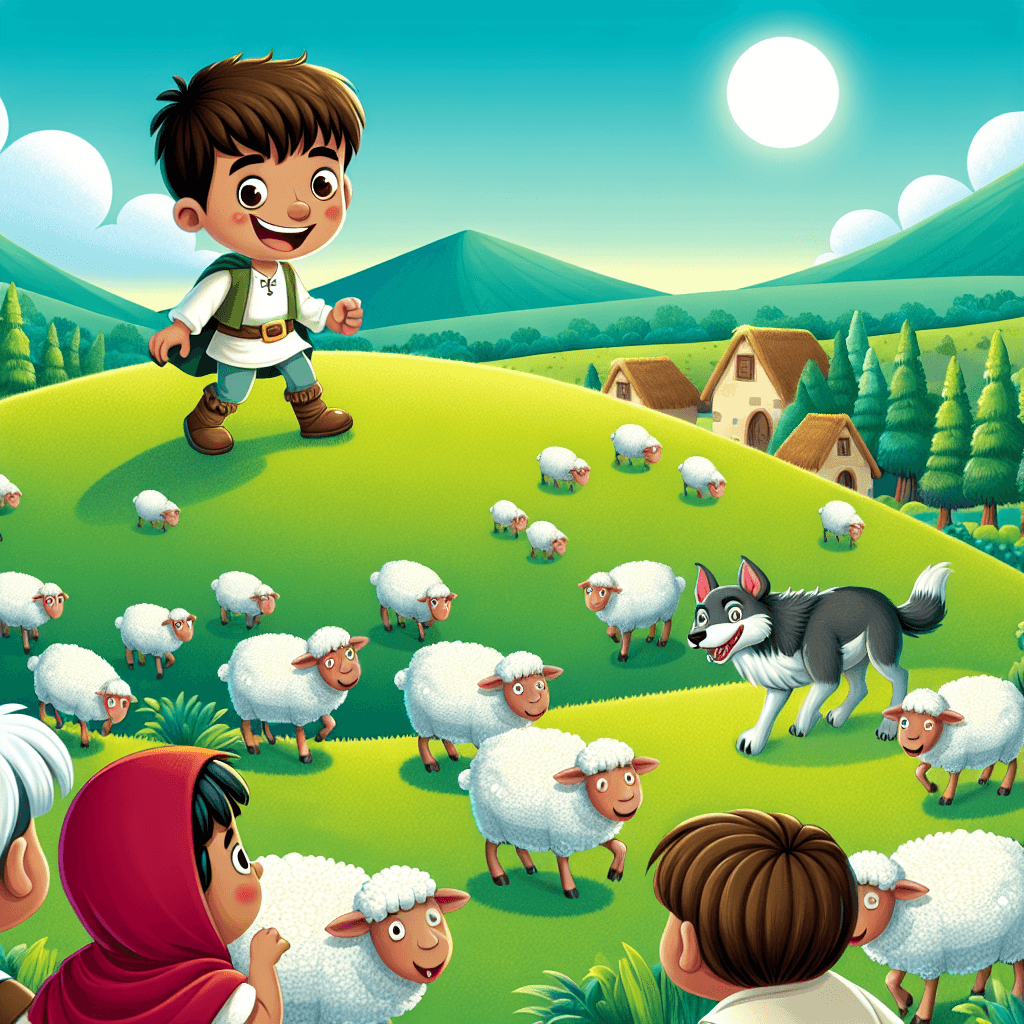
The Boy Who Cried Wolf: Exploring Truth and Consequences
Inquiry Framework
Question Framework
Driving Question
The overarching question that guides the entire project.How can understanding the consequences of dishonesty, as seen in "The Boy Who Cried Wolf", help us build more honest and trustworthy relationships in our community?Essential Questions
Supporting questions that break down major concepts.- What is the moral of the story "The Boy Who Cried Wolf"?
- How does lying affect relationships and trust?
- What are the consequences of seeking attention through dishonesty?
- How can we distinguish between truth and lies?
- In what ways can we communicate honestly and responsibly?
Standards & Learning Goals
Learning Goals
By the end of this project, students will be able to:- Understand the moral of "The Boy Who Cried Wolf."
- Analyze the effects of lying on relationships.
- Identify consequences of attention-seeking through dishonesty.
- Distinguish between truth and lies.
- Communicate honestly and responsibly.
Entry Events
Events that will be used to introduce the project to students"Fake News" Analysis
A local news station reports a series of bizarre, unbelievable events (constructed by the teacher). Students must analyze the reports, separating fact from fiction, mirroring the challenge of discerning truth in "The Boy Who Cried Wolf."The Trust Walk
Students participate in a "trust walk" where they are blindfolded and guided by a partner. Afterward, they discuss the experience and the importance of trust, relating it to the story's breakdown of trust.Tall Tales Challenge
The teacher presents a series of increasingly outrageous claims, some true, some false, and some ambiguous. Students debate the validity of each claim, exploring the slippery slope of exaggeration and falsehood.Portfolio Activities
Portfolio Activities
These activities progressively build towards your learning goals, with each submission contributing to the student's final portfolio.The Illustrated Wolf
Students will create an illustrated summary of "The Boy Who Cried Wolf," focusing on key events and characters.Steps
Here is some basic scaffolding to help students complete the activity.Final Product
What students will submit as the final product of the activityA story map with illustrations depicting the beginning, middle, and end of the story, highlighting the wolf's appearances and the boy's cries.Alignment
How this activity aligns with the learning objectives & standardsAligns with Learning Goal: Understand the moral of "The Boy Who Cried Wolf."A Villager's Diary
Students write a diary entry from the perspective of a character affected by the boy's lies (e.g., a villager, the boy's family).Steps
Here is some basic scaffolding to help students complete the activity.Final Product
What students will submit as the final product of the activityA first-person diary entry detailing the character's feelings of betrayal and the impact on their trust in the boy.Alignment
How this activity aligns with the learning objectives & standardsAligns with Learning Goal: Analyze the effects of lying on relationships.Consequences Chart
Students will create a "Consequences Chart" that maps out the boy's actions, his motivations, and the consequences of his lies.Steps
Here is some basic scaffolding to help students complete the activity.Final Product
What students will submit as the final product of the activityA chart with three columns: "Actions," "Motivations," and "Consequences," filled with specific examples from the story.Alignment
How this activity aligns with the learning objectives & standardsAligns with Learning Goal: Identify consequences of attention-seeking through dishonesty.Truth vs. Lies Debate
Students participate in a debate about whether the boy's actions were justified at any point, requiring them to differentiate between justifiable exaggeration and harmful lies.Steps
Here is some basic scaffolding to help students complete the activity.Final Product
What students will submit as the final product of the activityA structured debate with arguments for and against the boy's actions, supported by evidence from the story and real-life examples.Alignment
How this activity aligns with the learning objectives & standardsAligns with Learning Goal: Distinguish between truth and lies.Honesty Campaign
Students create a public service announcement (PSA) campaign to promote honesty and responsible communication, inspired by the lessons of "The Boy Who Cried Wolf."Steps
Here is some basic scaffolding to help students complete the activity.Final Product
What students will submit as the final product of the activityA PSA campaign including a poster, a short video script, and a social media post, all promoting honest communication and the importance of trust.Alignment
How this activity aligns with the learning objectives & standardsAligns with Learning Goal: Communicate honestly and responsibly.Rubric & Reflection
Portfolio Rubric
Grading criteria for assessing the overall project portfolioThe Illustrated Wolf Rubric
Story Map Creation
Focuses on the accuracy, clarity, and creativity of the illustrated story map.Story Map Accuracy
Accuracy of the story map, including the correct sequencing of events and depiction of key moments.
Exemplary
4 PointsThe story map accurately depicts all key events in the correct sequence with detailed illustrations. Demonstrates a sophisticated understanding of the narrative.
Proficient
3 PointsThe story map accurately depicts most key events in the correct sequence with clear illustrations. Demonstrates a thorough understanding of the narrative.
Developing
2 PointsThe story map depicts some key events, but the sequence may be unclear or inaccurate. Illustrations are basic and may lack detail. Demonstrates an emerging understanding of the narrative.
Beginning
1 PointsThe story map is incomplete and lacks key events or accurate sequencing. Illustrations are minimal and do not support understanding. Demonstrates initial understanding of the narrative.
Summary Clarity
Clarity and coherence of the written summaries under each illustration.
Exemplary
4 PointsSummaries are exceptionally clear, concise, and insightful, providing a deep understanding of each event's significance.
Proficient
3 PointsSummaries are clear, concise, and accurately describe each event's significance.
Developing
2 PointsSummaries are understandable but may lack detail or clarity in explaining each event's significance.
Beginning
1 PointsSummaries are unclear, incomplete, or do not accurately describe each event's significance.
Illustration Quality
Creativity and effort demonstrated in the illustrations.
Exemplary
4 PointsIllustrations are highly creative, detailed, and enhance the overall presentation, showing exceptional effort and engagement.
Proficient
3 PointsIllustrations are creative, detailed, and contribute to the overall presentation, showing good effort and engagement.
Developing
2 PointsIllustrations are basic but adequate, showing some effort and engagement.
Beginning
1 PointsIllustrations are minimal or lack detail, showing limited effort and engagement.