
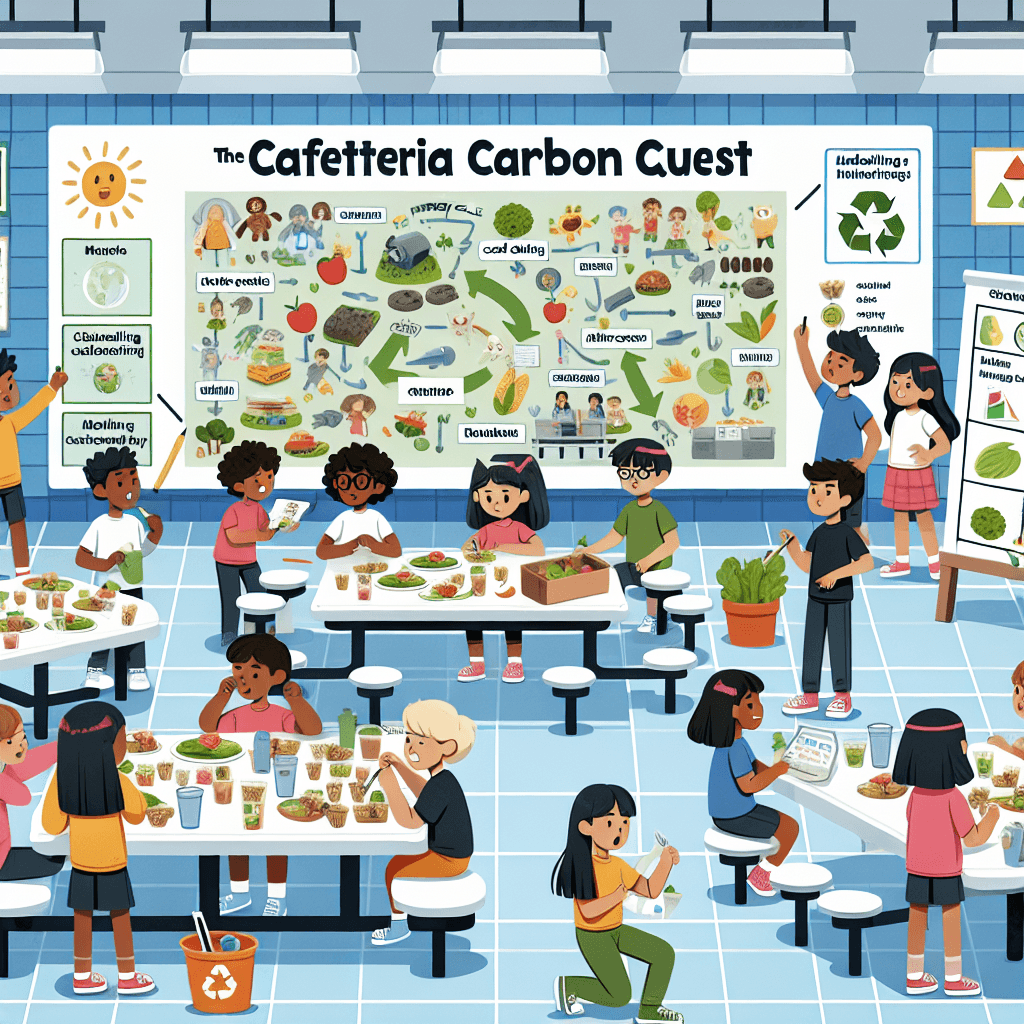
The Cafeteria Carbon Quest: Modeling Energy and Nutrient Flow
Inquiry Framework
Question Framework
Driving Question
The overarching question that guides the entire project.How can we redesign our school cafeteria into a closed-loop ecosystem that maximizes energy capture and restores the natural cycling of matter?Essential Questions
Supporting questions that break down major concepts.- How can we model the flow of energy and the cycling of matter within our school's cafeteria "ecosystem"?
- What are the biotic and abiotic components of our lunchroom, and how do they interact to move nutrients?
- In what ways do current cafeteria waste practices disrupt the natural carbon and nitrogen cycles?
- How does the role of decomposers change when we move from a "trash" system to a "reuse" system?
- How can we quantify the amount of energy lost versus energy captured in our current school lunch model?
- Which design interventions (like composting, vermiculture, or hydroponics) would most effectively turn school waste back into a nutrient resource?
Standards & Learning Goals
Learning Goals
By the end of this project, students will be able to:- Develop a comprehensive model that illustrates the transfer of energy and cycling of matter among biotic and abiotic components of the school cafeteria ecosystem.
- Analyze and quantify current cafeteria waste to determine how human practices disrupt natural carbon and nitrogen cycles.
- Design and evaluate a scientific solution (such as composting, vermiculture, or hydroponics) to transform cafeteria waste into a nutrient resource.
- Explain the vital role of decomposers in transitioning from a linear "trash" system to a circular "reuse" system.
- Apply mathematical reasoning to quantify the ratio of energy captured versus energy lost in current school lunch models.
Next Generation Science Standards (NGSS)
Next Generation Science Standards (NGSS) (Engineering Design)
Common Core State Standards (ELA/Literacy)
Entry Events
Events that will be used to introduce the project to studentsTransmission from the Nutrient Famine
Students view a 'glitched' video transmission from a student in the year 2074 who describes a world where soil nutrients have been depleted because they were all 'buried in 21st-century landfills.' The 'future' student begs the class to become 'Carbon Cartographers' to fix the school’s broken nutrient loops before it’s too late.The 'Energy Invoice' Shock
Students arrive to find a formal 'Energy Debt' notice on their desks, charging the class for the thousands of kilojoules of lost potential energy from yesterday's discarded cafeteria rolls. This shift from monetary cost to 'planetary debt' forces students to rethink food waste as a literal loss of fuel, sparking an investigation into how that energy could have been recaptured.The Great Lunchroom Autopsy
The classroom is transformed into a 'Forensic Lab' where a single, half-eaten lunch tray is cordoned off with yellow tape and 'Evidence' markers. Students must act as 'Nutrient Detectives' to map the stalled journey of carbon and nitrogen atoms that are now 'trapped' on the tray instead of returning to the ecosystem.Portfolio Activities
Portfolio Activities
These activities progressively build towards your learning goals, with each submission contributing to the student's final portfolio.Mapping the Cafeteria 'Micro-Biome'
In this introductory activity, students act as 'Ecosystem Cartographers.' They will explore the cafeteria to identify every element involved in the lunch process, categorizing them into biotic (living or once-living) and abiotic (non-living) factors. The goal is to move beyond seeing lunch as just 'eating' and instead see it as a complex exchange of matter and energy.Steps
Here is some basic scaffolding to help students complete the activity.Final Product
What students will submit as the final product of the activityAn annotated 'Cafeteria Ecosystem Map' that uses symbols and color-coding to distinguish between biotic and abiotic components and labels their initial roles in matter/energy flow.Alignment
How this activity aligns with the learning objectives & standardsThis activity directly addresses the 'living and non-living parts' component of MS-LS2-3. Students must identify biotic (food, students, bacteria) and abiotic (trays, plastic, water, heat) components and explain their roles in the system.The Great Carbon Leak Audit
Building on their maps, students now act as 'Nutrient Detectives.' They will conduct a waste audit to measure exactly how much matter is 'leaking' out of their cafeteria ecosystem. They will calculate the potential energy lost in the form of discarded calories and the carbon mass that is being diverted to landfills instead of being cycled back into the soil.Steps
Here is some basic scaffolding to help students complete the activity.Final Product
What students will submit as the final product of the activityA 'Nutrient Leakage Report Card' featuring data visualizations (bar graphs or pie charts) that show the ratio of consumed vs. wasted matter and the estimated 'lost energy' in kilojoules.Alignment
How this activity aligns with the learning objectives & standardsThis activity aligns with MS-ESS3-3 (monitoring human impact) and the 'cycling of matter' part of MS-LS2-3. By weighing waste, students quantify how much matter is being removed from the natural cycle and sent to a landfill 'dead end.'Recruiting the Micro-Engineers
Students will now investigate the 'Micro-Engineers'—decomposers like fungi, bacteria, and worms—that are missing from the current cafeteria system. They will research how these organisms break down complex matter back into simple nutrients. This activity prepares them to design a solution by understanding the biological mechanism required to close the loop.Steps
Here is some basic scaffolding to help students complete the activity.Final Product
What students will submit as the final product of the activityA 'Decomposer Job Application' or Infographic where students pitch a specific organism (e.g., Red Wiggler worms, Mycelium, or Aerobic Bacteria) as the best candidate to fix the school's broken nutrient cycle.Alignment
How this activity aligns with the learning objectives & standardsThis activity focuses on the 'cycling of matter among living parts' of MS-LS2-3, specifically highlighting the role of decomposers which are often the 'missing link' in human-made systems.The Zero-Waste Ecosystem Master Plan
In this final activity, students synthesize everything they have learned to create a 'Closed-Loop Master Plan.' They will redesign the cafeteria system to include a recovery method (like a worm bin, a garden-linked compost system, or a hydroponic setup) that ensures matter cycles back to the start and energy is maximized.Steps
Here is some basic scaffolding to help students complete the activity.Final Product
What students will submit as the final product of the activityA 'Closed-Loop Ecosystem Model' (digital or physical) showing the redesigned cafeteria, accompanied by a technical explanation of how matter and energy flow through the new, sustainable system.Alignment
How this activity aligns with the learning objectives & standardsThis is the cumulative assessment for MS-LS2-3. Students must create a complete model that shows the flow of energy and the cycling of matter. It also incorporates MS-ETS1-1 by requiring students to work within the constraints of the school environment.Rubric & Reflection
Portfolio Rubric
Grading criteria for assessing the overall project portfolioThe Cafeteria Carbon Quest Rubric
Ecosystem Systems Thinking
Assessment of the student's ability to map the cafeteria as a complex system and model the scientific principles of matter cycling and energy flow as per MS-LS2-3.Component Identification and Interaction
Ability to identify, categorize, and describe the relationship between biotic (living/once-living) and abiotic (non-living) components within the cafeteria ecosystem.
Exemplary
4 PointsAccurately identifies all biotic and abiotic components with sophisticated detail. Traces food sources to their origins with high precision and provides insightful role descriptions that explain the complex interdependence between factors (e.g., how abiotic plastic trays facilitate or hinder nutrient flow).
Proficient
3 PointsCorrectly identifies and categorizes biotic and abiotic components. Traces food sources to their origins and provides clear role descriptions explaining how abiotic factors influence the movement of matter.
Developing
2 PointsIdentifies most biotic and abiotic components but may have minor categorization errors. Tracing of food sources is basic, and role descriptions provide limited explanation of the interactions between components.
Beginning
1 PointsIdentifies few components or struggles to distinguish between biotic and abiotic factors. Role descriptions are missing or do not explain the relationship between components.
Modeling Matter and Energy Flow
Effectiveness in creating a visual and conceptual model that illustrates how matter cycles and energy flows (input, output, and transfer) through the redesigned cafeteria system.
Exemplary
4 PointsDevelops a highly sophisticated model that comprehensively illustrates the continuous cycling of matter and the multi-directional flow of energy. Includes clear labeling of energy transformations (e.g., chemical to heat) and demonstrates a deep understanding of ecosystem dynamics.
Proficient
3 PointsDevelops a clear model describing the cycling of matter and the flow of energy among living and non-living parts. Correctly identifies energy inputs and outputs and shows a functional closed-loop system.
Developing
2 PointsDevelops a basic model that shows some cycling of matter or energy flow, but the connections may be incomplete or contain minor scientific inaccuracies regarding how matter returns to the system.
Beginning
1 PointsProduces an incomplete or inaccurate model that fails to demonstrate the cycling of matter or the flow of energy between components. Links are missing or illogical.
Scientific Inquiry and Data Literacy
Evaluation of the student's ability to monitor human impact, use mathematical reasoning, and integrate technical information visually (MS-ESS3-3 & RST.6-8.7).Waste Quantification and Impact Analysis
Ability to collect, categorize, and transform waste data into scientific measurements (mass and energy) to evaluate human impact on nutrient cycles.
Exemplary
4 PointsConducts a precise waste audit with meticulous categorization. Calculations for energy loss (kJ) and carbon mass are flawlessly executed and interpreted to show a profound understanding of the 'broken loop' impact on global cycles.
Proficient
3 PointsConducts a thorough waste audit and correctly categorizes materials. Accurately uses conversion charts to estimate lost energy and carbon mass, drawing clear conclusions about human impact on the environment.
Developing
2 PointsConducts a basic waste audit but may have inconsistencies in categorization or minor mathematical errors in energy/carbon conversions. Conclusion on environmental impact is surface-level.
Beginning
1 PointsWaste audit is incomplete or inaccurately recorded. Fails to convert waste data into energy or carbon metrics, showing a limited understanding of the 'leakage' concept.
Data Visualization and Integration
Skill in translating raw technical and quantitative data into clear, visual representations (graphs, charts, flowcharts) to communicate findings.
Exemplary
4 PointsCreates professional-grade data visualizations that masterfully integrate quantitative data with visual elements. The 'Nutrient Leakage Report Card' provides an immediate and compelling narrative of the data.
Proficient
3 PointsCreates clear and accurate bar graphs or pie charts that represent the ratio of consumed vs. wasted matter. Visuals are correctly labeled and directly support the data findings.
Developing
2 PointsCreates basic visual representations of data, but they may lack clear labels, proper scaling, or direct connection to the waste audit results.
Beginning
1 PointsVisualizations are missing, incorrect, or do not represent the collected data. The connection between the audit and the visual is unclear.
Engineering Design and Problem Solving
Assessment of the student's ability to apply engineering design principles to solve environmental problems within specific constraints (MS-ETS1-1).Circular System Design and Innovation
Ability to design a solution that incorporates decomposers and sustainable practices to transition the cafeteria from a linear to a circular system.
Exemplary
4 PointsProposes an innovative and highly feasible redesign that optimizes the role of decomposers. The plan demonstrates exceptional creative problem-solving and a comprehensive understanding of how to restore natural cycles in a built environment.
Proficient
3 PointsProposes a functional redesign that incorporates a specific intervention (composting, vermiculture, etc.) to successfully cycle matter back into the system. Meets all project criteria and scientific goals.
Developing
2 PointsProposes a redesign that includes a solution, but the implementation may be unrealistic or only partially address the nutrient cycle 'leakage.' The role of the decomposer is mentioned but not fully integrated.
Beginning
1 PointsThe redesign lacks a clear intervention or fails to explain how the proposed solution would actually recycle matter. The 'closed-loop' concept is not demonstrated.
Constraint Analysis and Feasibility
Effectiveness in identifying and working within the real-world constraints (space, budget, health codes, etc.) of the school environment to ensure a successful design.
Exemplary
4 PointsThe design pitch meticulously addresses all potential constraints and provides evidence-based justifications for how the solution remains effective despite these limitations. Shows advanced engineering foresight.
Proficient
3 PointsThe design takes into account relevant scientific principles and school-specific constraints (like space or logistics). The solution is presented as a viable and practical plan for the school administration.
Developing
2 PointsThe design mentions some constraints but may overlook significant practical hurdles in the school environment. The solution feels somewhat disconnected from the reality of the cafeteria.
Beginning
1 PointsThe design ignores constraints and criteria, resulting in a plan that is impractical or scientifically unsound for the given environment.