
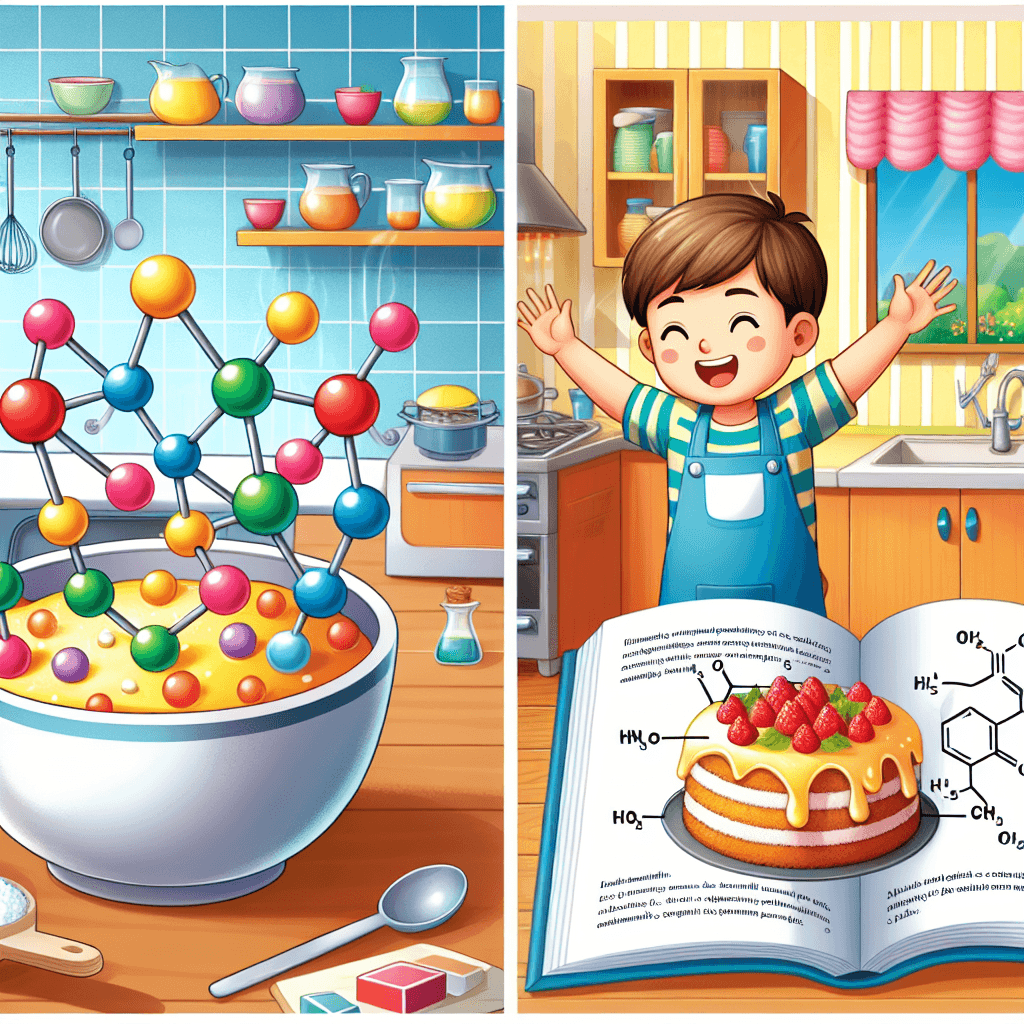
The Chemistry of Cooking: Atoms and Molecules in Food
Inquiry Framework
Question Framework
Driving Question
The overarching question that guides the entire project.How can we apply our understanding of atomic theory and the periodic table to explore the chemistry of food and its impact on taste, texture, and nutrition?Essential Questions
Supporting questions that break down major concepts.- What is the historical development of the atomic theory, and how has our understanding of atoms changed over time?
- How can the periodic table be used to predict the chemical and physical properties of food-related matter?
- In what ways does the kinetic molecular theory explain the interactions and chemical reactions of matter in the context of cooking and food preservation?
- How do the chemical properties of different food substances affect their taste, texture, and nutritional value?
- What role do atoms and molecules play in the states of matter that we observe in food processing and consumption?
Standards & Learning Goals
Learning Goals
By the end of this project, students will be able to:- Understand the historical development of atomic theory and how it applies to food chemistry.
- Apply the kinetic molecular theory to explain the interactions in cooking and food preservation.
- Analyze how the chemical properties of food affect taste, texture, and nutrition.
- Describe the role of atoms and molecules in the states of matter during food processing.
NGSS
Entry Events
Events that will be used to introduce the project to studentsChef's Molecular Mystery
Kick-off the project with a live cooking demonstration where a chef creates a dish using molecular gastronomy techniques, such as spherification or gelification. Students are then challenged to explore how understanding atomic structures and chemical properties enable these fascinating food transformations.Portfolio Activities
Portfolio Activities
These activities progressively build towards your learning goals, with each submission contributing to the student's final portfolio.Atomic Appetite: Building Models of Delicious Molecules
Students will create 3D models of simple and complex food molecules using everyday materials, exploring atomic composition and molecular structure.Steps
Here is some basic scaffolding to help students complete the activity.Final Product
What students will submit as the final product of the activity3D models of food molecules and presentations explaining their significance.Alignment
How this activity aligns with the learning objectives & standardsAligns with NGSS 7.PS1.1: Develop models to describe the atomic composition of simple molecules and extended structures.Chemistry Clash: Predicting Properties with the Periodic Table
Using the periodic table, students will predict and research the chemical and physical properties of food-related elements and compounds.Steps
Here is some basic scaffolding to help students complete the activity.Final Product
What students will submit as the final product of the activityA detailed report and seminar discussion on chemical properties of food elements and their kitchen applications.Alignment
How this activity aligns with the learning objectives & standardsAligns with NGSS 7.PS1.1 and 7.PS1.2: Develop models to describe atomic composition and analyze chemical interactions.Conservation Cuisine: Mass Matters in Recipes
By creating and following recipes, students will explore the concept of mass conservation during chemical reactions in cooking.Steps
Here is some basic scaffolding to help students complete the activity.Final Product
What students will submit as the final product of the activityA mass conservation analysis report and reflective writing piece.Alignment
How this activity aligns with the learning objectives & standardsAligns with NGSS 7.PS1.5: Use a model to describe conservation of mass in chemical reactions.From Nature to Nurture: The Journey of Food Additives
Students delve into the origin and impact of synthetic food additives, tracing their development from natural resources.Steps
Here is some basic scaffolding to help students complete the activity.Final Product
What students will submit as the final product of the activityA presentation on the development and societal impact of a synthetic food additive.Alignment
How this activity aligns with the learning objectives & standardsAligns with NGSS 7.PS1.3: Gather information on synthetic materials' natural origins and societal impact.Rubric & Reflection
Portfolio Rubric
Grading criteria for assessing the overall project portfolioMasteryMate Chemistry of Food Rubric
Knowledge and Understanding
Evaluates the student's grasp of atomic theory, periodic table utilization, and molecular interactions.Atomic Theory
Understanding of the historical development and modern implications of atomic theory in food chemistry.
Exemplary
4 PointsDemonstrates a comprehensive understanding of atomic theory and articulates its historical development and modern applications in food chemistry with clarity and depth.
Proficient
3 PointsShows a thorough understanding of atomic theory, outlining its historical development and modern applications in food chemistry with minor inaccuracies.
Developing
2 PointsPresents a basic understanding of atomic theory with some historical context but struggles to connect to modern food chemistry applications.
Beginning
1 PointsExhibits a limited understanding of atomic theory with minimal historical context and unclear connections to food chemistry.
Periodic Table Application
Ability to use the periodic table to predict chemical and physical properties of food-related matter.
Exemplary
4 PointsEffectively and accurately uses the periodic table to predict properties of food-related matter; demonstrates insightful reasoning and connections.
Proficient
3 PointsUses the periodic table accurately to predict properties of food-related matter with effective reasoning and connections.
Developing
2 PointsAttempts to use the periodic table to predict properties of food-related matter but lacks accuracy and clarity in reasoning.
Beginning
1 PointsStruggles to use the periodic table accurately and provide reasoning for property predictions of food-related matter.
Molecular Interactions
Understanding of molecular interactions and their implications for cooking and food preservation.
Exemplary
4 PointsDemonstrates sophisticated understanding of molecular interactions, providing clear and detailed explanations for their role in cooking and food preservation.
Proficient
3 PointsShows thorough understanding of molecular interactions, providing clear explanations for their role in cooking and food preservation.
Developing
2 PointsShows emerging understanding of molecular interactions but provides limited explanations for their role in cooking and food preservation.
Beginning
1 PointsShows minimal understanding of molecular interactions with unclear or incorrect explanations for their role in cooking and food preservation.
Application and Analysis
Assesses student's ability to apply knowledge to analyze chemical properties and processes.Chemical Property Prediction
Ability to predict and analyze chemical properties of food substances using scientific principles.
Exemplary
4 PointsAccurately predicts and analyzes chemical properties with depth, demonstrating insightful application of scientific principles.
Proficient
3 PointsAccurately predicts and analyzes chemical properties using scientific principles with minor inaccuracies.
Developing
2 PointsMakes attempts to predict and analyze chemical properties but shows inconsistencies in application of scientific principles.
Beginning
1 PointsStruggles to predict and analyze chemical properties and shows limited application of scientific principles.
Mass Conservation Analysis
Understanding and application of mass conservation principles in cooking and broader chemical reactions.
Exemplary
4 PointsDemonstrates thorough understanding of mass conservation, supported by accurate data analysis and clear connections to chemical processes.
Proficient
3 PointsShows understanding of mass conservation principles with mostly accurate data analysis and clear chemical process connections.
Developing
2 PointsDemonstrates basic understanding of mass conservation but provides limited data analysis and weak connections to chemical processes.
Beginning
1 PointsShows minimal understanding of mass conservation with inaccurate data analysis and unclear connections to chemical processes.
Research and Presentation
Evaluates the effectiveness of students' research, synthesis of information, and presentation skills.Research and Synthesis
Effectiveness in gathering, interpreting, and synthesizing information on food additives and molecular structures.
Exemplary
4 PointsGathers and synthesizes information with precision, presenting detailed and insightful analysis on food additives and molecular structures.
Proficient
3 PointsGathers and synthesizes information effectively, presenting a clear analysis on food additives and molecular structures.
Developing
2 PointsGathers information but provides limited synthesis and basic analysis on food additives and molecular structures.
Beginning
1 PointsStruggles to gather information and presents minimal analysis and synthesis on food additives and molecular structures.
Presentation Skills
Quality and clarity of presentations regarding food additives and molecular models.
Exemplary
4 PointsDelivers an engaging, well-organized presentation with clear communication and effective peer engagement.
Proficient
3 PointsDelivers a clear and organized presentation, effectively communicating key points with peers.
Developing
2 PointsDelivers a basic presentation with some organization, but lacks effective communication or engagement.
Beginning
1 PointsStruggles with delivering a clear and organized presentation, with limited communication and engagement.