
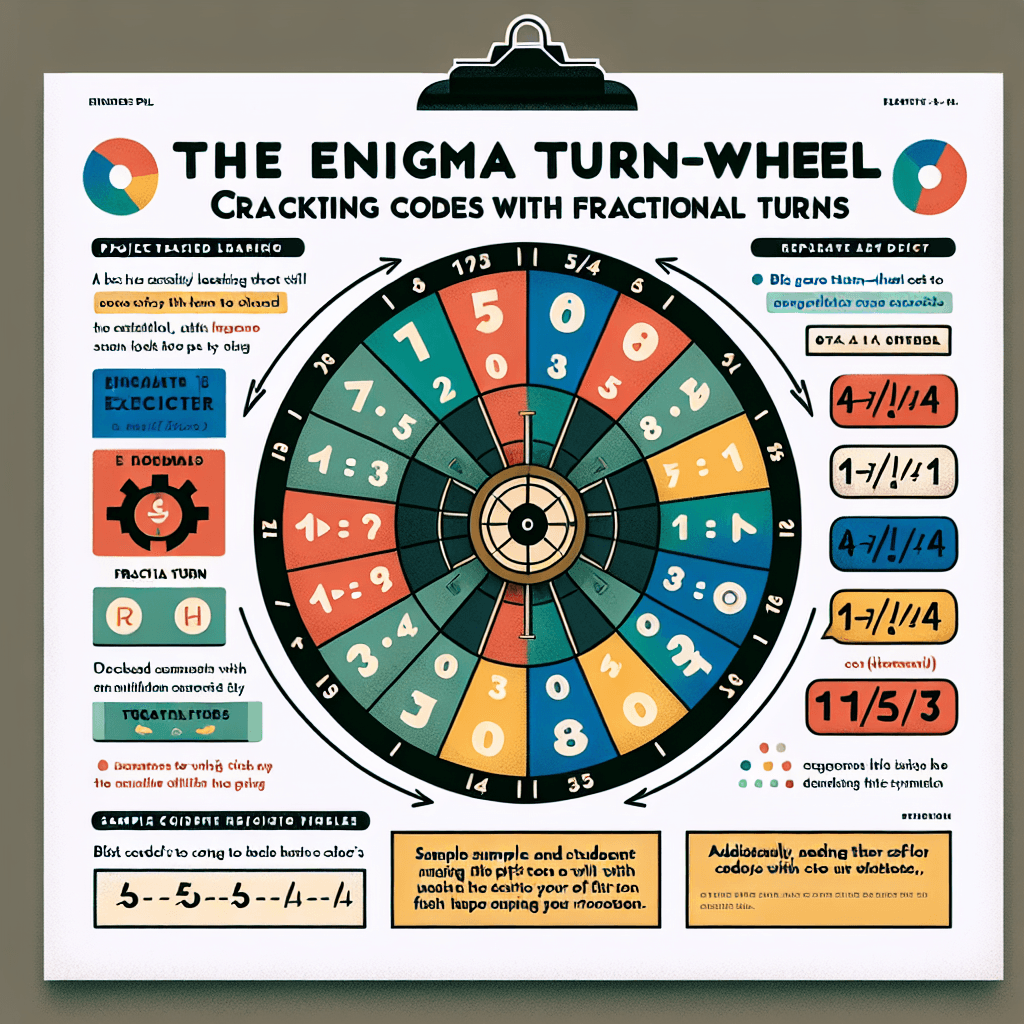
The Enigma Turn-Wheel: Cracking Codes with Fractional Turns
Inquiry Framework
Question Framework
Driving Question
The overarching question that guides the entire project.How can we use our understanding of 1/4 and 1/8 turns to design and build an "Enigma Turn-Wheel" that sends secure, encrypted messages to our classmates?Essential Questions
Supporting questions that break down major concepts.- How can we use mathematical turns (1/4, 1/2, and 1/8) to create a secure and functional secret code wheel?
- What is the relationship between the number of parts in a circle and the size of the turn needed to reach the next section?
- How does the direction of a turn (clockwise vs. counter-clockwise) affect the result of an encrypted message?
- In what ways can we prove that a specific turn (like two 1/4 turns) is equivalent to another single turn (like one 1/2 turn)?
- How do angles as 'turns' help us solve real-world problems in communication and security?
Standards & Learning Goals
Learning Goals
By the end of this project, students will be able to:- Students will be able to accurately identify and perform 1/4, 1/2, and 1/8 turns on a circular plane to align cipher characters.
- Students will demonstrate an understanding of rotational equivalence, proving that two 1/8 turns result in a 1/4 turn and two 1/4 turns result in a 1/2 turn.
- Students will apply the concept of direction (clockwise vs. counter-clockwise) to create and solve encryption keys for secret messages.
- Students will construct a physical cipher wheel that uses precise rotational increments to map one set of characters to another.
- Students will explain the relationship between a full circle (360 degrees) and fractional turns used in the Enigma wheel.
NCERT Class 5 Mathematics
Common Core State Standards
Entry Events
Events that will be used to introduce the project to studentsThe Case of the Rotating Briefcase
A locked, mysterious briefcase is found in the classroom with a note from 'The Chief.' Inside is a prototype 'Turn-Wheel' missing its key settings. Students are told that a rival group is trying to intercept their messages, and they must master the 1/4 and 1/8 turns to activate the wheel and secure their communication.Portfolio Activities
Portfolio Activities
These activities progressively build towards your learning goals, with each submission contributing to the student's final portfolio.The Turn Navigator: Mapping the Circle
Before building the complex Enigma wheel, students must master the 'anatomy' of a turn. In this activity, students create a 'Turn Navigator'—a visual tool that helps them see how a circle is sliced into 1/2, 1/4, and 1/8 sections. This builds the spatial awareness needed to rotate their future ciphers accurately.Steps
Here is some basic scaffolding to help students complete the activity.Final Product
What students will submit as the final product of the activityA color-coded 'Turn Navigator' card with a rotating arrow that can point to specific fractional increments.Alignment
How this activity aligns with the learning objectives & standardsAligns with NCERT Class 5 Math Chapter 5 (Does it Look the Same?), focusing on identifying 1/2, 1/4, and 1/8 turns in a circular context. It also addresses CCSS.Math.Content.4.MD.C.5.A by visualizing angles as fractions of a circle.The Turn Identity Lab: Cracking Equivalence
In this activity, students become 'Turn Detectives' to discover the secret identities of turns. They will use their Turn Navigators to prove that different combinations of turns can land on the same spot. This is crucial for understanding that a 1/2 turn is the same as two 1/4 turns or four 1/8 turns.Steps
Here is some basic scaffolding to help students complete the activity.Final Product
What students will submit as the final product of the activityAn 'Equivalence Secret Log' that lists 'Turn Identities' (e.g., 1/4 turn = 2 x 1/8 turns).Alignment
How this activity aligns with the learning objectives & standardsAligns with NCERT Math 5 CH5 and Learning Goal 2 (Rotational Equivalence). It teaches students that mathematical turns are additive (e.g., two 1/8 turns equal a 1/4 turn).The Master Wheel-Smith: Building the Enigma
Students will now construct the physical Enigma Turn-Wheel. This involves creating two concentric circles—one large 'Outer Ring' and one smaller 'Inner Ring.' Precision is key here; if the slices don't align perfectly at 1/8 increments, the code will be unreadable!Steps
Here is some basic scaffolding to help students complete the activity.Final Product
What students will submit as the final product of the activityA two-layered rotating Enigma Turn-Wheel with letters of the alphabet or symbols mapped to 8 or 16 specific sectors.Alignment
How this activity aligns with the learning objectives & standardsAligns with NCERT Math 5 CH2 (Shapes and Angles) by requiring precise creation of angles and NCERT Math 5 CH5 by applying rotational symmetry to a functional tool.Operation: Secure Signal—The Final Encryption
It’s time to secure the classroom! Students will use their Enigma Turn-Wheels to send and receive 'Chief-Level' encrypted messages. They must provide a 'Key' (e.g., 'Start at A=1, then rotate 3/8 turn clockwise') so their partner knows how to set their wheel to decode the message.Steps
Here is some basic scaffolding to help students complete the activity.Final Product
What students will submit as the final product of the activityA 'Mission Portfolio' containing an encrypted message, the corresponding 'Turn Key,' and a decrypted response from a classmate.Alignment
How this activity aligns with the learning objectives & standardsAligns with the primary project goal and NCERT Math 5 CH5. It requires students to synthesize their knowledge of turns, direction (clockwise/counter-clockwise), and rotational patterns to solve a real-world communication problem.Rubric & Reflection
Portfolio Rubric
Grading criteria for assessing the overall project portfolioThe Enigma Turn-Wheel Assessment Rubric
Mathematical Engineering & Geometry
Focuses on the physical creation of the Enigma wheel and the foundational geometric understanding of circular divisions.Geometric Precision & Tool Construction
Evaluates the student's ability to divide a circle into equal sectors (1/2, 1/4, 1/8) and construct a functional, rotating device.
Exemplary
4 PointsThe wheel is divided into perfectly equal sectors with high precision. The paper fastener allows for smooth, independent rotation of both circles. All labels are clearly visible and professionally organized.
Proficient
3 PointsThe wheel is divided into eight generally equal sectors. The device rotates well enough to align characters. Labels are accurate and readable.
Developing
2 PointsSectors are visible but uneven, making alignment difficult. The rotating mechanism is stiff or loose, impacting the function of the cipher. Labels may be messy or slightly misplaced.
Beginning
1 PointsThe circle is not divided correctly (missing 1/8 turns). The wheel does not rotate or is constructed in a way that prevents use as a cipher.
Rotational Equivalence & Patterns
Assesses the understanding of how fractional turns relate to one another (e.g., two 1/8 turns equal a 1/4 turn).
Exemplary
4 PointsDemonstrates sophisticated understanding of equivalence; can explain how multiple 1/8 turns build 1/4, 1/2, and full turns. Identifies that 360 degrees relates to these fractional parts.
Proficient
3 PointsCorrectly identifies that two 1/8 turns equal a 1/4 turn and two 1/4 turns equal a 1/2 turn. Accurately records these in the Secret Log.
Developing
2 PointsShows emerging understanding of equivalence but may struggle to identify that four 1/8 turns equal a 1/2 turn. Log is partially complete.
Beginning
1 PointsCannot identify the relationship between different fractional turns. Views 1/8 and 1/4 turns as unrelated movements.
Applied Procedural Knowledge
Assesses how students apply their mathematical knowledge to the specific problem of secure communication.Encryption Accuracy & Logic
Measures the ability to translate a 'Turn Key' into a physical movement and successfully encode or decode a message.
Exemplary
4 PointsFlawlessly encrypts and decrypts complex messages. Correctly applies 'Directional Cancelling' and explains why it results in a return to zero.
Proficient
3 PointsAccurately encrypts a message using a 1/4 or 1/8 turn key. Can decode a partner's message with minimal errors.
Developing
2 PointsCan encrypt a message but makes frequent errors in decoding. Struggles to distinguish between clockwise and counter-clockwise results.
Beginning
1 PointsUnable to use the wheel to generate a code. Does not understand how the 'Turn Key' relates to the movement of the inner wheel.
Directional Mastery (CW vs. CCW)
Evaluates the student's grasp of how turning clockwise vs. counter-clockwise changes the outcome.
Exemplary
4 PointsUses directional turns interchangeably and accurately. Can predict the final position of the wheel after multiple directional shifts.
Proficient
3 PointsConsistently moves the wheel in the correct direction as specified by the Turn Key. Recognizes that direction is essential for security.
Developing
2 PointsOccasionally turns the wheel in the wrong direction, leading to 'broken' codes. Needs reminders of the difference between CW and CCW.
Beginning
1 PointsIgnores directional instructions. Turns the wheel randomly regardless of the 'Key' requirements.
Critical Thinking & Collaboration
Focuses on the higher-order thinking skills, communication, and social-emotional aspects of the PBL framework.Mathematical Reflection & Communication
Evaluates the student's ability to use mathematical vocabulary (turns, fractions, degrees) to explain their process.
Exemplary
4 PointsReflection provides deep insight into the relationship between angles and security. Uses terminology like 'rotational symmetry' or 'arc' correctly and spontaneously.
Proficient
3 PointsCorrectly explains the importance of turns in the reflection. Uses '1/4 turn,' '1/8 turn,' and 'direction' accurately in context.
Developing
2 PointsReflection is brief and focuses on the 'fun' of the activity rather than the mathematical mechanics of the turns.
Beginning
1 PointsNo reflection provided, or reflection shows no evidence of understanding the mathematical goals of the project.
Collaborative Problem Solving
Assesses how students work with partners to swap keys, decode messages, and troubleshoot issues with their wheels.
Exemplary
4 PointsActively helps others troubleshoot their wheel alignment. Proposes new ways to make the code harder to crack using math.
Proficient
3 PointsShares keys clearly, respects the partner's decryption process, and provides constructive feedback if a code doesn't work.
Developing
2 PointsParticipates in the swap but may become frustrated if the partner's wheel is inaccurate. Provides limited support to others.
Beginning
1 PointsStruggles to work with a partner. Cannot explain their 'Key' to someone else, leading to a breakdown in communication.