
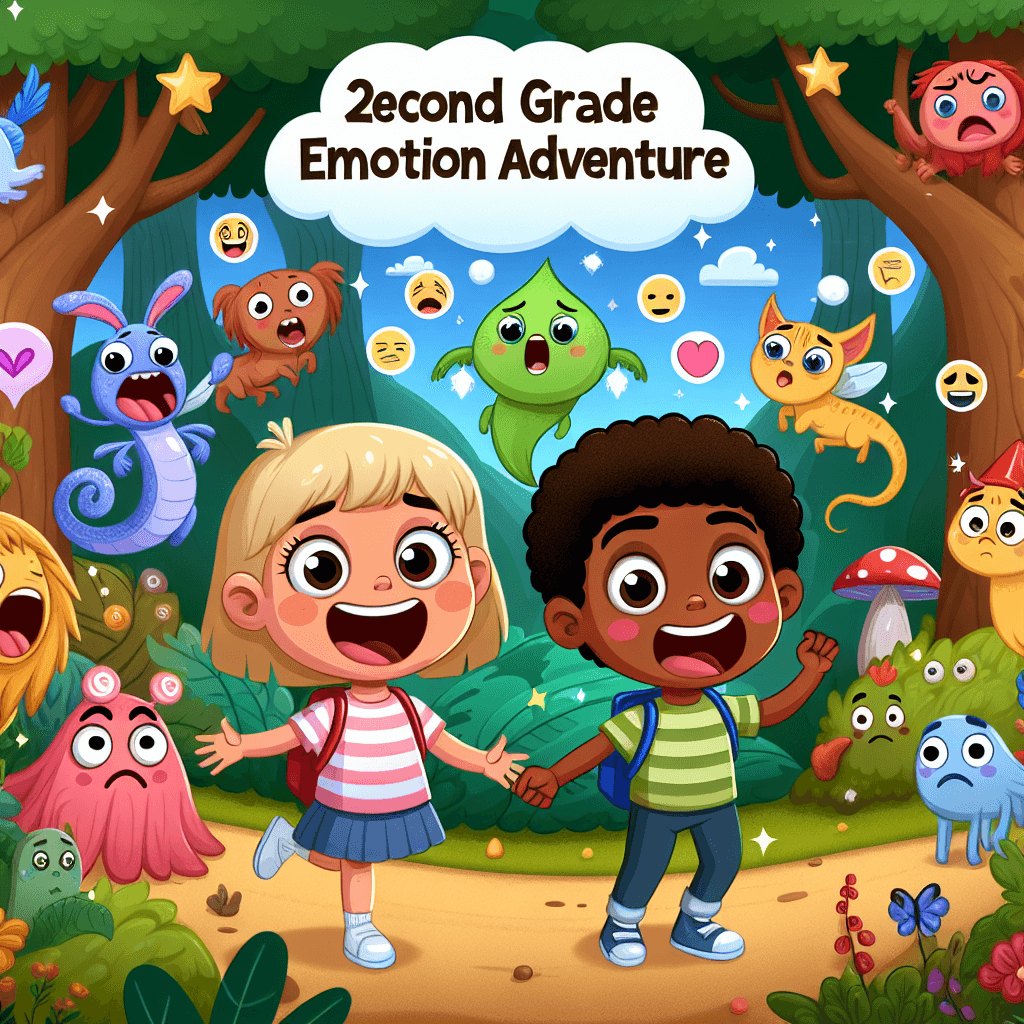
The Feeling Storybook: A 2nd Grade Emotion Adventure
Inquiry Framework
Question Framework
Driving Question
The overarching question that guides the entire project.How can we create a feeling storybook that uses words and pictures to show different feelings, helps us understand our own and others' emotions, and teaches us why talking about feelings is important?Essential Questions
Supporting questions that break down major concepts.- How can you show different feelings through words and pictures?
- Why is it important to understand your own feelings and the feelings of others?
- How do stories help us understand and talk about feelings?
Standards & Learning Goals
Learning Goals
By the end of this project, students will be able to:- Students will be able to define and use new vocabulary words related to emotions in their storybooks.
- Students will improve their writing and speaking skills through the creation and presentation of their feeling storybooks.
- Students will develop social and emotional learning (SEL) skills, including empathy and emotional understanding, by exploring different feelings in their storybooks.
- Students will demonstrate an understanding of why it is important to talk about feelings by incorporating this theme into their stories.
- Students will be able to show different feelings through words and pictures.
- Students will understand their own feelings and the feelings of others through stories.
- Students will understand how stories help us understand and talk about feelings
Entry Events
Events that will be used to introduce the project to studentsEmotions in Action: A Theatrical Start
A local theatre group visits the class to perform a short skit where the actors exaggerate different emotions. After the performance, students discuss what clues (facial expressions, body language, tone of voice) helped them identify each feeling, sparking interest in how feelings can be expressed and recognized.Portfolio Activities
Portfolio Activities
These activities progressively build towards your learning goals, with each submission contributing to the student's final portfolio.My Feelings Vocabulary
Students will create a feelings word bank to use as a reference throughout the project.Steps
Here is some basic scaffolding to help students complete the activity.Final Product
What students will submit as the final product of the activityA personal feelings word bank with definitions and example sentences for each emotion word.Alignment
How this activity aligns with the learning objectives & standardsAddresses the learning goal: Students will be able to define and use new vocabulary words related to emotions in their storybooks.Storybook Blueprint
Students will plan out the structure and content of their storybook, focusing on a clear beginning, middle, and end.Steps
Here is some basic scaffolding to help students complete the activity.Final Product
What students will submit as the final product of the activityA detailed storybook outline, including character descriptions, plot points, and key emotional moments.Alignment
How this activity aligns with the learning objectives & standardsAddresses the learning goal: Students will improve their writing skills through the creation of their feeling storybooks.Expressive Reading Rehearsal
Students will practice reading their storybooks aloud, focusing on expressive reading and clear pronunciation.Steps
Here is some basic scaffolding to help students complete the activity.Final Product
What students will submit as the final product of the activityA recorded practice reading of their storybook, with self-assessment notes on areas for improvement.Alignment
How this activity aligns with the learning objectives & standardsAddresses the learning goal: Students will improve their speaking skills through the presentation of their feeling storybooks.Emotional Impact Peer Review
Students will participate in peer review sessions, providing constructive feedback on each other's storybooks from an emotional impact perspective.Steps
Here is some basic scaffolding to help students complete the activity.Final Product
What students will submit as the final product of the activityWritten peer feedback for two classmates, focusing on how well the story conveyed emotions and promoted understanding.Alignment
How this activity aligns with the learning objectives & standardsAddresses the learning goal: Students will develop social and emotional learning (SEL) skills, including empathy and emotional understanding, by exploring different feelings in their storybooks.The Importance of Feelings Reflection
Students will add a reflection page to their storybook, summarizing the importance of talking about feelings based on their story's message.Steps
Here is some basic scaffolding to help students complete the activity.Final Product
What students will submit as the final product of the activityA reflection page in the storybook that answers the question: Why is talking about feelings important?Alignment
How this activity aligns with the learning objectives & standardsAddresses the learning goal: Students will demonstrate an understanding of why it is important to talk about feelings by incorporating this theme into their stories.Rubric & Reflection
Portfolio Rubric
Grading criteria for assessing the overall project portfolioThe Feeling Storybook Rubric
Vocabulary Mastery
Assesses the student's understanding and application of new vocabulary words related to emotions.Emotion Word Definitions
Accuracy and depth of definitions for selected emotion words.
Exemplary
4 PointsProvides accurate and insightful definitions for all 5-7 selected emotion words, demonstrating a sophisticated understanding of their nuances.
Proficient
3 PointsProvides mostly accurate definitions for the selected emotion words, showing a good understanding of their meanings.
Developing
2 PointsProvides basic definitions for some of the selected emotion words, but some definitions may be unclear or incomplete.
Beginning
1 PointsStruggles to define the selected emotion words, with many definitions missing or inaccurate.
Example Sentence Quality
Quality and relevance of example sentences demonstrating the understanding of each emotion word.
Exemplary
4 PointsCrafts exceptionally clear and relevant example sentences that vividly illustrate the meaning and usage of each emotion word in context.
Proficient
3 PointsCreates clear and relevant example sentences that demonstrate a solid understanding of how to use each emotion word correctly.
Developing
2 PointsWrites example sentences that are somewhat relevant but may lack clarity or full understanding of the emotion word.
Beginning
1 PointsStruggles to write relevant example sentences, showing limited understanding of how to use the emotion words in context.
Storybook Planning
Focuses on the student's ability to plan and structure their storybook effectively, emphasizing a clear narrative arc and emotional development.Story Structure
Clarity and coherence of the story outline, including a clear beginning, middle, and end.
Exemplary
4 PointsPresents an exceptionally clear, well-organized, and coherent story outline with a compelling beginning, engaging middle, and satisfying conclusion.
Proficient
3 PointsPresents a clear and organized story outline with a discernible beginning, middle, and end.
Developing
2 PointsPresents a story outline with some sense of structure, but the beginning, middle, or end may be unclear or underdeveloped.
Beginning
1 PointsStruggles to create a coherent story outline, with a poorly defined beginning, middle, and end.
Emotional Challenge
Effectiveness in choosing a central feeling/emotional challenge and demonstrating its evolution throughout the story.
Exemplary
4 PointsChooses a profound and relatable emotional challenge, skillfully portraying its evolution throughout the story with depth and nuance.
Proficient
3 PointsChooses a relevant emotional challenge and effectively demonstrates its evolution throughout the story.
Developing
2 PointsChooses an emotional challenge, but its evolution throughout the story is not clearly demonstrated or fully developed.
Beginning
1 PointsStruggles to choose a relevant emotional challenge or demonstrate its development within the story.
Feelings Word Integration
Integration of specific feelings words into the story outline to enhance emotional expression.
Exemplary
4 PointsMasterfully integrates specific feelings words throughout the story outline, enhancing emotional expression and creating a powerful impact.
Proficient
3 PointsIntegrates specific feelings words effectively into the story outline to enhance emotional expression.
Developing
2 PointsIntegrates some feelings words into the story outline, but their impact on emotional expression is limited.
Beginning
1 PointsFails to adequately integrate feelings words into the story outline, resulting in minimal emotional expression.
Expressive Reading
Evaluates the student's speaking skills, focusing on their ability to read expressively and assess their own performance.Clarity and Pronunciation
Clarity and pronunciation during the practice reading.
Exemplary
4 PointsDemonstrates exceptional clarity and precise pronunciation throughout the practice reading, ensuring every word is easily understood.
Proficient
3 PointsDemonstrates good clarity and pronunciation during the practice reading, with only minor errors.
Developing
2 PointsDemonstrates some clarity and pronunciation, but frequent errors may impede understanding.
Beginning
1 PointsStruggles with clarity and pronunciation, making it difficult to understand the reading.
Emotional Expressiveness
Expressiveness and emotional delivery in conveying the story's feelings and tone.
Exemplary
4 PointsDelivers the story with outstanding expressiveness and emotional depth, perfectly capturing the intended feelings and tone, creating a captivating experience for the listener.
Proficient
3 PointsReads the story with appropriate expressiveness and emotional delivery, conveying the story's feelings and tone effectively.
Developing
2 PointsShows some expressiveness, but the emotional delivery is inconsistent or does not fully capture the story's intended feelings and tone.
Beginning
1 PointsReads with minimal expressiveness, failing to convey the story's feelings and tone effectively.
Self-Assessment
Quality and insightfulness of self-assessment notes on areas for improvement.
Exemplary
4 PointsProvides exceptionally insightful and detailed self-assessment notes, identifying specific areas for improvement with clear strategies for enhancement.
Proficient
3 PointsProvides thoughtful and relevant self-assessment notes, identifying key areas for improvement.
Developing
2 PointsProvides basic self-assessment notes, but the areas for improvement are vague or lack specific strategies.
Beginning
1 PointsProvides minimal or superficial self-assessment notes, showing little reflection on areas for improvement.
Peer Review
Measures the student's ability to provide constructive peer feedback, focusing on emotional understanding and clarity.Feedback Quality
Thoroughness and constructiveness of feedback on classmates' storybook outlines.
Exemplary
4 PointsProvides exceptionally thorough and constructive feedback, offering insightful suggestions and specific examples to enhance classmates' storybook outlines.
Proficient
3 PointsProvides thorough and constructive feedback on classmates' storybook outlines, offering helpful suggestions.
Developing
2 PointsProvides some feedback on classmates' storybook outlines, but it may be general or lack specific examples.
Beginning
1 PointsProvides minimal or superficial feedback on classmates' storybook outlines, offering little constructive criticism.
Emotional Clarity
Focus on the clarity and impact of emotions conveyed in the story.
Exemplary
4 PointsOffers astute observations on the clarity and emotional impact of the story, providing actionable suggestions to amplify the emotional resonance.
Proficient
3 PointsFocuses on the clarity and impact of emotions conveyed in the story, providing useful feedback.
Developing
2 PointsAddresses the clarity and impact of emotions, but the feedback is limited or lacks depth.
Beginning
1 PointsProvides little or no feedback on the clarity and impact of emotions conveyed in the story.
Emotional Understanding
Effectiveness of suggestions for enhancing emotional understanding in the story.
Exemplary
4 PointsOffers highly effective and innovative suggestions for enhancing emotional understanding in the story, demonstrating a deep understanding of SEL skills.
Proficient
3 PointsOffers effective suggestions for enhancing emotional understanding in the story.
Developing
2 PointsProvides suggestions for enhancing emotional understanding, but they may be generic or not fully developed.
Beginning
1 PointsProvides minimal or ineffective suggestions for enhancing emotional understanding in the story.
Feelings Reflection
Assesses the student's reflection on the importance of talking about feelings, linking it to their storybook's message.Emotional Reflection
Depth of reflection on the emotional journey of the main character.
Exemplary
4 PointsProvides a profoundly insightful and nuanced reflection on the emotional journey of the main character, demonstrating a deep understanding of their feelings and growth.
Proficient
3 PointsProvides a thoughtful reflection on the emotional journey of the main character, showing a good understanding of their feelings.
Developing
2 PointsProvides a basic reflection on the emotional journey of the main character, but it may lack depth or insight.
Beginning
1 PointsProvides a superficial or minimal reflection on the emotional journey of the main character.
Importance of Feelings
Clarity and persuasiveness of the explanation regarding the importance of talking about feelings.
Exemplary
4 PointsArticulates an exceptionally clear and persuasive explanation of why it is important for people to talk about their feelings, drawing compelling examples from the story to support the argument.
Proficient
3 PointsProvides a clear and persuasive explanation of why it is important for people to talk about their feelings, referencing examples from the story.
Developing
2 PointsExplains why it is important to talk about feelings, but the explanation may lack clarity or persuasive examples.
Beginning
1 PointsStruggles to explain why it is important for people to talk about their feelings, providing minimal or unclear reasoning.
Story Integration
Integration of examples from the story to support the explanation.
Exemplary
4 PointsSeamlessly integrates specific and relevant examples from the story to powerfully support the explanation, demonstrating a strong connection between the narrative and the reflective insights.
Proficient
3 PointsIntegrates relevant examples from the story to support the explanation effectively.
Developing
2 PointsIncludes some examples from the story, but their relevance or connection to the explanation may be weak.
Beginning
1 PointsFails to integrate relevant examples from the story to support the explanation.