
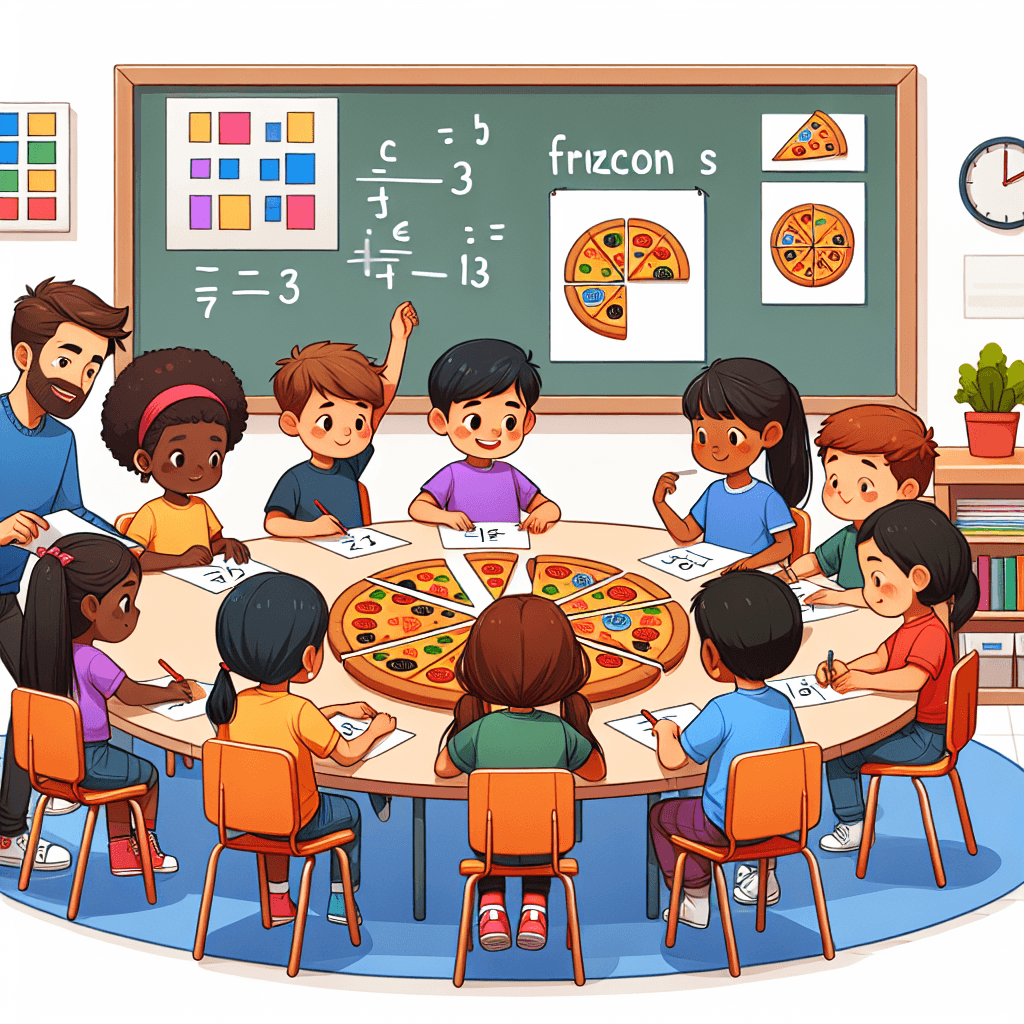
The Great Fraction Pizza Party
Inquiry Framework
Question Framework
Driving Question
The overarching question that guides the entire project.How can we create our own pizzas while exploring the different ways fractions like halves, quarters, eighths, and tenths help us in understanding math concepts?Essential Questions
Supporting questions that break down major concepts.- What are fractions and why are they useful?
- How can we identify and model halves, quarters, eighths, and tenths using real-life examples, like pizzas?
- What strategies can we use to compare and order unit fractions?
- How do we calculate unit fractions of a given number and apply this knowledge in everyday situations?
- In what ways can we add and subtract fractions with the same denominator, and why is this important?
Standards & Learning Goals
Learning Goals
By the end of this project, students will be able to:- Students will be able to identify and model fractions of halves, quarters, eighths, and tenths using real-life examples such as pizza.
- Students will learn strategies to compare and order unit fractions effectively.
- Students will calculate unit fractions of a given number and apply this knowledge to solve real-life problems.
- Students will demonstrate the ability to add and subtract fractions with the same denominator.
Common Core Standards
Entry Events
Events that will be used to introduce the project to studentsThe Mystery Pizza Chef Challenge
Students walk into the classroom to find a video message from "The Mystery Pizza Chef" challenging them to create perfect fractions of pizzas to uncover a special ingredient list that must be used for the school's Great Fraction Pizza Party. This not only sparks curiosity but connects directly with their project goal of understanding fractions.Math-Fraction Escape Room
Transform the classroom into an escape room where students solve fraction puzzles to 'unlock' pizza ingredients. This adventurous setup challenges their conventional perception of math and encourages teamwork and problem-solving.Fraction Treasure Hunt
Students embark on a school-wide treasure hunt to find and assemble pizza ingredients, using maps and clues based purely on fractions, leading to a grand pizza-making event. This event directly links fractions with adventure and discovery, appealing to their sense of exploration.Portfolio Activities
Portfolio Activities
These activities progressively build towards your learning goals, with each submission contributing to the student's final portfolio.Fraction Comparison: The Topping Challenge
Students will compare and order fractions by determining how much of each ingredient they need for their pizzas. Through a fun 'ingredient card' game, they will position ingredients based on fractional needs, learning to compare different fractions effectively.Steps
Here is some basic scaffolding to help students complete the activity.Final Product
What students will submit as the final product of the activityCompleted fraction order chart with ingredient cards placed in sequence from smallest to largest fractions.Alignment
How this activity aligns with the learning objectives & standardsSupports standard 2.NF.A.3 by explaining the equivalence and comparison of fractions.Slice & Dice: Fraction Calculation Fiesta
Learners will calculate unit fractions and apply this calculation to real-life scenarios. They will be tasked with determining how much pizza each person gets when divided equally among different numbers of people.Steps
Here is some basic scaffolding to help students complete the activity.Final Product
What students will submit as the final product of the activityWritten explanations of how each group solved their fraction problems and a display of the divided pizza images.Alignment
How this activity aligns with the learning objectives & standardsAddresses the learning goal of calculating unit fractions and aligns with standards related to modeling fractions (2.G.A.3).Fraction Addition & Subtraction: Numbers on the Dough
This activity emphasizes the addition and subtraction of fractions through an interactive pizza-making session where students must collaborate to complete 'pizza orders' that require combining or dividing fractions.Steps
Here is some basic scaffolding to help students complete the activity.Final Product
What students will submit as the final product of the activityA completed set of fraction equations showing the addition and subtraction needed to fulfill pizza orders.Alignment
How this activity aligns with the learning objectives & standardsAligns with 2.NF.B.6 and 2.OA.A.1 by teaching students to add and subtract fractions, and solve problems using these operations.Fraction Fundamentals: Pizza Jam Session
In this activity, students will dive into the very basics of understanding fractions by using pizzas. They will learn to partition circles into halves, quarters, eighths, and tenths by constructing pizza models out of colored paper. This will scaffold their understanding of equal parts and how different fractions represent different amounts of the same whole.Steps
Here is some basic scaffolding to help students complete the activity.Final Product
What students will submit as the final product of the activityA visually engaging portfolio with labeled pizza models showing different fractions.Alignment
How this activity aligns with the learning objectives & standardsAligns with 2.G.A.3 by helping students partition shapes into equal shares and describe the shares.Rubric & Reflection
Portfolio Rubric
Grading criteria for assessing the overall project portfolioGreat Fraction Pizza Party Assessment Rubric
Understanding of Fractions
Evaluates the student's ability to identify and represent fractions, especially halves, quarters, eighths, and tenths, using pizza models.Fraction Identification and Modeling
Assesses how well students can identify and model fractions in real-life scenarios using pizza.
Exemplary
4 PointsModels fractions with precision and creativity using pizza; identifies halves, quarters, eighths, and tenths accurately and innovatively.
Proficient
3 PointsAccurately models fractions and correctly identifies halves, quarters, eighths, and tenths using pizza.
Developing
2 PointsShows basic modeling of fractions; identifies halves and quarters correctly but struggles with eighths and tenths.
Beginning
1 PointsStruggles to model fractions accurately; limited identification of halves, quarters, eighths, and tenths.
Comparing and Ordering Fractions
Measures the student's ability to compare and order different fractions effectively.
Exemplary
4 PointsDemonstrates advanced ability to compare and order fractions accurately, showing clear understanding of size differences.
Proficient
3 PointsCorrectly compares and orders fractions with minor errors; understands basic differences in size.
Developing
2 PointsAttempts to compare and order with inconsistent accuracy; partial understanding of size differences.
Beginning
1 PointsShows minimal ability to compare and order fractions; struggles with understanding size differences.
Fraction Operations
Assesses the student’s ability to perform addition and subtraction of fractions with the same denominator.Addition and Subtraction of Fractions
Evaluates how well students can solve problems involving adding and subtracting fractions.
Exemplary
4 PointsSolves fraction addition and subtraction problems with precise calculations and clear explanations.
Proficient
3 PointsCorrectly solves most addition and subtraction problems with fractions; explanations are generally clear.
Developing
2 PointsSolves some simple fraction problems correctly; explanations are incomplete or partially incorrect.
Beginning
1 PointsStruggles to solve fraction problems correctly; explanations are confused or absent.
Application of Fraction Concepts
Evaluates how well the student applies fraction knowledge to solve real-world problems and scenarios presented in the activities.Calculation of Unit Fractions
Measures the ability to calculate unit fractions of given numbers in everyday scenarios.
Exemplary
4 PointsDemonstrates exceptional understanding by accurately calculating unit fractions in all scenarios presented.
Proficient
3 PointsCorrectly calculates most unit fractions in various scenarios with few errors.
Developing
2 PointsAttempts calculations with partial success; struggles with some scenarios.
Beginning
1 PointsHas difficulty calculating unit fractions accurately in presented scenarios.
Engagement and Collaboration
Gauges student participation and teamwork skills during group activities and discussions.Class Participation and Teamwork
Measures the student's engagement level and ability to work collaboratively in the group activities.
Exemplary
4 PointsConsistently demonstrates leadership and active engagement in class and group work; supports peers effectively.
Proficient
3 PointsActively participates in class and group work; contributes ideas and assists team efforts.
Developing
2 PointsParticipates sporadically in activities; contributions to group work are inconsistent.
Beginning
1 PointsRarely engages in class or group activities; limited contribution to teamwork.