
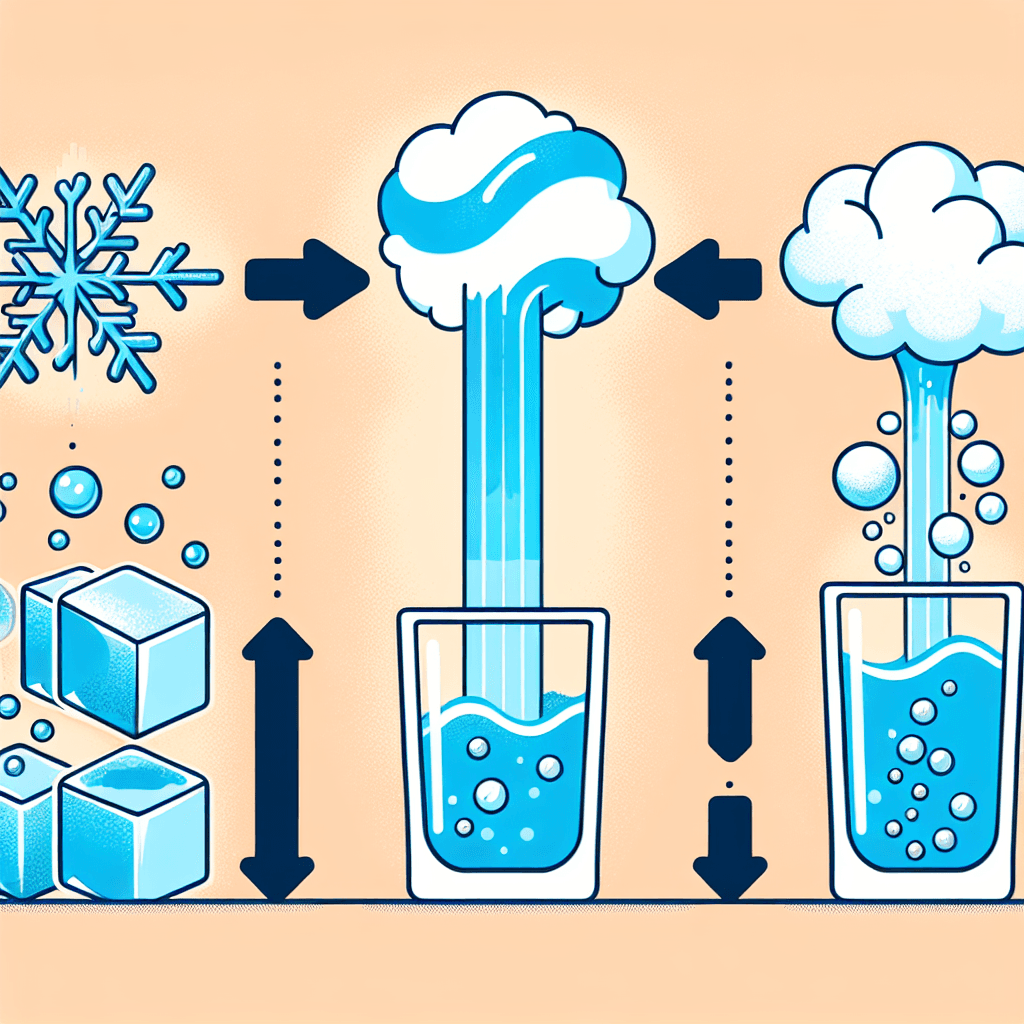
The Many Faces of Water: Solid, Liquid, Gas
Inquiry Framework
Question Framework
Driving Question
The overarching question that guides the entire project.How can we explore and identify the various forms and sources of water on Earth, and understand why they are vital for life?Essential Questions
Supporting questions that break down major concepts.- What is the difference between salt water and fresh water?
- Where are glaciers, rivers, and lakes located, and what types of water do they provide?
- How does temperature affect the state of water on Earth?
- Why is water vital for life on Earth?
- How can we identify the different forms and sources of water in our environment?
Standards & Learning Goals
Learning Goals
By the end of this project, students will be able to:- Understand and identify different types of water sources on Earth, including fresh water from rivers, lakes, and glaciers, and salt water in oceans.
- Explain how temperature affects the state of water, leading to its presence in liquid or solid forms.
- Differentiate between types of water based on properties such as salt content, and understand their distribution in various bodies of water.
- Describe why water is essential for life on Earth by exploring its roles and importance.
- Identify and apply key vocabulary related to water sources and states in scientific discussions.
NGSS
Entry Events
Events that will be used to introduce the project to studentsPlanet Earth Postcards
Students receive mysterious postcards from different parts of the world showing stunning locations like glaciers, rivers, and oceans, each asking questions about the kinds of water found there. The challenge is to create responses to these messages by exploring and uncovering facts about the different states and types of water on Earth.The Water Detective Challenge
Invite students to become 'Water Detectives' tasked with solving the mystery of 'The Missing Water.' They receive a 'Top Secret Mission Brief' detailing a global water crisis where they must explore different locations such as rivers, lakes, and oceans to find out what types of water exist, how they differ, and where they can be found.Global Water Broadcast
Students role-play as news reporters capturing the latest discoveries about different water bodies—glaciers, rivers, lakes, and oceans—presenting a 'live' broadcast that aims to educate their peers about the global distribution and state of water, differentiating between drinkable and non-drinkable sources.The Water Rock Cycle
Pique curiosity by exploring the 'Water Rock Cycle,' where students are introduced to the concept through a story that compares water's transformation across states to a rock concert! Students create their own models or skits that illustrate the cycle using props related to dew, rain, ice cubes, and warmth.Portfolio Activities
Portfolio Activities
These activities progressively build towards your learning goals, with each submission contributing to the student's final portfolio.Water State Explorers
Through simple experiments, students observe how temperature changes affect water’s state. By making ice, melting it, and observing steam, they discover water’s transformation between solid, liquid, and gas.Steps
Here is some basic scaffolding to help students complete the activity.Final Product
What students will submit as the final product of the activityA series of illustrated diagrams showing the transition of water between different states.Alignment
How this activity aligns with the learning objectives & standardsAligns with the Disciplinary Core Idea ESS2.C, illustrating the roles of temperature in water's state changes.Fresh vs. Salt Water Taste Test
In a safe and controlled environment, students compare fresh and salt water properties by tasting (simulated safely with saline solutions) and analyzing differences in flavor, texture, and drinkability.Steps
Here is some basic scaffolding to help students complete the activity.Final Product
What students will submit as the final product of the activityA comparative report highlighting the differences between fresh and salt water.Alignment
How this activity aligns with the learning objectives & standardsSupports understanding of fresh vs. salt water characteristics, meeting the learning goal of differentiating types of water based on their properties.Water Reporter
Students create a news report showcasing their findings about Earth's water sources, exploring how water is essential for life and its geographical distribution.Steps
Here is some basic scaffolding to help students complete the activity.Final Product
What students will submit as the final product of the activityNews report videos or live presentations explaining the significance of different water sources.Alignment
How this activity aligns with the learning objectives & standardsAligns with NGSS-SEP, as students communicate their understanding and findings effectively.Rubric & Reflection
Portfolio Rubric
Grading criteria for assessing the overall project portfolioWater Exploration and Understanding Rubric
Understanding Water States
Evaluates the student's ability to identify and describe the different states of water and the conditions that cause these changes.Observation and Recording
Measures how well students observe and document the transformation of water through its states: solid, liquid, and gas.
Exemplary
4 PointsDemonstrates comprehensive observation skills by accurately and thoroughly documenting all stages of water transformation with precise details and clarity.
Proficient
3 PointsShows good observation skills by documenting key stages of water transformation with clear and relevant details.
Developing
2 PointsExhibits basic observation skills by noting some stages of water transformation with limited detail.
Beginning
1 PointsShows limited ability to observe and record water transformation stages, lacking clarity or detail.
Explanation of State Changes
Assesses the student’s ability to explain how and why water changes states based on temperature variations.
Exemplary
4 PointsProvides a sophisticated explanation of water state changes incorporating scientific vocabulary and a complete understanding of temperature effects.
Proficient
3 PointsGives a clear explanation of water state changes with an appropriate use of vocabulary related to temperature effects.
Developing
2 PointsExplains water state changes with some understanding, using limited or incorrect vocabulary.
Beginning
1 PointsStruggles to explain water state changes, showing minimal understanding and incorrect vocabulary usage.
Understanding Water Sources
Focuses on the student's ability to identify and differentiate between various water sources (fresh and saltwater) and their significance.Identification and Differentiation
Evaluates the ability to correctly identify different water sources and describe their characteristics and differences.
Exemplary
4 PointsAccurately identifies all water sources with detailed descriptions and clear differentiation between freshwater and saltwater properties.
Proficient
3 PointsCorrectly identifies most water sources with clear descriptions and appropriate differentiation between properties.
Developing
2 PointsIdentifies some water sources with vague descriptions and limited differentiation.
Beginning
1 PointsStruggles to identify or differentiate water sources, with unclear or incorrect descriptions.
Communication of Water Source Importance
Assesses how well students communicate their understanding of the significance of different water sources for life on Earth.
Exemplary
4 PointsCommunicates a broad and deep understanding of the importance of various water sources using informative and engaging presentations.
Proficient
3 PointsEffectively communicates understanding of important water sources with clear and organized information.
Developing
2 PointsCommunicates basic understanding of water source importance with reliance on provided information.
Beginning
1 PointsStruggles to communicate the significance of water sources with minimal clarity.
Scientific Reporting in Portfolio Activities
Evaluates the students' ability to compile and communicate scientific findings effectively through their portfolio activities.Portfolio Organization
Measures how well students organize and present their portfolio to convey their findings and learning progress.
Exemplary
4 PointsOrganizes portfolio with exceptional clarity and logical flow, displaying a sophisticated arrangement of content and evidence.
Proficient
3 PointsPresents portfolio in a clear and logical manner, with well-organized content and sufficient evidence.
Developing
2 PointsOrganizes portfolio with some logic but lacks clear presentation and organization of content.
Beginning
1 PointsPresents an unorganized portfolio with poor clarity and little logical flow.
Evidence and Reflection
Assesses the inclusion of evidence and self-reflection in the portfolio activities to demonstrate learning.
Exemplary
4 PointsIncorporates comprehensive evidence and insightful reflections, demonstrating extensive engagement with the learning process.
Proficient
3 PointsIncludes adequate evidence and reflection showing clear engagement and understanding of the activities.
Developing
2 PointsIncludes limited evidence and basic reflections, showing partial engagement with the learning activities.
Beginning
1 PointsProvides minimal evidence and reflection, lacking in-depth engagement with the learning process.