
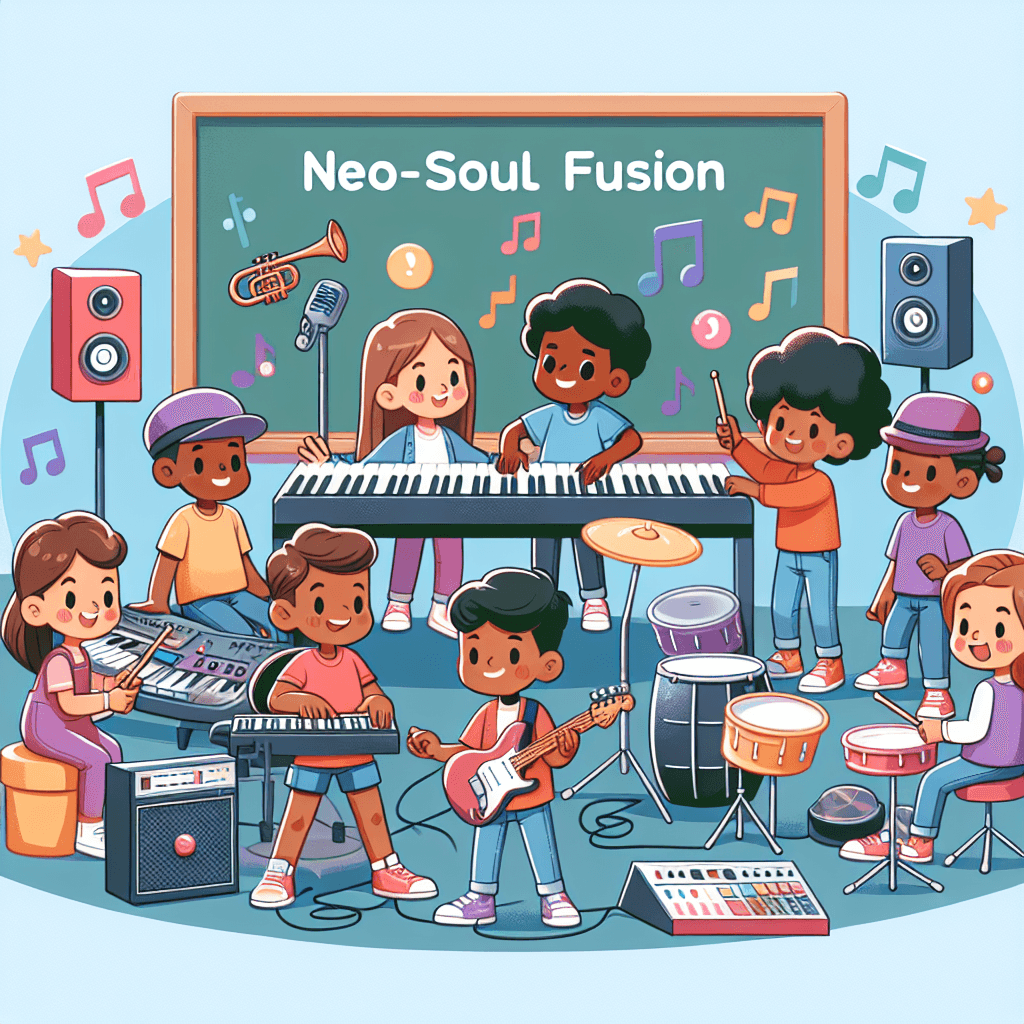
The Neo-Soul Fusion Challenge: Producing the Next R&B Hit
Inquiry Framework
Question Framework
Driving Question
The overarching question that guides the entire project.How can we, as music production apprentices, produce an original soul-fusion beat that honors the legacy of 90s icons like Mary J. Blige while capturing the modern aesthetic of artists like SZA to meet a professional client's brief?Essential Questions
Supporting questions that break down major concepts.- What are the signature musical elements—rhythm, harmony, and instrumentation—that define the '90s soul' of Mary J. Blige and the 'modern R&B' of SZA?
- How can we use Digital Audio Workstation (DAW) tools like MIDI, sampling, and effects to blend vintage vibes with contemporary sounds?
- How does a producer translate a client's abstract artistic vision into a specific musical arrangement?
- In what ways does the cultural history of R&B influence the music being created for today's top artists?
- How do we balance creative experimentation with the technical requirements of a professional music industry brief?
- How can collaboration between different age groups and skill levels enhance the unique 'groove' of a track?
Standards & Learning Goals
Learning Goals
By the end of this project, students will be able to:- Analyze and identify the key musical characteristics of 90s Neo-Soul (e.g., Rhodes piano, boom-bap drums) and modern R&B (e.g., 808s, atmospheric pads) to inform beat production.
- Utilize Digital Audio Workstation (DAW) tools to compose an original track, incorporating MIDI sequencing, drum programming, and audio effects.
- Translate a professional client brief into a musical arrangement that balances creative expression with specific industry requirements.
- Develop a collaborative workflow between production partners to select, refine, and organize musical ideas into a cohesive song structure.
- Evaluate and iterate on musical compositions based on peer feedback and self-assessment against the 'SZA-style' hit criteria.
National Core Arts Standards (Music)
Entry Events
Events that will be used to introduce the project to studentsThe FaceTime From the Future
Students arrive at the studio to find a personalized video message from 'Nova,' a rising R&B star. She explains she’s stuck between two worlds—her mom’s Mary J. Blige records and her own love for SZA—and tasks the apprentices with creating a 'bridge' beat that honors the past while sounding like the future.Portfolio Activities
Portfolio Activities
These activities progressively build towards your learning goals, with each submission contributing to the student's final portfolio.The Hybrid Groove: Drum Layering 101
The heartbeat of any R&B track is the drum pattern. In this activity, students will use a Digital Audio Workstation (DAW) to program a drum loop that bridges the 90s and the 2020s. They will learn to layer 'vintage' acoustic drum samples with 'modern' electronic 808s to create a hybrid groove that feels both nostalgic and fresh.Steps
Here is some basic scaffolding to help students complete the activity.Final Product
What students will submit as the final product of the activityAn 8-bar 'Hybrid Groove' drum loop exported as an MP3 or WAV file.Alignment
How this activity aligns with the learning objectives & standardsAligns with MU:Cr2.1.7b: Select, organize, and document musical ideas for arrangements and compositions within a specific form that demonstrate unity and variety.The Vibe Check: Harmonic Layering
Now that the rhythm is set, students will add the 'vibes'—the harmonic and melodic layers. They will explore using MIDI controllers to play 'Neo-Soul' chords (using Rhodes or Electric Piano sounds) and layering them with 'Modern' synth pads to create a lush, atmospheric background for Nova’s vocals.Steps
Here is some basic scaffolding to help students complete the activity.Final Product
What students will submit as the final product of the activityA multi-track MIDI sequence featuring a chord progression and a melodic counter-point (a 'hook' line).Alignment
How this activity aligns with the learning objectives & standardsAligns with MU:Cn11.0.7a: Demonstrate how interests, knowledge, and understanding of others’ responses to music and the craft of the producer/engineer inform creating and performing music.The Client Critique: Refinement & Mixdown
A producer's job is never done after the first draft. In this 'Client Review' session, students will present their work-in-progress to their 'mentor' (the teacher) and their 'studio partner' (the other apprentice). They will receive feedback based on the client brief: 'Is it too 90s? Is it too modern?' and make specific technical adjustments.Steps
Here is some basic scaffolding to help students complete the activity.Final Product
What students will submit as the final product of the activityA 'Producer’s Revision Log' detailing what was changed (e.g., 'Turned down the snare reverb to make it punchier') and why.Alignment
How this activity aligns with the learning objectives & standardsAligns with MU:Cr3.1.7a: Evaluate their own work, applying selected criteria... and feedback from others, and describe the rationale for making revisions.Sonic DNA: The Genre Detective Lab
Before hitting the record button, producers must understand the 'Sonic DNA' of their clients. In this activity, students will act as musical detectives, analyzing the specific production elements that define Mary J. Blige’s 90s soul (boom-bap drums, electric piano, grit) and SZA’s modern R&B (atmospheric textures, 808 bass, vocal layering). This sets the foundation for a 'fusion' approach.Steps
Here is some basic scaffolding to help students complete the activity.Final Product
What students will submit as the final product of the activityA 'Sonic Blueprint' Mood Board (digital or physical) that lists 5 key characteristics of each era and identifies 'The Bridge'—elements that can work in both styles.Alignment
How this activity aligns with the learning objectives & standardsAligns with MU:Re7.2.7b: Identify and compare the context of programs of music from a variety of genres, cultures, and historical periods.Rubric & Reflection
Portfolio Rubric
Grading criteria for assessing the overall project portfolioThe Neo-Soul Fusion Challenge: Music Production Rubric
Musical Research & Genre Analysis
Evaluating the apprentice's ability to research and translate genre-specific history into a creative blueprint.Research & Analysis (Sonic DNA)
Ability to analyze, identify, and document the specific musical elements that define 90s soul (Mary J. Blige) and modern R&B (SZA).
Exemplary
4 PointsDemonstrates sophisticated analysis; Mood Board identifies nuanced elements (e.g., specific synth types, drum swing percentages) and proposes an innovative, seamless 'Bridge' strategy.
Proficient
3 PointsProvides clear and accurate identification of 5 key characteristics for each era; Sonic Blueprint clearly outlines a logical 'Bridge' between styles.
Developing
2 PointsIdentifies basic characteristics but may miss key distinctions between eras; 'Bridge' elements are present but lack a clear connection to the client brief.
Beginning
1 PointsLists minimal or inaccurate characteristics; Sonic Blueprint is incomplete or fails to distinguish between the two genres.
Technical Production: Rhythm Section
Assessing the technical and creative execution of the drum foundation using DAW tools.Rhythmic Engineering (Hybrid Groove)
Execution of drum programming that blends 'Boom-Bap' foundations with modern 808 sub-bass and rhythmic 'swing.'
Exemplary
4 PointsDrums exhibit professional-grade layering; the 808 and kick are perfectly tuned/balanced, and the hi-hat 'swing' creates a compelling, human feel.
Proficient
3 PointsSuccessfully layers 90s samples with 808s; rhythmic emphasis on beats 2 and 4 is consistent and the loop feels cohesive.
Developing
2 PointsDrums are programmed but layering may sound cluttered; 'swing' or rhythmic emphasis is attempted but inconsistent.
Beginning
1 PointsDrum loop is basic or off-beat; lacks the required layering of vintage and modern elements.
Composition & Sound Design
Evaluating the use of harmony and texture to meet the client's 'SZA-style' aesthetic.Harmonic & Atmospheric Layering
Ability to layer Neo-Soul chord progressions with modern atmospheric textures using MIDI and virtual instruments.
Exemplary
4 PointsComposition features sophisticated 7th/9th chords with seamless 'washy' textures; the melodic counter-point is memorable and professional.
Proficient
3 PointsAppropriately uses Rhodes/Wurlitzer for a 4-chord soul progression layered with a dreamy synth pad; MIDI is quantized effectively.
Developing
2 PointsChord progression is basic and layering is present but may lack harmonic depth or atmospheric 'vibe.'
Beginning
1 PointsChord choices do not reflect the soul genre; layering is absent or creates sonic clashing.
Iteration & Professional Growth
Assessing the apprentice's professional workflow, openness to feedback, and iterative improvement.The Producer's Revision Log
Demonstrates the ability to evaluate work, respond to peer/mentor feedback, and document technical revisions in a log.
Exemplary
4 PointsRevision log shows deep metacognition; adjustments (EQ, Volume, Effects) are precise and significantly elevate the track to meet the client's vision.
Proficient
3 PointsSuccessfully uses feedback to fix specific issues; Revision Log clearly details 'what' was changed and 'why' based on the client brief.
Developing
2 PointsAttempts revisions but changes may be superficial; Revision Log is brief or lacks specific technical rationale.
Beginning
1 PointsWork-in-progress is presented but feedback is not incorporated; Revision Log is missing or provides no detail.
Final Product Synthesis
Evaluating the overall success of the project as a professional deliverable for the client.Alignment with Client Brief
How well the final beat fulfills the client 'Nova’s' request for a 90s/Modern fusion that sounds like the 'future.'
Exemplary
4 PointsThe final product is a stunning, industry-ready 'future soul' hit that perfectly balances nostalgic grit with modern polish.
Proficient
3 PointsThe beat clearly satisfies the client brief, successfully bridging the Mary J. Blige and SZA aesthetics into a cohesive track.
Developing
2 PointsThe track leans too heavily into one era or the other; the fusion feels forced rather than integrated.
Beginning
1 PointsThe final beat does not resemble the requested style or fails to provide the required elements for an R&B artist.